

Drivers continue to weather high gas prices as affordability remains a top concern for voters.
The national average price of a gallon of gas stands at $4.14, marking an increase of $1.16, or 38%, since the outbreak of the Iran war in February, AAA data showed.
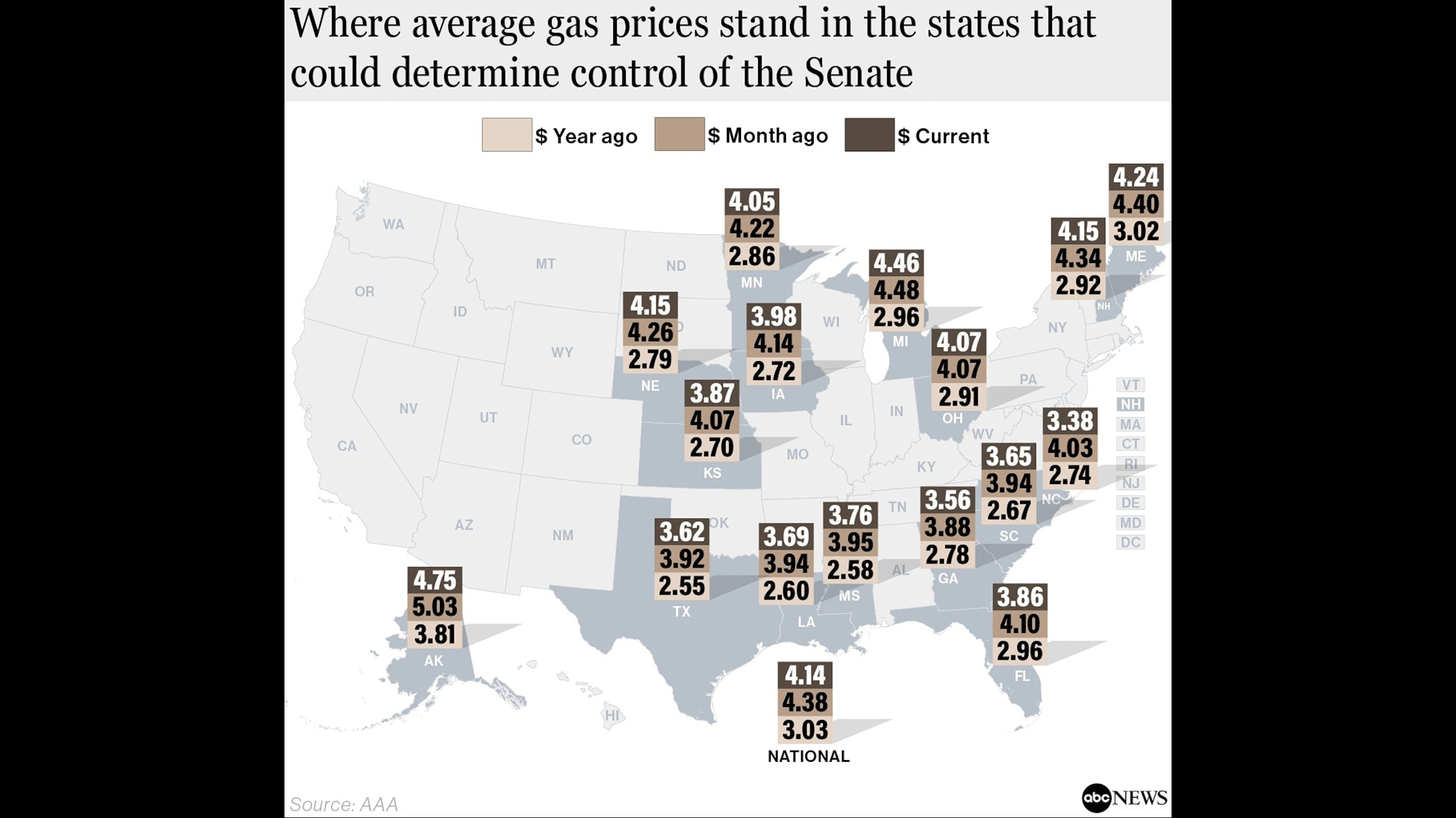
Prices vary across the country, however, meaning fuel costs differ in the key states expected to determine control of Congress.
Excluding Senate races classified as solidly red or blue, ABC News lists races of varying levels of competitiveness in 16 states: Alaska, Iowa, Kansas, Maine, Michigan, Ohio, Texas, Nebraska, South Carolina, Minnesota, New Hampshire, Georgia, North Carolina, Florida, Louisiana and Mississippi.
Among those states, 11 have gas prices below the national average, AAA data shows.
The state with the highest gas prices among the set of 16 is Alaska, which features an average price of $4.75 a gallon. By contrast, the state among that group with the lowest gas prices is North Carolina, where the average price of a gallon is $3.38, AAA data shows.
While their prices differ, each of the 16 states has experienced a notable increase in gasoline prices over the last year, due in large part to an oil supply shortage set off by the Iran war.
The smallest change in prices among those states over the past year took hold in North Carolina, where the average price of gas jumped 23%, AAA data showed.
In Michigan, the state with the largest change, the average price soared more than 50% compared to a year earlier. Ten of the 16 states saw a rise in gas prices of at least 40% over the past year, according to AAA.
While gas prices nationwide remain elevated, a decline in oil prices over the past week has helped ease costs at the pump, Patrick De Haan, petroleum analyst at GasBuddy, told ABC News on Monday.
The drop in oil prices continued on Monday as the West Texas Intermediate futures price, a benchmark index for U.S. trading, registered at about $96.30 a barrel. That figure marked a decline of nearly 8% on Monday. As of Tuesday morning, U.S. oil prices remained essentially unchanged.
In addition to the recent drop in oil prices, seasonal fluctuations have provided price relief for drivers in the fall, De Haan said. A slowdown in travel has eased demand for gas as families have returned from summer vacation and resumed routine driving associated with work and school commutes.
“That’s opened the door for one of the biggest declines since earlier this summer,” De Haan said.
The national average price has dropped 12 cents over the past week, AAA data shows.
Gas prices have fallen at least 10 cents over the past week in six of the 16 states that play host to a contested Senate race.
In Michigan, the average price of a gallon of gas has dropped 30 cents over the past week, AAA data shows. Gas prices have dropped 29 cents in Ohio over that period, while prices in Iowa have experienced a decline of 18 cents.
Even after the recent relief, gas prices have stayed well above their level a year ago, De Haan said.
“Gas prices and diesel are still very elevated,” De Haan added.
Copyright © 2026, ABC Audio. All rights reserved.