

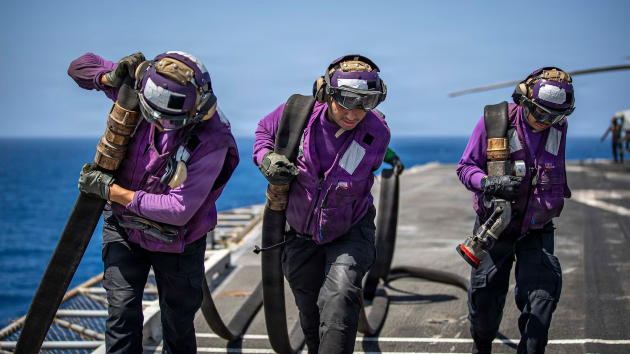
(WASHINGTON) — The Pentagon is increasingly strained by a growing list of unplanned and rising expenses over the last year, with fuel costs emerging as one of the most significant pressures.
Defense Department records show the average price the agency paid for fuel climbed from $154.14 per barrel in October to $195.72 in April – a nearly 27% increase in just six months, documents show. Those costs are averages across two dozen types of fuels the military uses, including gasoline and jet fuel.
Oil and fuel prices have surged during the Iran war. That surge could saddle the Pentagon with more than $1 billion in unplanned costs this year to power its jets, tanks and other military equipment, based on the department’s fuel consumption in recent years. The Defense Department purchases some 80 million barrels of fuel annually.
Commanders are also grappling with surging civilian fuel and commercial airfare costs, adding to the financial strain on a military that depends heavily on both. Troops typically use commercial flights and rental cars to travel to different training events, and are often compensated for miles driven in personal vehicles.
Because of that, travel is being heavily scrutinized, with some formations dramatically reducing travel for training and other events or outright canceling the bulk of it since at least April, multiple U.S. officials explained to ABC News and documents show.
“Current energy market dynamics are increasing fuel costs, which can affect the costs of transporting personnel, supplies and equipment,” Lt. Col. Orlando Howard, an Army spokesperson, said in a statement, adding that the service is prioritizing travel and equipment usage to preserve funding for critical operations and readiness requirements.
According to internal documents and multiple U.S. officials, the Army has been forced to make sweeping cuts to training as it grapples with a $4 billion-$6 billion shortfall through the remainder of the fiscal year, which ends Sept. 30.
That shortfall is attributed to a confluence of factors, including the Iran war, expanding missions on the U.S. southern border, and the National Guard’s ongoing mission in Washington, D.C., which is aimed to double in size to some 5,000 troops for the summer.
Compounding those issues are rising fuel costs, all spurring intense financial scrutiny. The reductions have eliminated dozens of training courses, including programs for medical personnel, engineers and artillery troops. The service has also sharply curtailed helicopter flight hours, limiting many crews to minimum flying requirements, internal service plans show.
But it is not only the Army that is feeling the strain of financial belt-tightening – some of the other services also face unexpected expenses that could impact training cycles.
Adm. Daryl Caudle, the Navy’s Chief of Naval Operations, warned lawmakers in May that the sea service might start running out of money soon.
“You see a large Navy force in the Middle East. So we’re burning bright … but it does come at cost, and it comes at operational costs,” Caudle told the House Armed Services Committee, adding that the service will start running out of money in the summer.
“I will have to start making decisions to change training, operations, certification events, those type of things we do to generate our force, in the July timeframe and their current expenditure,” he said.
One internal Army assessment in April found that the financial pain could leave units slated to deploy to Europe next year with what the assessment framed as an insufficient amount of training. The review, which examined the Army’s III Armored Corps – a roughly 70,000-soldier formation headquartered at Fort Hood, Texas – concluded it could take more than a year to restore affected units to their pre-Iran war training levels.
The military’s complex web of fuel purchasing provides some protection against market volatility. In many cases, the Pentagon purchases fuel through contracts 18 months in advance.
But those agreements include provisions that allow prices to be adjusted if the market shifts, limiting the department’s ability to fully insulate itself from sustained increases.
Fuel prices surged in 2022 following Russia’s invasion of Ukraine, destabilizing markets. The national average for a gallon of regular gasoline in the U.S. climbed past $5 for one week that summer, according to federal data. That year, Congress twice gave the Pentagon more money for fuel, totaling $5.2 billion.
Additionally, the Defense Department is using far more fuel this year than it projected when budgets were set more than a year ago, with the Air Force burning through 10% more than it projected it would, Gen. Kenneth Wilsbach, the chief of staff of the Air Force, told lawmakers in May, amid the ongoing war with Iran.
That could mean the use of hundreds of thousands of gallons of extra fuel. The Defense Department is by far the federal government’s largest fuel consumer, burning roughly 227 million gallons of diesel and about 2.2 billion gallons of jet fuel annually since 2021, according to Pentagon data.
Meanwhile, the Marine Corps is not facing any notable funding shortfall, nor has it had to scale back any training, according to the service, though it is significantly smaller than the other branches of the military.
“Annually, we adjust our budgeted spend plans to address various contingencies as they arise, ensuring we prioritize our most critical mission requirements,” a Marine Corps spokesperson said in a statement.
ABC News’ Luis Martinez contributed to this report.
Copyright © 2026, ABC Audio. All rights reserved.