
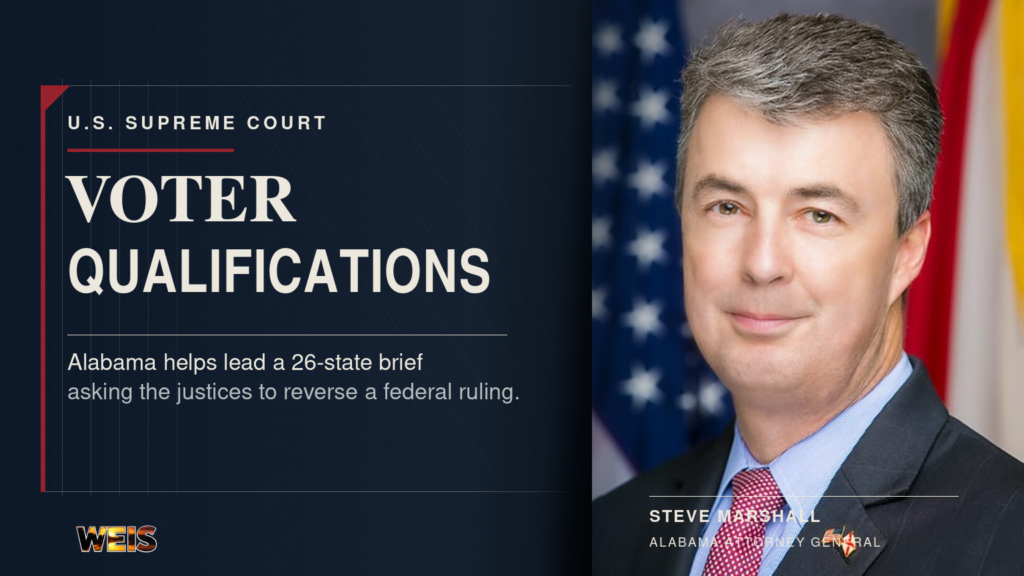
MONTGOMERY– Alabama Attorney General Steve Marshall has joined Kansas in leading a 26-state brief to the U.S. Supreme Court. The filing asks the justices to reverse a federal appeals court ruling involving Arizona’s voter-registration requirements and voter-roll maintenance laws.
The amicus brief filed in Republican National Committee v. Mi Familia Vota supports the Republican National Committee in Supreme Court case No. 25-1017. An amicus, or friend-of-the-court, brief lets nonparties present arguments about issues before the court.
According to the Attorney General’s Office, the filing asks the justices to affirm states’ constitutional authority to establish and enforce voter qualifications. The states also seek clarification of the National Voter Registration Act of 1993. Specifically, they want the court to address its application to state registration forms and voter-list maintenance.
The case concerns Arizona laws enacted in 2022, including House Bill 2492 and House Bill 2243. The states’ brief says the measures sought to enforce Arizona’s citizenship requirement for voting. They also sought to keep ineligible noncitizens off voter rolls.
The U.S. Court of Appeals for the Ninth Circuit ruled against portions of the Arizona laws. As described in the brief, the appeals court held that the NVRA preempted Arizona’s proof-of-citizenship requirement. That requirement applied to applicants using the state registration form.
In addition, the Ninth Circuit held that a 2018 consent decree barred enforcement of part of House Bill 2492. The appeals court also addressed the NVRA’s 90-day provision. It concluded that the provision limited Arizona’s ability to conduct a systematic program to remove identified noncitizens near a federal election.
The coalition asks the Supreme Court to reverse those holdings.
States Defend Authority Over Registration Forms
The first part of the brief argues that the NVRA permits states to design and use their own voter-registration forms. Therefore, the coalition maintains that a state form may request documentary proof of citizenship even though the federal registration form does not.
The filing focuses on language allowing a registration form to seek information that election officials consider “necessary.” In this context, the information would help officials assess an applicant’s eligibility.
The states argue that “necessary” does not mean absolutely indispensable. Instead, they say the term can cover information that is useful, appropriate, or suited to determining eligibility.
The brief further disputes the Ninth Circuit’s interpretation of another NVRA provision. That provision requires forms distributed through public-assistance agencies to be “equivalent” to the federal form.
According to the coalition, equivalent does not necessarily mean identical. Therefore, the filing argues that a state form may meet the federal criteria while seeking additional information.
Moreover, the states contend that any ambiguity should be resolved in a way that avoids constitutional concerns. Their filing cites the Supreme Court’s 2013 decision in Arizona v. Inter Tribal Council of Arizona, which discussed state authority to obtain information needed to enforce voter qualifications.
The coalition says the Ninth Circuit’s interpretation gives too little weight to the states’ historic role in voter registration and election administration. It also asks the justices to recognize a presumption against reading an ambiguous federal election law to displace state authority.
Brief Challenges Effect of Earlier Consent Decree
The second section addresses a 2018 consent decree entered in League of United Latin American Citizens of Arizona v. Reagan. The decree resulted from an agreement involving private litigants and Arizona executive-branch officials before lawmakers enacted House Bill 2492.
The Ninth Circuit held that the decree blocked Arizona officials from enforcing a later requirement. That requirement called for the rejection of state-form applications lacking documentary proof of citizenship.
However, the 26-state coalition argues that the decree cannot restrict the Arizona Legislature’s authority to pass enforceable laws.
According to the filing, the Legislature was not a party to the decree and did not consent to its terms. In addition, the states argue that a significant change in state law may provide grounds to modify a consent decree under federal court rules.
The brief says an earlier agreement with executive officials cannot block a later statute without raising federalism and separation-of-powers concerns. In the coalition’s view, a decree may resolve a dispute within a federal court’s jurisdiction. Yet it cannot permanently prevent a legislature from exercising its lawmaking authority.
The states add that Arizona’s Constitution reserves initiative power to voters. Consequently, they argue that the Ninth Circuit’s reasoning could also affect laws enacted directly by Arizona citizens.
Coalition Disputes 90-Day Restriction
The third section concerns an NVRA provision restricting certain systematic voter-removal programs. The restriction covers the 90 days before a federal election.
However, the coalition argues that it does not prevent states from removing noncitizens who were never eligible to register.
The brief offers two related readings of the law. First, it argues that the restriction applies to list-maintenance programs specifically addressed by the NVRA, particularly those involving changes of residence.
Second, it contends that the restriction protects people who were eligible when they registered but later became ineligible. Under that reading, it does not protect registrations that were invalid from the beginning.
Under either interpretation, the coalition says the 90-day provision does not cover the removal of noncitizens.
The states also offer a constitutional argument. If the law required states to retain identified noncitizens during that period, they say it would improperly burden state authority over voter qualifications.
The filing cites Alabama’s experience to illustrate that argument. According to the brief, Alabama’s primary, runoff, special, and general elections created several 90-day periods. Together, those periods covered more than 70% of 2026.
The coalition says an expansive reading of the restriction could prevent voter-roll action through much of an election year.
The brief also refers to 2024 litigation involving Alabama Secretary of State Wes Allen. That case concerned his effort to identify people who had previously provided noncitizen identification numbers.
The coalition argues that it shows how the 90-day rule can impede state efforts when information arrives late in an election cycle.
Marshall said states must be able to enforce citizenship requirements in federal, state, and local elections. He also said courts have repeatedly interpreted the NVRA in ways that interfere with that authority.
“The United States Constitution is clear that the States set and enforce voter qualifications for all elections, including federal elections,” Marshall said.
The Attorney General’s Office also pointed to two guilty pleas entered this summer in Alabama federal court. The office said a Canadian national and a Mexican national admitted voting in the 2024 general election.
Marshall said noncitizen voting dilutes the voices of qualified citizens and undermines public confidence in elections.
Alabama and Kansas are joined by Alaska, Arkansas, Florida, Georgia, Idaho, Indiana, Iowa, Kentucky, Louisiana, Mississippi, Missouri, Montana, Nebraska, New Hampshire, Ohio, Oklahoma, Pennsylvania, South Carolina, South Dakota, Tennessee, Texas, Utah, West Virginia, and Wyoming.
The brief asks the Supreme Court to reverse the Ninth Circuit’s decision.



You must be logged in to post a comment.