

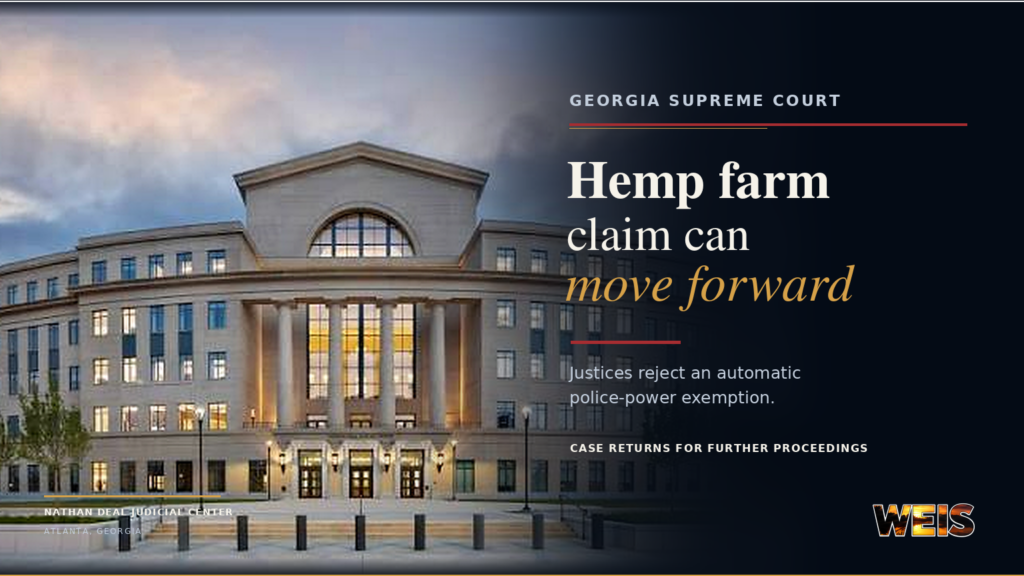
ATLANTA– A new Georgia Supreme Court ruling allows a property-damage claim involving a state law-enforcement operation to continue.
The Sept. 9 decision rejects an automatic shield for government activity performed under the state’s broad police power. However, it does not award compensation to the property owner or decide the underlying dispute.
Instead, the ruling sends the lawsuit back for further proceedings. The case could guide similar claims across Georgia, including those arising in Northwest Georgia.
What happened at the farm
The dispute began with a July 21, 2021, drug-suppression operation near a licensed hemp farm in Dahlonega.
According to court records, Blue 42 Organics holds state and federal registrations to grow hemp. In addition, the company recorded its farm’s GPS coordinates as part of that registration process.
Blue 42 alleges that the Governor’s Drug Suppression Task Force flew three helicopters and one single-engine airplane over the farm. The aircraft allegedly flew low enough to destroy two rows of hemp worth about $37,000.
Moreover, the company claims the operation disturbed cattle and threatened future grazing leases on the property. Those claims remain allegations because courts have not yet resolved the facts.
Blue 42 sued the Georgia Department of Public Safety through an inverse-condemnation claim. That type of lawsuit seeks payment when government action takes or damages property without formal eminent-domain proceedings.
However, DPS argued that sovereign immunity blocked the lawsuit. The agency said the alleged damage occurred while the state exercised its police power.
A trial court accepted that argument and dismissed the case. Then, the Georgia Court of Appeals upheld the dismissal in June 2025.
What the justices decided
The Georgia Supreme Court reversed the lower court in Blue 42 Organics v. Georgia Department of Public Safety. Chief Justice Nels S.D. Peterson wrote the opinion.
The court explained that “police power” covers much more than police work. For example, it includes government action involving health, safety, zoning, building standards, public morals, and nuisance control.
Because that power reaches so broadly, the justices rejected a rule that would exempt every such action from compensation claims. Otherwise, they concluded, the exception could largely erase Georgia’s constitutional property protections.
The Georgia Constitution generally requires compensation when government takes or damages private property for public purposes. In addition, Georgia’s protection expressly covers property damage, not only the physical seizure of land.
The court identified two established situations that may excuse compensation. One involves government action to eliminate an actual nuisance. The other covers property destruction during an urgent necessity or emergency.
For example, earlier cases addressed destroying property to stop a spreading fire. Courts have also considered emergency action involving war, public-health threats, and unsafe dams.
However, Blue 42’s complaint describes a routine law-enforcement exercise rather than an emergency. At this stage, the record also does not establish that the licensed hemp crop created a nuisance.
Therefore, the justices found that DPS had not shown an automatic legal bar to the claim. The court reversed the dismissal and allowed the lawsuit to move forward.
What the ruling does — and does not — mean
The decision does not make law-enforcement agencies automatically responsible whenever an operation damages private property. Instead, courts must consider the facts and the reason for the government’s action.
Likewise, the justices did not decide whether Blue 42 deserves compensation. They also left open whether an emergency exception or another defense could apply after the parties develop more evidence.
Still, the opinion removes a broad rule that previously ended some claims at the courthouse door. Government agencies cannot defeat every compensation claim merely by labeling their conduct an exercise of police power.
As a result, Georgia property owners may now receive closer judicial review of similar claims. The ruling may affect disputes involving state agencies, counties, or cities when their operations damage private property.
However, each claim will depend on its own evidence. Property owners must still prove the elements of inverse condemnation and connect the damage to a public purpose.
Meanwhile, government defendants may still argue that urgent necessity, nuisance abatement, or another valid exception defeats a claim.
What happens next
The Supreme Court reversed the Court of Appeals judgment, so the litigation can continue. The lower courts must now consider the case under the narrower rule announced by the justices.
Further proceedings could examine the aircraft operation, the alleged crop losses, and DPS’s possible defenses. Therefore, no court has yet ordered the state to pay the claimed $37,000.
Justice Benjamin Land was disqualified from the case. The remaining justices concurred with the ruling.
Ultimately, the case establishes a boundary rather than a final payout. Georgia’s police power remains broad, but it does not automatically override the state constitution’s promise of just compensation.



You must be logged in to post a comment.