

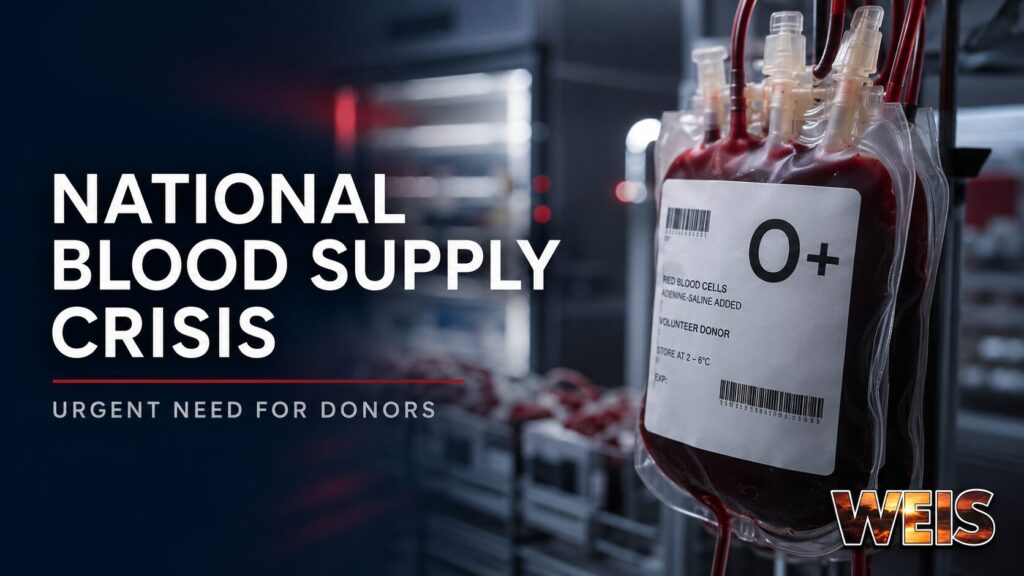
CENTRE– The blood needed after a serious crash, during emergency surgery, or when complications arise in childbirth must already be waiting at the hospital. It cannot be collected after the emergency begins.
That reality has become especially urgent as blood providers across the country report critically low supplies. Meanwhile, Blood Assurance says hospitals across its region are requesting more blood for patient care.
The need directly affects Cherokee County. Blood Assurance lists Cherokee Medical Center in Centre among the hospitals that depend on the organization and its volunteer donors.
Local residents have an opportunity to help today. The Centre Fire Department is hosting a Blood Assurance community blood drive from 10 a.m. until 2 p.m. at 421 East Main Street.
Second National Crisis Declared
The American Red Cross declared its second-ever national blood supply crisis Monday, July 27. The organization said donations had fallen to a four-year summer low and were no longer keeping pace with hospital demand.
The Red Cross, which supplies about 40% of the nation’s blood, reported having less than a one-day national supply of O-positive blood. As a result, it began limiting type O distributions to individual hospitals to preserve blood for patients facing the most critical emergencies.
The declaration followed an emergency shortage announced earlier in July. According to the Red Cross, its overall blood supply fell nearly 25% during June. At the same time, distributions to hospitals climbed nearly 3,500 units above expected levels each week.
January 2022 marked the only other time the Red Cross declared a national blood supply crisis.
However, the shortage does not affect only one blood collection organization. The Association for the Advancement of Blood and Biotherapies, known as AABB, reported July 22 that most blood centers across the country had critically low inventories of Rh-negative and O-positive red blood cells.
AABB reported moderate availability of A-positive and B-positive red blood cells. It also found that the national platelet supply was meeting demand at that time.
Those distinctions are important. The Red Cross and Blood Assurance operate separate collection and distribution systems. Therefore, the Red Cross inventory figures do not represent Blood Assurance’s exact supply. However, the AABB report confirms that the shortage has spread throughout much of the nation’s blood-collection network.
Why Summer Creates a Critical Gap
Blood donations typically decline during summer, even as the need for blood can increase.
Schools and colleges host many blood drives throughout the year. When classes dismiss for summer, many of those regular collection opportunities disappear. Vacations, changing schedules, and seasonal illnesses also keep some established donors away.
This summer brought additional complications. The Red Cross cited extreme heat, poor air quality, and widespread illness as factors that reduced donor turnout.
At the same time, the period between Memorial Day and Labor Day is often called the summer trauma season. More people travel and participate in outdoor activities, increasing the potential for serious crashes and other injuries that may require emergency transfusions.
Blood Assurance is also reporting increased demand from hospitals across its service area. The organization provides blood to hospitals in Alabama, Georgia, Tennessee, Kentucky, and North Carolina. Its Alabama hospital partners include Cherokee Medical Center in Centre, DeKalb Regional Medical Center in Fort Payne, and Highlands Medical Center in Scottsboro.
Hospitals use donated blood for far more than major accidents. Patients undergoing cancer treatment, surgery, organ transplants, and treatment for sickle cell disease may need transfusions. Blood can also be critical for premature babies and mothers experiencing complications during childbirth.
The Food and Drug Administration reports that someone in the United States needs a blood transfusion every two seconds.
Blood Cannot Be Stockpiled Indefinitely
Unlike many emergency supplies, blood components have limited storage lives and require constant replenishment.
Platelets, which help blood clot, can generally remain in storage for only five to seven days. Hospitals frequently use them to treat cancer patients, surgical patients, and people with serious bleeding.
Red blood cells last longer, but they also expire. Consequently, blood providers cannot collect a large supply once and hold it indefinitely for future emergencies.
The challenge is maintaining a steady stream of donors every day. A hospital may have an adequate supply one week and face pressure the next if collections fall while trauma cases, surgeries, or other patient needs rise.
A Red Cross survey found that fewer than one in five respondents understood that blood cannot simply be stockpiled. That limited shelf life means a national shortage cannot be corrected through a single large collection effort. Providers need both immediate donations and donors who continue giving throughout the year.
Why Type O Blood Is So Important
All blood types remain important because hospitals try to provide patients with compatible, type-specific blood whenever possible. However, type O blood plays a particularly important role during emergencies.
O-negative red blood cells can be given to patients of any blood type. Therefore, doctors often rely on them when a trauma patient needs blood before hospital personnel can determine that person’s type.
O-positive is the most commonly transfused blood type and can be given to about 80% of patients. The Red Cross says type O blood accounts for approximately 60% of the blood products it distributes.
Because hospitals depend so heavily on type O blood, a shortage can quickly affect emergency rooms, trauma centers, operating rooms, and maternity units.
A Local Donation Can Reach a Local Patient
Blood Assurance says a single whole-blood donation may help as many as three patients because it can be separated into red blood cells, platelets, and plasma.
Donating usually requires about one hour from registration through the post-donation refreshment period. According to the FDA, the actual blood collection generally takes between 15 and 20 minutes.
After collection, blood establishments test donations for several transfusion-transmitted infections. Donated blood remains quarantined until testing confirms it is suitable for use.
Once processed and cleared, the blood becomes part of the supply that hospitals rely on before an emergency occurs.
For Cherokee County donors, that connection is especially close. Blood Assurance identifies Cherokee Medical Center as one of the hospitals supported by its volunteer donor network. A donation made through the Centre blood drive can help strengthen the system serving patients locally and throughout the surrounding region.
Centre Blood Drive Taking Place Today
The Centre Fire Department and Blood Assurance will hold today’s drive from 10 a.m. until 2 p.m. The Bloodmobile will be at the fire department, located at 421 East Main Street in Centre.
Eligible donors who give blood during July will receive a $25 Blood Assurance eGift card. The card will be sent by email within 10 days. Therapeutic donors are not eligible for the promotional gift.
Before donating, participants should eat a good meal, drink plenty of water, avoid energy drinks, and bring a valid photo ID.
Appointments may be scheduled through Blood Assurance’s Centre Fire Department blood drive page.
The national numbers describe a crisis affecting hospitals across the country. However, the response can begin locally—with one donor, one appointment, and one unit of blood already waiting when a patient needs it.
Research sources: American Red Cross crisis declaration, AABB blood availability report, Blood Assurance hospital network, and FDA blood-donation information.



You must be logged in to post a comment.