

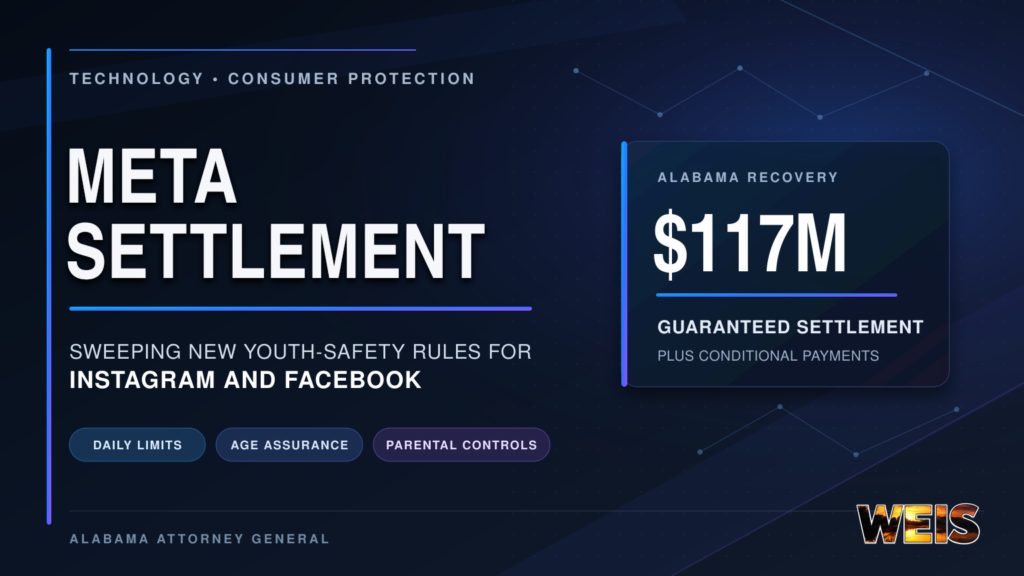
MONTGOMERY– Alabama will receive more than $117 million through a major youth-safety settlement with Meta Platforms Inc.
The agreement also requires Meta to add broad new protections for young people on Instagram and Facebook.
Alabama Attorney General Steve Marshall announced the settlement Wednesday. He said it would change how major social media companies design products for children and teenagers.
The agreement resolves consumer-protection claims from 47 states and the District of Columbia. Puerto Rico, American Samoa, and the Northern Mariana Islands also joined the settlement.
The states accused Meta of designing Instagram with addictive features. They also claimed the company exposed young users to serious mental-health risks. In addition, the states accused Meta of misleading the public about platform safety.
However, a court never ruled on those allegations. Meta did not admit liability, wrongdoing, or any violation of law.
“This settlement sends a clear message that Alabama will hold big tech accountable when it fails to protect our children online,” Marshall said. “Meta will pay millions of dollars to Alabama and has taken a critical step toward comprehensive reforms for youth safety.”
Marshall said his office would closely monitor Meta. He also promised to watch for loopholes that predators or other bad actors could exploit.
Settlement Requires Daily Limits and Overnight Restrictions
The settlement’s time-management rules mainly cover users ages 13 through 17. Meta will identify them through their stated or predicted ages.
During the first phase, Instagram and Facebook must set a combined two-hour daily limit for teenagers. The limit will apply across linked Meta accounts and reset at midnight.
However, the agreement makes the two-hour limit a default setting. A linked supervising parent may approve a longer limit. Teenagers and parents may also choose a stricter limit.
The limit generally excludes time spent on direct messages, account settings, and qualifying long-form videos. Once a teenager reaches the limit, Meta must block other covered features until the next day.
Meta must also restrict overnight access from midnight until 6 a.m. Teenagers may still use limited messaging and account settings during those hours. However, Meta must prevent them from using those features to reach the broader platform.
Meanwhile, Meta must turn off most push notifications from 10 p.m. until 7 a.m. The company may still send urgent account-security and platform-integrity alerts.
The settlement also creates a school-hours setting. Meta must turn off most push notifications from 8 a.m. until 3 p.m. on weekdays.
Messaging, security, and platform-integrity alerts remain exempt. Supervising parents may also adjust the school-hours setting.
The agreement defines the school year as Aug. 15 through June 15.
“Productive Pauses” Will Interrupt Scrolling
Meta must add what the agreement calls “Productive Pauses” within four months of the effective date.
Teenagers will see a clear notice after 15 minutes of continuous use. Meta must show stronger pauses after 60 and 90 minutes of daily use.
The notices aim to interrupt excessive or unplanned scrolling. Meta must study how teenagers respond and share the results with an independent auditor.
The first-phase time limits will last five years. However, the full settlement will remain in effect for 10 years.
A second phase could begin if Snapchat, TikTok, and YouTube adopt similar restrictions. The agreement also sets other financial and industry-wide conditions for that change.
If those conditions occur, Meta would set a 60-minute limit on each covered platform. Teenagers could still receive up to two combined hours across Meta platforms.
Settlement Addresses Likes, Filters, Feeds, and Harmful Content
The agreement reaches far beyond screen-time limits.
Meta must hide visible numbers of likes and reactions from teenagers by default. A supervising parent must approve any change that displays those figures.
Meta must also prevent teenagers from using certain “Cosmetic Procedure Filters.” The agreement applies that term to effects that reshape or idealize a person’s face.
The restriction does not cover ordinary skin smoothing or conventional makeup filters. It also excludes fantasy characters, animal effects, parody, and exaggerated distortions.
Furthermore, Meta must offer teenagers a non-personalized, chronological feed. The company must first offer that option within four months.
Meta must then prompt newly identified teen users within 10 days. The company must repeat the reminder every 90 days unless the user turns it off.
The settlement also covers several categories of harmful content. They include bullying, sexual material, suicide, self-harm, eating disorders, graphic violence, gambling, and illegal drugs.
Other covered material includes dangerous viral challenges and risky stunts.
Meta must maintain systems that quickly review potentially harmful content reports in English or Spanish. Those systems should provide a decision within six hours in at least 90% of cases.
Teenagers must also receive an appeal option when Meta finds no violation.
Meta Must Strengthen Protections Against Suspicious Adults
Meta must continue limiting contact between teenagers and potentially suspicious accounts.
When a suspicious account starts a message thread with a teenager, Meta must warn the young user.
Meta must also alert supervising parents in certain high-risk cases. Those alerts include possible financial blackmail involving intimate images.
Parents may also receive alerts about accounts linked to inappropriate sexual interactions with children.
In addition, parents will receive more information about a teenager’s activity. That information includes time spent on each platform, messages, long-form videos, contacts, and reported accounts.
Meta must notify parents when their teenager communicates directly with an adult user for the first time. The company must send those notices daily when applicable.
The platforms must also flag repeated searches related to suicide, self-harm, or eating disorders. Meta will send those alerts to supervising parents.
Agreement Requires New Age-Assurance System
Meta must create an age-assurance system within one year of the settlement’s effective date.
The company may use licensed technology, its own age-prediction systems, or both. Meta must also use reliable age signals from Apple and Google systems or app stores.
New users will receive the settlement’s youth protections until Meta assesses their ages.
Independent experts must test the age-assurance methods each year. The agreement also sets accuracy targets for identifying teenagers.
Commercial systems may misclassify no more than 10% of users ages 16 and 17 as adults. The limit drops to 3% for users ages 13 through 15.
Meta must also improve its efforts to find children younger than 13. Those steps include reviewing accounts that may belong to the same underage user.
The company must simplify the process for reporting suspected underage accounts. It must also examine the friend networks of accounts removed for age violations.
Within one year, Meta must begin developing and testing a model for users younger than 13. Later, the company must use that model to review accounts and report its results.
Independent Auditor Will Monitor Meta
A bipartisan committee of attorneys general will help select an independent auditor. Meta and the committee must agree on that selection within 60 days.
The auditor may review relevant records, systems, data, internal documents, and communications. The auditor may also speak with Meta personnel. Meta will pay the reasonable costs.
Annual reports will examine whether Meta followed the settlement. They will also identify any major gaps or weaknesses.
If the auditor finds a serious problem, Meta must submit a corrective plan within 30 days. The company generally must start that plan within 90 days.
The auditor must publish summaries of each final report. Those summaries will describe Meta’s progress and the auditor’s recommendations.
The reports will also state whether Meta accepted the recommendations. In addition, attorneys general may use the auditor’s findings in enforcement cases.
Alabama’s $117 Million Payment Will Arrive in Installments
The settlement gives Alabama 10 guaranteed installments of $11,734,540.91. Together, those payments total about $117,345,409.
Meta must make the first payment within 30 days after the agreement takes effect. Later payments will arrive each Jan. 15, beginning in 2027.
However, the settlement still needs a federal consent judgment. The agreement takes effect after the court enters that judgment.
The case remains before the U.S. District Court for the Northern District of California.
The agreement also lists 10 possible payments of $5,057,609.31 for Alabama. Those payments remain conditional and are not guaranteed.
Alabama would receive them only if the industry meets several conditions. Those conditions involve similar platform restrictions and financial obligations for other companies.
If all conditions occur, Alabama’s installment recovery could reach about $167.9 million.
Separately, the agreement assigns Alabama about $10.76 million from a Cambridge Analytica settlement fund. That nationwide fund totals about $459.3 million.
The agreement lists roughly $16.68 billion in maximum state installment payments nationwide. It also creates a $75 million fund for state investigation and litigation costs.
Together with the Cambridge Analytica allocation, the settlement’s potential nationwide value reaches about $17.2 billion.
Marshall’s office called it the largest state consumer-protection settlement outside the tobacco settlements of the 1990s.
Alabama Has Not Announced How It Will Divide the Money
The agreement allows states to spend their payments on several lawful purposes. Those options include youth mental-health services, crisis lines, and digital-wellness education.
States may also support after-school programs, outdoor activities, digital-literacy counselors, and phone-free school efforts. In addition, they may award grants to schools or local governments.
However, the agreement does not explain how Alabama will divide its share. It says a separate consent judgment will provide Alabama’s payment instructions.
Marshall said his staff handled the case without outside attorneys. Therefore, the full state recovery will go to Alabama.
The Meta agreement continues Marshall’s broader effort to address online risks for children. His office previously reached a youth-safety settlement with Roblox.
Meanwhile, Alabama continues to pursue a case against TikTok. The state claims TikTok designed its platform to addict children and misled parents about safety.
A court has set that case for trial in September.


You must be logged in to post a comment.