

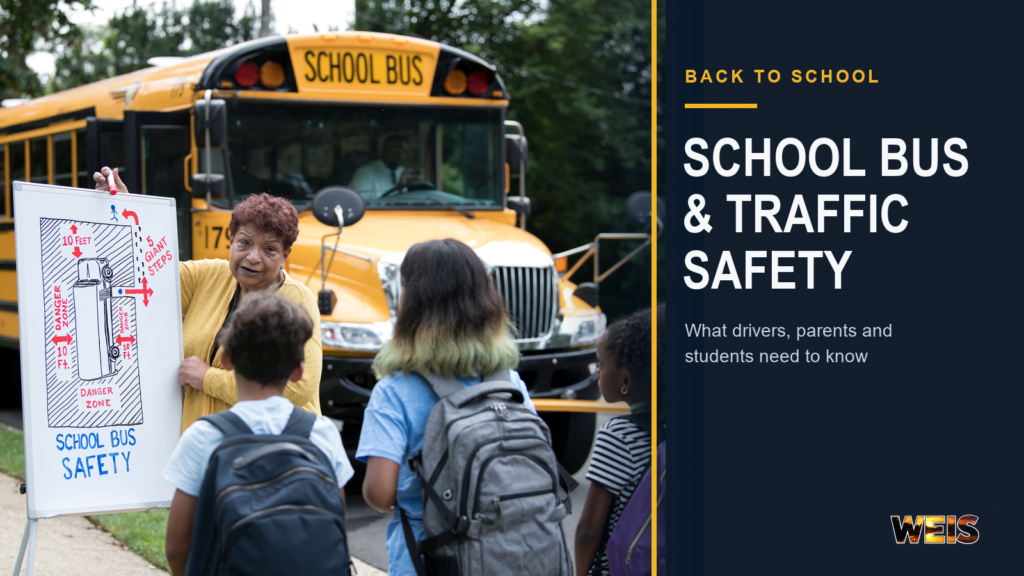
With school buses rolling before sunrise and school-zone lights flashing again, the school day now begins long before the first bell. It starts at neighborhood bus stops, along rural highways and inside crowded campus drop-off lines.
That makes every driver part of the school safety system. One hurried pass, one glance at a phone or one wrong assumption about a stopped bus can place a child in danger.
The Bus Is Safe, but the Loading Zone Demands Attention
The National Highway Traffic Safety Administration calls school buses one of the safest vehicles on the road. However, children face greater risk while approaching or leaving a bus than while riding inside it.
Federal data show why the area around a bus deserves full attention. From 2015 through 2024, 204 school-age children died in school-bus-related traffic crashes. That total includes 39 school bus occupants and 78 occupants of other vehicles. It also includes 77 pedestrians, seven bicyclists and three other nonoccupants.
In addition, occupants of other vehicles accounted for 70% of all deaths in school-bus-related crashes during that decade. Those figures cover any traffic crash involving a school bus. They do not mean the bus caused each crash.
Illegal passing creates another clear danger. From 2000 through 2024, 63 people died in crashes involving an illegal pass of a stopped school bus. Twenty-seven were pedestrians age 18 or younger, according to NHTSA’s current school bus safety data.
Yellow Means Prepare; Red Means Stop
A school bus uses its lights to tell drivers what will happen next.
Flashing yellow lights mean the bus is preparing to stop. Drivers should slow down and prepare to stop as well. Yellow does not mean speed up and try to get past the bus.
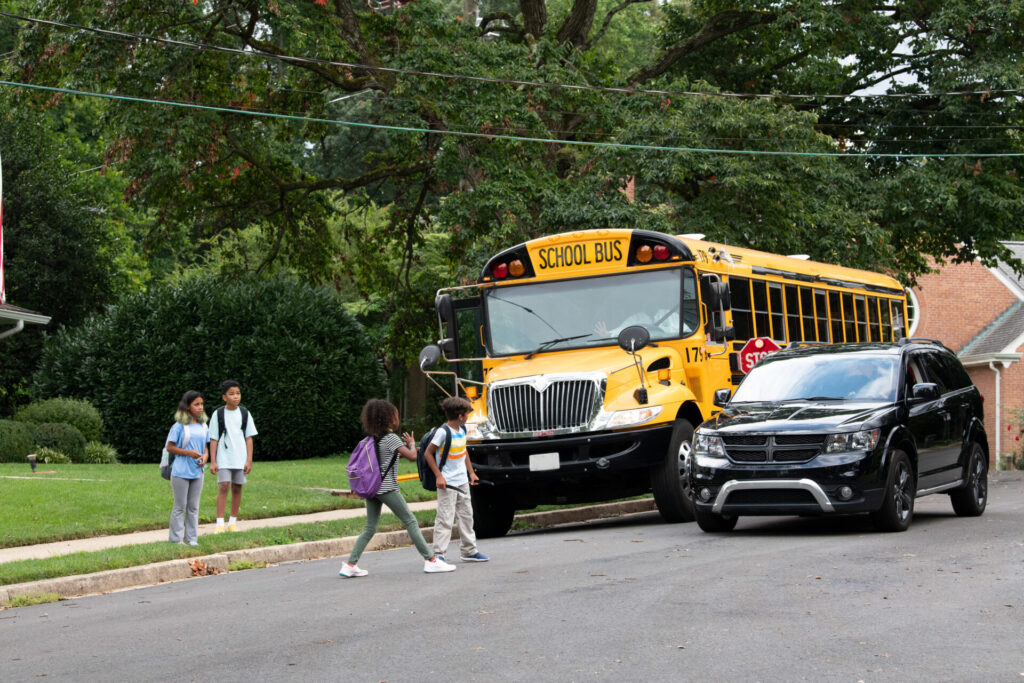
Flashing red lights and an extended stop arm mean the bus has stopped to load or unload children. Drivers who must stop should remain stopped until the red lights turn off, the arm retracts and the bus begins moving. They should also make sure children have cleared the roadway.
Drivers should expect children to act unpredictably. A child may drop a backpack, turn back toward home or cross from an unexpected direction. Leave enough space to see the loading area and react safely.
When Alabama Drivers Must Stop
The current Alabama Driver Manual tells motorists to stop at least 20 feet from a school bus when its red lights flash and stop arm extends.
Drivers approaching from either direction must stop on an undivided road. The rule applies to two-lane roads and undivided roads with four or more lanes.
The exception involves a divided highway. On a divided highway with four or more lanes, a driver traveling on the opposite roadway does not have to stop for a bus across the median. Traffic traveling behind the bus must still stop.
Passing a stopped school bus carries five points under Alabama’s driver license point system.
When Georgia Drivers Must Stop
The Georgia Department of Driver Services gives drivers a roadway-by-roadway guide.
Traffic in both directions must stop on:
- A two-lane road;
- A two-lane road with a center turn lane;
- A four-lane road without a median; and
- A road with four or more lanes and a center turn lane.
On a divided road with a physical median, only traffic traveling behind the bus must stop. Drivers on the other side of the median may continue with caution.
A center turn lane does not create Georgia’s divided-highway exception. Drivers should never assume that painted lines alone permit them to pass a stopped bus.
Georgia requires motorists to remain stopped until the bus resumes travel or turns off its signals. Children must also be safely out of the roadway. A conviction can bring a mandatory court appearance, up to a $1,000 fine and six license points. A driver younger than 21 can also face a license suspension.
Five Giant Steps Can Keep a Child Out of the Danger Zone
Families can make bus stops safer by building a simple routine. NHTSA recommends that children arrive about five minutes before the bus. Running late can lead to running into the road.
Children should wait at least 10 feet from the curb. NHTSA describes that distance as five giant steps. Horseplay, pushing and phone use should wait until children are safely away from traffic.
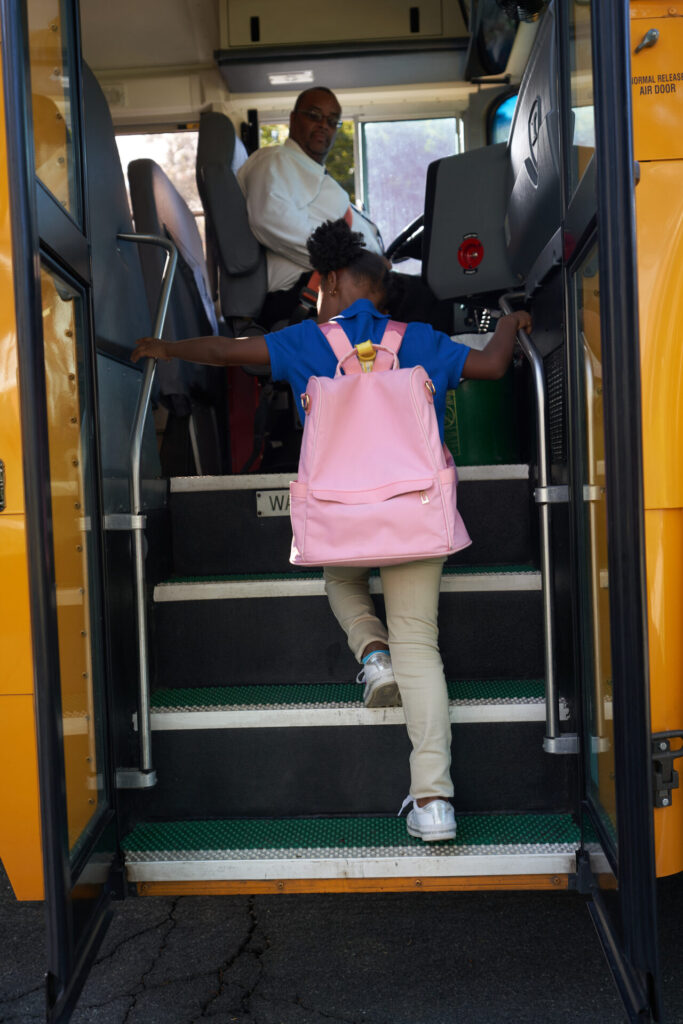
Children should wait for the bus to stop and the driver to signal before approaching. They should use the handrail, take one step at a time and face forward after finding a seat.
After leaving the bus, children should never walk behind it. Those who must cross should move at least 10 feet in front of the bus. They should make eye contact with the driver and wait for a signal before crossing.
If a child drops something near the bus, the child should tell the driver. A child should never bend down near the wheels or return for an item without the driver’s knowledge.
School Zones and Parent Drop-Off Lines
The Alabama Law Enforcement Agency’s back-to-school guidance asks drivers to slow down in school zones and neighborhoods. It also urges them to obey crossing guards and put phones away.
Families should leave several minutes early, especially during the first weeks of school. A little extra time reduces the urge to speed, make an unsafe turn or stop in an unauthorized area.
At school, drivers should follow the designated arrival route. Children should exit on the curb side whenever possible. They should not unload across the street unless school officials direct that movement.
Drivers should not block crosswalks or stop in travel lanes. They should also watch for buses, staff members and children moving between parked vehicles.
Phone use deserves special attention. NHTSA reports that reading or sending a text takes a driver’s eyes off the road for about five seconds. At 55 mph, that is like traveling the length of a football field without looking.
Walking and Biking to School
Parents should walk the route with younger children before they travel alone. NHTSA’s back-to-school safety guidance recommends adult supervision for children age 10 and younger.
Students should use sidewalks and marked crosswalks when available. If no sidewalk exists, pedestrians should walk along the edge of the road while facing traffic. Before crossing, they should look left, right and left again.
Children should put phones and headphones away before crossing. Bright or reflective clothing can help drivers see students during early morning hours.
Young bicyclists need a properly fitted helmet. They should ride in the same direction as traffic and obey signs and signals. The safest route may be longer, but it should avoid high-speed roads and difficult crossings when possible.
Teen Drivers Face New Routines, Too
The start of school changes traffic patterns for inexperienced drivers. New routes, earlier departure times and friends in the vehicle can add pressure.
Parents can help by making a practice drive before the first busy morning. They should review parking rules, school-zone speeds and the safest place to enter campus.
Teens should buckle every passenger, put the phone away and limit distracting conversations. They also need enough travel time to avoid speeding. Most importantly, adults should model the same habits they expect from young drivers.
One Extra Minute Can Protect a Child
Across Northeast Alabama and Northwest Georgia, one school route may include a rural curve, a multilane highway, a neighborhood street and a crowded campus loop. Each setting requires patience and full attention.
No bell schedule is worth an unsafe pass. No message is worth looking away from the road. A driver’s extra minute can give a child the time and space needed to reach school or return home safely.
School bus safety is not only the bus driver’s responsibility. It belongs to every motorist, parent and student who shares the road.
Photos courtesy of NHTSA



You must be logged in to post a comment.