

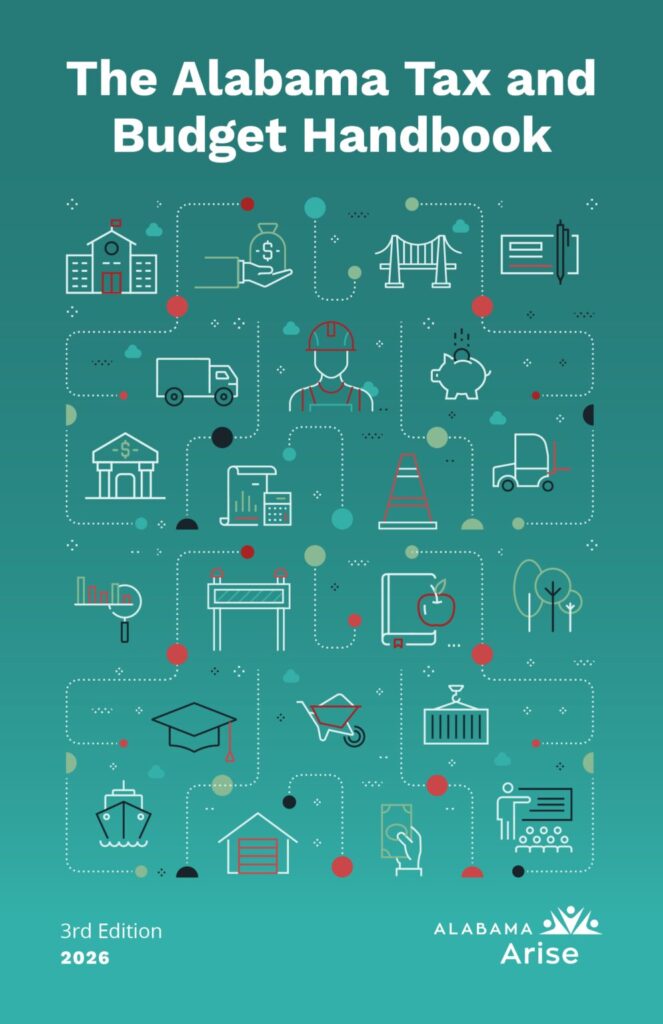
Alabama should reform its outdated, imbalanced tax system to help working people get ahead and to ensure adequate funding for vital services like education and health care, a new Alabama Arise handbook released Thursday concludes. Legislators also should implement several changes to make the state’s budgeting process more responsive and transparent, the handbook finds.
In The Alabama Tax and Budget Handbook, Arise uses graphs and illustrations to explain what state tax dollars pay for and where the state gets its money. The handbook highlights how key public services are funded and walks readers through how Alabama’s budgets become law annually.
Those explanations are especially timely as lawmakers work to finalize state budgets for fiscal year 2027. The handbook’s policy recommendations also could help Alabama address future revenue declines, secure funding for unmet needs like Medicaid expansion and public transportation, and cover new state obligations for food assistance under the Supplemental Nutrition Assistance Program (SNAP).
The 84-page handbook examines the state’s four major kinds of taxes – income, sales, property and business – to show how they measure up in terms of adequacy and equity for Alabamians and how they compare to taxes in other states.
“Our handbook is designed to help Alabamians better understand how state budgets and taxes affect their everyday lives,” said Carol Gundlach, Alabama Arise’s senior policy analyst and a handbook co-author. “We want to equip residents to advocate knowledgeably and effectively for policy changes that would improve life for their families and communities.”
The less you make, the more you pay: Alabama’s upside-down tax system
Alabama’s tax system is upside down and holds the state back from reaching its full potential, the handbook finds. On average, the lowest-paid fifth of Alabamians – those making less than $19,500 a year – pay nearly 12% of their incomes in state and local taxes. Meanwhile the wealthiest 1% – those making more than $484,300 annually – pay just 5.4%.
The biggest driver of this imbalance is Alabama’s overreliance on sales taxes, including on groceries and other necessities. Sales taxes hit families with low incomes the hardest because they must spend most of what they make on food, clothing and other items subject to sales tax just to get by. Lawmakers reduced Alabama’s state sales tax on groceries from 4% to 3% in 2023, and then to 2% in 2025. Even after those improvements, however, Alabama remains one of only nine states still taxing groceries.
Other aspects of the state’s tax system do little to offset the regressive effects of sales taxes, the handbook finds. The state’s income tax is relatively flat and taxes many families deeper into poverty. Alabama’s combined state and local property taxes are the nation’s lowest and provide large breaks to wealthy landowners. And skewed tax breaks like the state deduction for federal income taxes overwhelmingly benefit the wealthiest households at the expense of revenue for education and other services that benefit all Alabamians.
“Alabama’s upside-down tax structure makes it harder for families to make ends meet,” Gundlach said. “Our tax system forces people with low and middle incomes to subsidize enormous tax giveaways for wealthy households. And as the cost of living continues to rise, high sales taxes make food, clothing and other necessities even more expensive for struggling Alabamians.”
Opportunities to improve Alabama’s tax system
The handbook recommends numerous improvements to make Alabama’s taxes more equitable and allow stronger investments in public services. Here are a few key recommendations:
- Modernize the sales tax on goods and services, including eliminating the grocery tax.
- Make the income tax more progressive by increasing the standard deduction and establishing a state Earned Income Tax Credit.
- Eliminate the federal income tax deduction for businesses and individuals.
- Increase overall property tax rates while increasing the homestead exemption to protect homeowners with low incomes.
- Adopt combined reporting, a practice that reduces tax avoidance by treating businesses and their subsidiaries as one taxpayer.
- Limit tax incentives for luring companies to Alabama.
“Alabama’s tax system starves our state of the money we need to strengthen investments in education, health care, public transportation and other vital services that improve the quality of life for all of us,” Gundlach said. “Our lawmakers can and should take action to make our tax system more fair, more adequate and more sustainable.”
Opportunities to make state budgets more transparent and responsive
The budget process is more complicated in Alabama than in many other states. Most states have a single primary budget for public services, but Alabama has two. The Education Trust Fund supports services related to K-12 and higher education, and the General Fund supports all other services, including Medicaid and corrections.
Alabama sets aside more than 90% of its revenues for a specific purpose, a process known as earmarking. Earmarks can help ensure stable funding for services, but they also can make it harder to understand state funding. In addition, earmarking can limit lawmakers’ ability to create a budget that adequately meets current needs, the handbook concludes.
The handbook recommends new budgeting practices that would make Alabama’s budgets more transparent and adaptable. Here are a few key recommendations:
- Forecast revenues for multiple years into the future.
- Prepare fiscal notes with multiyear projections of bills’ revenue effects.
- Get a stronger current-year baseline for the cost of public services.
- Seek independent consensus revenue forecasts in addition to those from the Executive Budget Office and Legislative Services Agency.
- Enhance fiscal flexibility through gradual earmarking reform.
“Alabamians deserve a government that gives everyone a voice and an economy that offers everyone a chance to get ahead,” Gundlach said. “By improving our state’s budget process and righting the wrongs of our upside-down tax system, we can build an Alabama that truly works for everyone.”
About the handbook
Alabama Arise published the first edition of The Alabama Tax and Budget Handbook in 2005 to help educate the public about how state taxes and budgets work and how they affect people’s everyday lives. Arise published a second edition in 2015 and now the new third edition in 2026.
Arise’s new handbook includes recent changes to state law and an expanded discussion of the budgeting process. The 2026 edition also explores how racism shaped the historical origins of many of Alabama’s tax and budget practices and examines the ongoing disparate racial impacts of those policies. The publication closes with a glossary defining terms commonly encountered in tax and budget debates.
The Alabama Tax and Budget Handbook is available to read online here. A downloadable PDF of the handbook is available here.



You must be logged in to post a comment.