

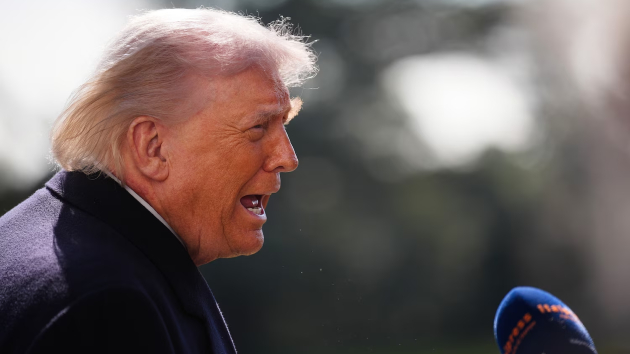
(WASHINGTON) — President Donald Trump on Friday told reporters he hasn’t made a final decision about what comes next in his pressure campaign on Iran but he made clear he was “not happy” with the current negotiations over his demand that Tehran end its nuclear program.
Trump spoke as left the White House for a trip to Texas amid the massive U.S. military buildup he’s ordered in the region.
“I’m not happy with the fact that they’re not willing to give us what we have to have,” Trump said. “So, I’m not thrilled with that. We’ll see what happens with talking later. We’ll — we’ll have some additional talks today. But no, I’m not happy with the way they’re going.”
“Well, we haven’t made a final decision,” he added. “They cannot have nuclear weapons, and we’re not thrilled with the way they’re negotiating. So, we’ll see how it all works.”
Asked if there’s a risk that U.S. strikes could lead to prolonged conflict in the Middle East, Trump said “there’s always a risk. You know, when there’s war, there’s a risk in anything both good and bad.”
Trump, who has yet to explain why he might soon order a strike on Iran and what his overall objective is, also spoke of regime change in Tehran, but only in vague terms.
Asked if his team had told him U.S. strikes now will lead to regime change right away, Trump said no.
“No, nobody’s told me that. You don’t know. I mean, nobody knows. There might be and there might not be,” he said.
Trump repeated that he preferred diplomacy over military action.
“We have the greatest military anywhere in the world. There’s nothing close. I’d love not to use it, but sometimes you have to,” he said.
His remarks came after it was announced earlier Friday that Secretary of State Marco Rubio would travel to Israel on Monday and Tuesday, with rising tensions with Iran said to be high on his agenda.
That trip announcement came just hours after the U.S. embassy in Israel ordered the departure of nonessential employees and family members.
Meanwhile, in an interview aboard Air Force Two on Thursday, Vice President JD Vance told The Washington Post that there was “no chance” of a drawn-out war in Iran as a result of potential strikes that are being weighed by the White House.
“The idea that we’re going to be in a Middle Eastern war for years with no end in sight — there is no chance that will happen,” Vance told the Post.
Vance’s comments come as the U.S. and Iran held indirect talks on Thursday in Geneva, Switzerland, which concluded without a resolution so far.
Vance added that while he doesn’t know what President Donald Trump will do in Iran, he described the range of options as strikes that would “ensure Iran isn’t going to get a nuclear weapon” or actions that could lead to a diplomatic solution.
The vice president told the Post that he remained a “skeptic of foreign military interventions” and said he believed the president was as well. He added that “we all prefer the diplomatic option,” while conceding, “but it really depends on what the Iranians do and what they say.”
Vance dismissed questions from the Post about his past criticisms of the U.S. involvement in Iraq and if he could have foreseen being part of an administration now flirting with the prospect of regime change.
“Well, I mean, look. Life has all kinds of crazy twists and turns,” Vance said. “But I think Donald Trump is an ‘America First’ president, and he pursues policies that work for the American people.”
“I do think we have to avoid repeating the mistakes of the past. I also think that we have to avoid overlearning the lessons of the past. Just because one president screwed up a military conflict doesn’t mean we can never engage in military conflict again. We’ve got to be careful about it, but I think the president is being careful,” he said.
Vance’s comments came ahead of his meeting with Omani Foreign Minister Badr Al Busaidi and other U.S. officials Friday in Washington to discuss Iran, a source familiar with the meeting confirmed to ABC News.
The scheduled meeting follows Thursday’s gathering in Geneva between special envoy Steve Witkoff and Jared Kushner, Trump’s son-in-law, with Al Busaidi for indirect talks between Iran and the United States.
Copyright © 2026, ABC Audio. All rights reserved.