

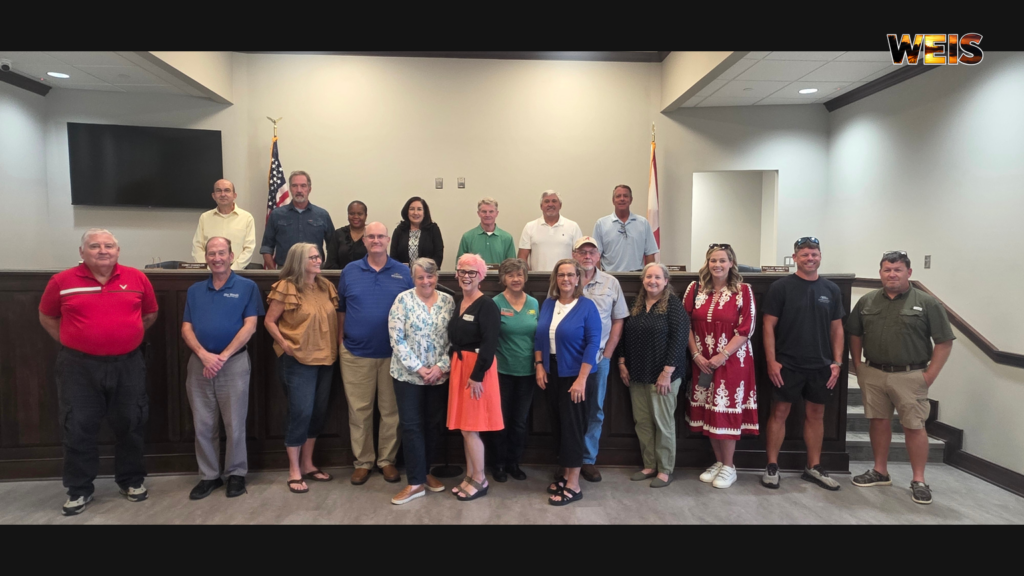
CENTRE– Centre’s membership in Main Street Alabama’s network brought city representatives together Thursday to help develop a report on downtown’s strengths, needs and opportunities.
The report forms part of the services included in Centre’s network membership. The Oct. 8 meeting began at 10 a.m. at Centre City Hall. Mayor Jay Howell welcomed the group and introduced Shelley Paasch, Main Street Alabama’s program development specialist.
However, local representatives emphasized that a possible move to designated status remains exploratory. They want to learn more before deciding whether to pursue that next level of participation.
Paasch said she would use information from the discussion to prepare a five- to eight-page report for the city. She expects to deliver it within two or three weeks.
Taking Stock of Downtown
Paasch began with an overview of Main Street Alabama before asking participants about Centre’s strengths, challenges and goals.
She asked what makes the community special and which features define its downtown. She also asked participants to identify local decision-makers, influential community members and existing partnerships.
Other questions explored how local government supports revitalization and how businesses, property owners and community organizations work together.
Paasch then asked about business recruitment and retention, support for entrepreneurs, available funding and opportunities for growth. The discussion also addressed local resources, volunteer recruitment and ways to keep volunteers involved.
Events, advertising and tourism formed another part of the conversation. In addition, Paasch asked how Centre markets downtown to residents and visitors and whether it has branding or tourism initiatives.
She emphasized community pride as an important ingredient in a successful local effort. Her questions sought information that could help shape recommendations specific to Centre.
A Program Built Around Local Participation
Main Street Alabama is a nonprofit that helps communities strengthen historic downtowns and neighborhood commercial districts. Its work combines economic development with preservation, using local history, businesses and community character as starting points.
The organization reports 36 designated programs and 34 network communities statewide. Paasch also pointed to Dothan and Selma as recent additions to the designated program.
Paasch joined Main Street Alabama in June. According to her official biography, she brings nearly 20 years of experience in downtown development, entrepreneurship, broadband expansion and community partnerships.
Her previous work includes business assistance with Kansas Main Street and partnership coordination with the Kansas Office of Broadband Development.
At Thursday’s meeting, she also discussed the roles of volunteers, committees and a governing board. Those responsibilities form part of a broader approach that requires ongoing local participation.
Four Areas of Downtown Development
The program uses four connected areas of work: organization, promotion, design and economic vitality.
Organization brings together businesses, property owners, public officials and other community partners. It also establishes the leadership, committees and volunteer support needed to carry out local plans.
Promotion focuses on downtown’s identity through advertising, events, retail promotions and other marketing efforts. Paasch discussed using media to help tell the community’s story and promote its businesses and activities.
Meanwhile, design addresses the district’s appearance and function, including storefronts, signs, public spaces and historic buildings.
Economic vitality focuses on strengthening existing businesses, attracting businesses the local market can support and improving the use of commercial space.
Main Street Alabama also identifies eight guiding principles: a comprehensive approach, incremental progress, self-help, partnerships, existing local assets, quality, change and implementation.
Together, those principles call for locally driven work, cooperation between public and private partners and steady progress through completed projects. They also encourage communities to build on what makes their districts distinctive.
Network Participation and Designated Status
The presentation distinguished introductory network participation from the more intensive designated program.
Centre has joined at the network level. According to Main Street Alabama, that membership costs $600 annually and requires a consistent local contact. However, communities may remain at that level for as many years as they choose.
Thursday’s meeting gathered information for Centre’s first network report, which will assess the community and recommend steps to strengthen its revitalization efforts.
Network benefits also include an initial staff visit, annual report updates and access to training at discounted rates. Members also receive quarterly training calls and newsletters, staff guidance and two individual technical-assistance calls each year.
The slides presented Thursday also outlined how staff can help communities assess their readiness for designation.
To apply, a community must spend at least one year in the network and document progress in building its capacity. It must also attend an application workshop.
The readiness slide describes additional steps, including acting on report recommendations, attending training and securing funding for a local program and director. The process then moves through a letter of intent, an application and a presentation to Main Street Alabama’s board.
Selection is competitive, with the organization accepting up to three new designated programs annually, depending on its capacity.
Designation provides more extensive assistance, including board and committee training, strategic planning, market analysis and community-specific branding.
The presentation also listed a resource-team visit, director education and eligibility for selected grants or initiatives when funding is available.
However, designation requires a sustained local financial commitment. Main Street Alabama’s published fees for new programs are $7,500 in the first year, $5,000 in the second and $3,000 in the third.
Established programs pay $1,500 annually beginning in the fourth year. Communities must also fund a qualified local director and other program expenses.
Roots in Preservation and Economic Development
Main Street Alabama’s history reaches back to earlier statewide preservation efforts. The Alabama Historical Commission previously coordinated the program until budget cuts in 2003 and 2004 eliminated state-level staffing and funding.
The current nonprofit began in 2009 and incorporated in 2010. It later launched its statewide program in 2013.
Its approach draws on the national Main Street model, which grew from downtown revitalization experiments in the 1970s. The National Trust for Historic Preservation established the National Main Street Center in 1980 to expand that work.
For Centre, the immediate next step is the report Paasch plans to prepare from Thursday’s discussion. Local representatives can then review the recommendations as they consider whether to pursue a more extensive commitment.


You must be logged in to post a comment.