

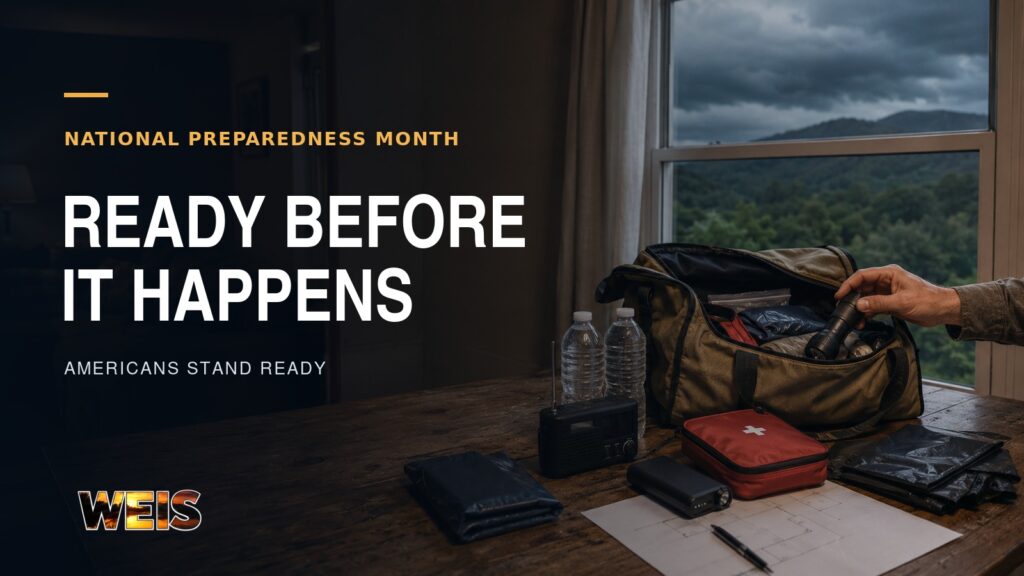
CHEROKEE COUNTY– September is National Preparedness Month, an annual campaign that urges families, businesses, and communities to prepare before an emergency leaves little time to act.
The 2026 theme, “Americans Stand Ready,” emphasizes self-reliance, responsibility, and neighbors helping neighbors. FEMA says even small steps can protect lives and make communities more resilient.
This year’s observance arrives with a new resource for Alabama residents. The Alabama Emergency Management Agency activated a statewide notification system Aug. 26 for floods and other disasters.
Residents can text ALalert to 77295 for emergency alerts and notifications. They can text ALinfo to the same number for preparedness information and updates. Registration is also available through the ALalert section of the Alabama EMA website.
That system should become one part of a broader household plan. Emergency officials recommend knowing local risks, receiving warnings in several ways, making and practicing a plan, building supplies, and preparing for each person’s needs.
A Campaign Created After September 11
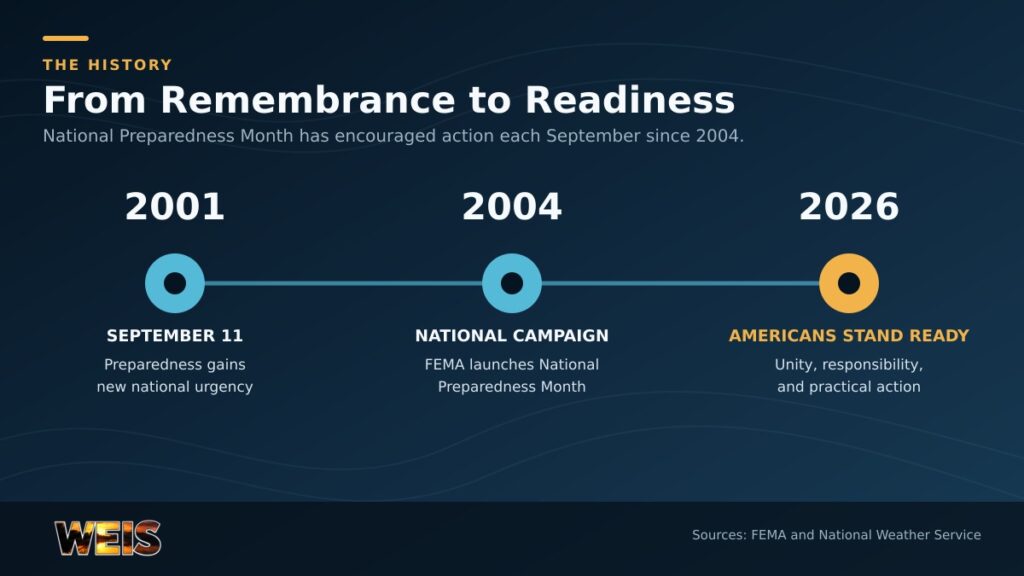
FEMA launched National Preparedness Month in 2004 as a September campaign honoring the events of Sept. 11, 2001. The observance grew from FEMA’s Ready Campaign, a public-education effort developed with the Ad Council.
The National Weather Service in Birmingham says the campaign prepares people for natural disasters, technological emergencies, and acts of terrorism. It also promotes four basic actions: learn the risks, make a plan, build a supply kit, and get involved.
National Preparedness Month ends Sept. 30 with National Preparedness Day, a national day of action. However, emergency managers stress that preparedness must continue throughout the year.
Know the Risks in Northeast Alabama
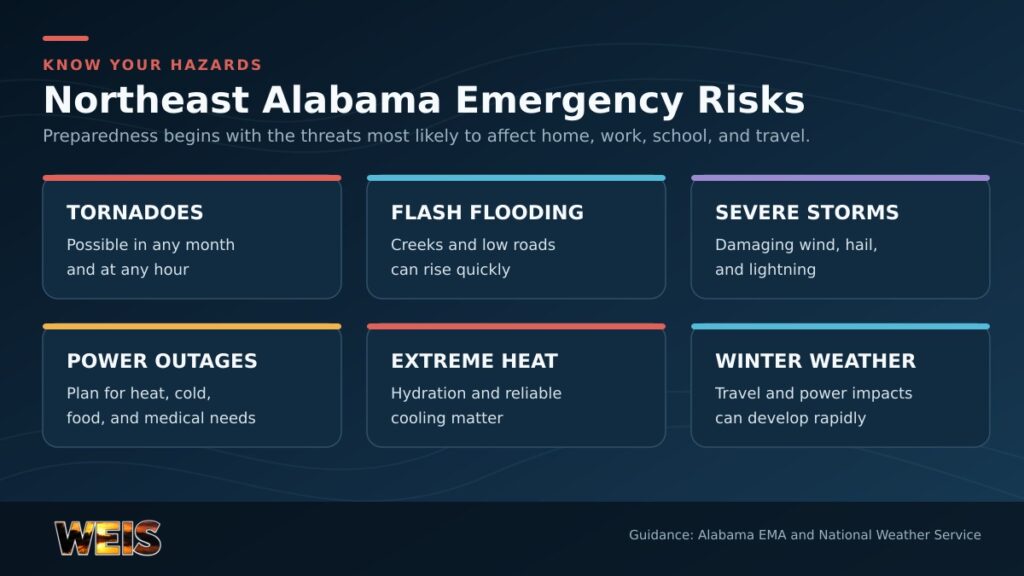
Preparedness begins with understanding what can happen where a person lives, works, attends school, or travels.
Northeast Alabama faces severe thunderstorms, tornadoes, flash flooding, extreme heat, winter weather, wildfires, extended power outages, hazardous-material incidents, and other emergencies. Remnants of tropical systems can also bring flooding, strong winds, and tornadoes far inland.
National Weather Service safety guidance notes that Alabama tornadoes can occur during any month and at any hour. The state typically sees a primary severe-weather season from March through May and a secondary season during late fall.
Flooding can develop quickly in low-lying areas, near creeks, and along roads with poor drainage. Mountains and valleys can channel heavy rainfall, increasing the danger in parts of northeast Alabama.
People should learn whether their home, workplace, school, and regular travel routes are in flood-prone areas. They should also identify the safest nearby shelter before a tornado warning is issued.
Build a Reliable Warning System
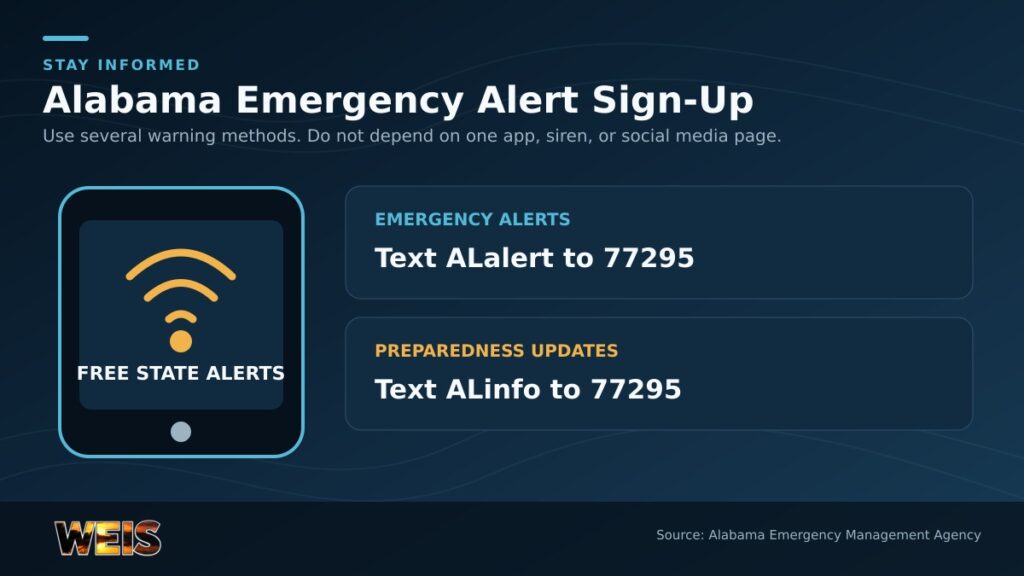
No household should depend on one app, one siren, or one social media page for emergency warnings.
Start with the new statewide ALalert system. Cherokee County residents can also register for local mass notifications through the Cherokee County EMA webpage.
The county’s mobile application provides National Weather Service alerts, shelter information, school and road closings, damage reporting, and county contacts. As WEIS previously reported, the app supplements other warning methods and does not replace 911.
A programmed NOAA Weather Radio offers another dependable warning source, especially overnight. Keep fresh batteries available and select the correct county alert code.
Wireless Emergency Alerts may also reach compatible cellphones automatically. Make sure emergency alerts remain enabled, keep phones charged, and place devices where sleeping family members can hear them.
Follow local EMA, law enforcement, fire departments, schools, utilities, and the National Weather Service. Still, treat social media as a secondary information source because posts may appear late or circulate without verification.
Make and Practice a Household Plan
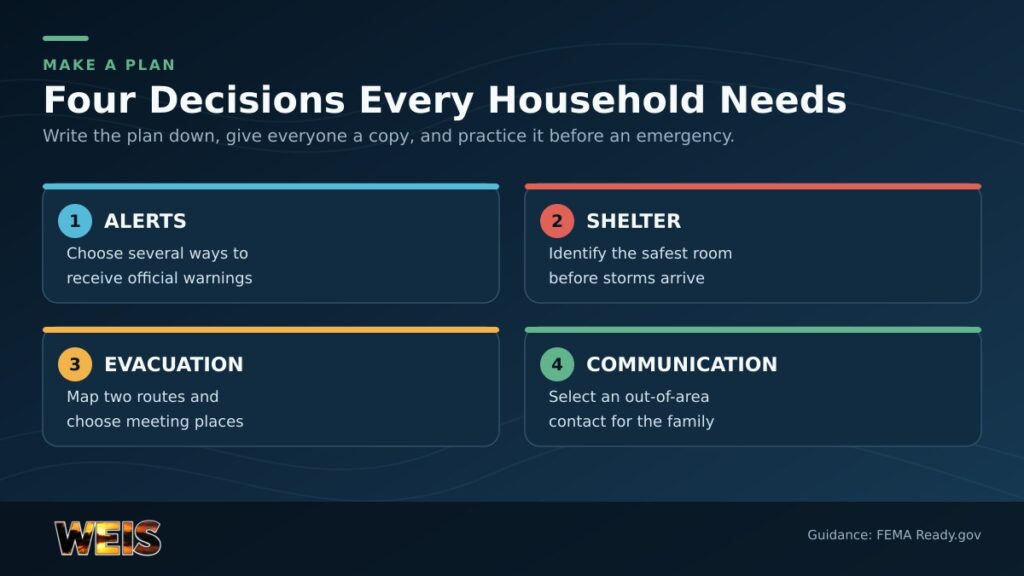
Ready.gov’s family planning guidance starts with four questions: How will the household receive alerts? Where will everyone shelter? What evacuation route will they use? How will family members communicate?
A useful plan should include:
- A safe room for tornadoes and severe weather.
- At least two evacuation routes from the home and neighborhood.
- A meeting place near the home and another outside the neighborhood.
- An out-of-area contact who can relay messages.
- Contact information for schools, caregivers, employers, doctors, veterinarians, and utilities.
- Plans for children, older adults, disabilities, medical equipment, pets, and livestock.
- A paper copy in case phones lose power or service.
Choose an interior room on the lowest floor of a sturdy building for tornado protection. A basement, storm shelter, or FEMA-rated safe room offers better protection when available. Mobile homes and vehicles are not safe tornado shelters, so residents must decide where they will go before storms arrive.
Families should review school and workplace emergency procedures. Parents also need to know who may pick up children and where schools will reunite families after an evacuation.
Practice the plan at least twice a year and whenever someone moves, changes schools, develops a medical need, or begins a new job. During a drill, time how long it takes to reach shelter and check whether everyone can receive the warning.
Build Supplies for Several Days
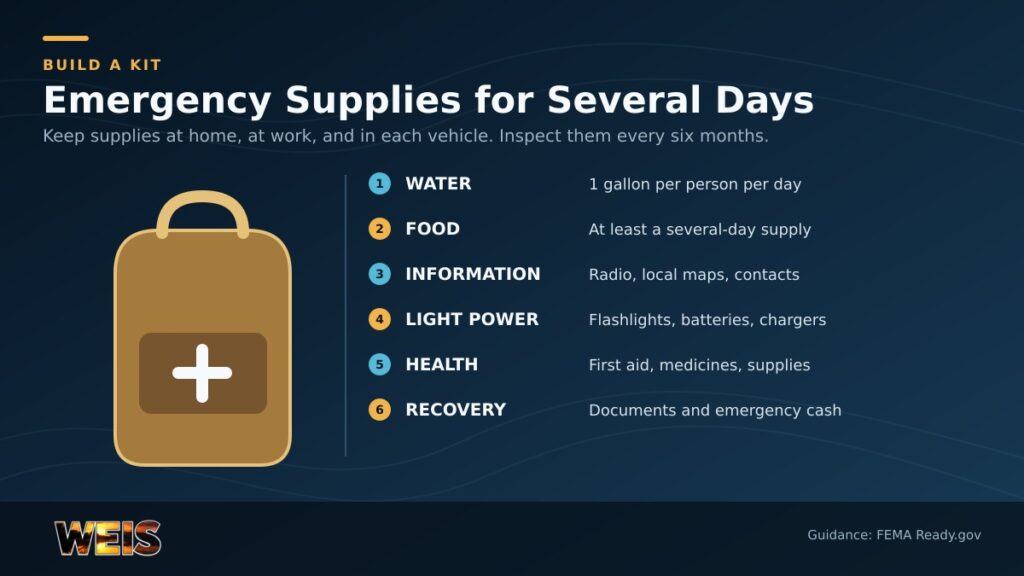
FEMA’s basic disaster supply list begins with one gallon of water per person per day for several days. Households also need at least several days of nonperishable food.
A basic kit should contain:
- Water and ready-to-eat food.
- A manual can opener.
- A battery-powered or hand-crank radio.
- A NOAA Weather Radio.
- Flashlights and extra batteries.
- A first-aid kit.
- Prescription medicines and medical supplies.
- Phone chargers and portable power banks.
- A whistle to signal for help.
- Dust masks, work gloves, and sturdy shoes.
- Moist wipes, garbage bags, and sanitation supplies.
- A wrench or pliers for shutting off utilities when instructed.
- Local maps, copies of important documents, and emergency contacts.
- Cash in small bills because card readers and ATMs may not work.
- Seasonal clothing, blankets, rain gear, and personal hygiene items.
Do not stop with one container in a closet. Keep suitable supplies at home, at work, and in each vehicle. A vehicle kit can include water, snacks, a flashlight, jumper cables, a phone charger, a first-aid kit, reflective markers, blankets, and weather-appropriate clothing.
Build the kit gradually if cost is a concern. Add one or two items during each shopping trip, use supplies already at home, and replace water, food, batteries, and medicines before they expire.
Store supplies in easy-to-carry containers where everyone can reach them. Inspect the kit every six months and after any emergency use.
Prepare for Tornadoes, Floods, Fires, and Outages
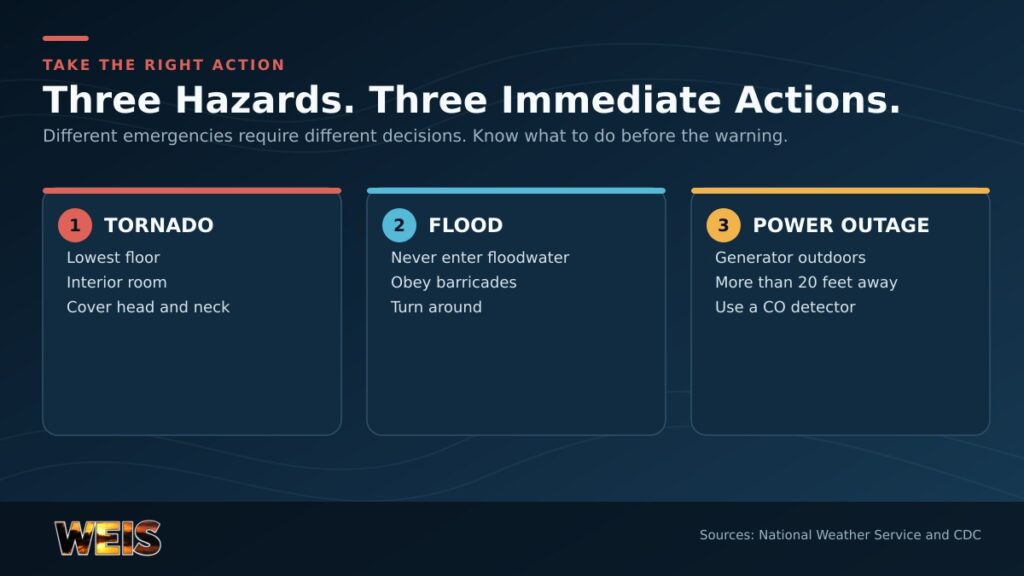
Different hazards require different actions. A household plan should spell out when to shelter, when to evacuate, and when to stay away from damaged areas.
During a tornado warning, move immediately to a basement, safe room, or small interior room on the lowest floor. Stay away from windows, cover the head and neck, and protect children with helmets, blankets, or mattresses when available.
During flooding, never drive or walk through water covering a road. Water may hide a washed-out surface, and its depth can be difficult to judge. Follow the National Weather Service’s “Turn Around, Don’t Drown” guidance when barricades are in place or water crosses the route.
Every home should have working smoke alarms inside and outside sleeping areas and on every level. The U.S. Fire Administration recommends monthly testing and replacement of the entire alarm every 10 years. Families should map two ways out of each room and choose an outdoor meeting place.
Power outages can create hazards after the storm ends. Keep refrigerator and freezer doors closed, use flashlights instead of candles, and avoid downed power lines.
The Centers for Disease Control and Prevention says portable generators must operate outdoors and more than 20 feet from windows, doors, and vents. Never run one in a home, garage, carport, basement, shed, or enclosed porch. Place a battery-powered or battery-backup carbon monoxide detector inside the home.
Plan for Health, Disabilities, and Caregiving
An emergency plan must fit the people who will use it.
The CDC advises people who take daily medicines to ask a doctor or pharmacist how to create an emergency supply. Keep a current list showing each medicine, diagnosis, dosage, schedule, medical-supply need, and allergy.
Plan how to keep refrigerated medicine cold with a cooler and chemical ice packs. People who use oxygen, powered wheelchairs, home dialysis equipment, communication devices, or other electrical medical equipment should arrange backup power and an evacuation option.
Create a support network of relatives, friends, neighbors, and caregivers. Give trusted people a copy of the plan and explain how to operate medical or mobility equipment.
Emergency kits may also need hearing-aid batteries, glasses, mobility aids, charging cables, special foods, incontinence supplies, service-animal supplies, or written instructions for caregivers. People who are deaf or hard of hearing can consider smoke alarms with strobes or vibrating alerts.
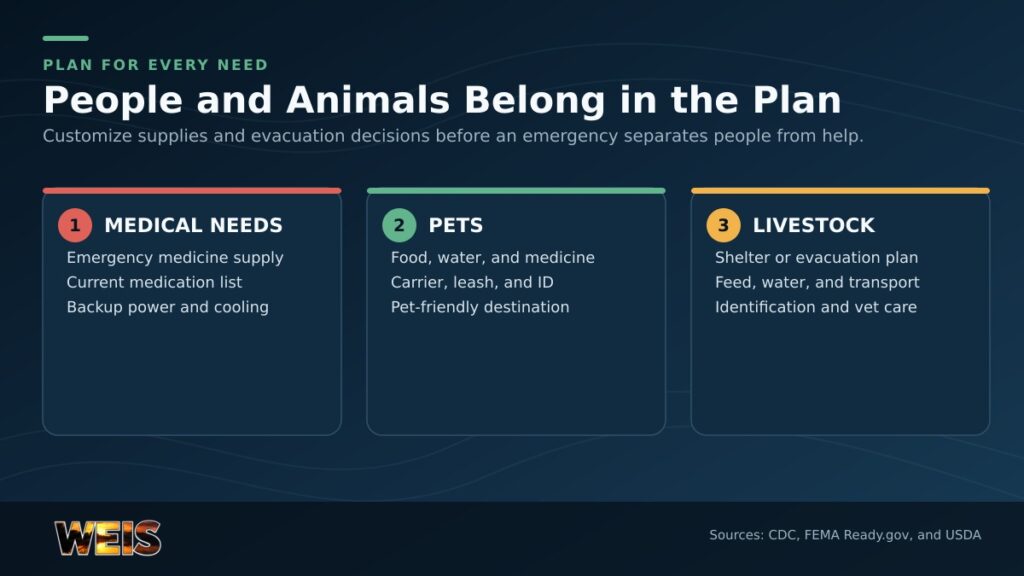
Include Children, Pets, and Livestock
Children cope better when adults explain emergencies calmly and give them simple jobs. Teach them their full name, address, emergency contacts, meeting places, and how to call 911. Practice without creating unnecessary fear.
Parents should keep comfort items, diapers, formula, age-appropriate food, medicines, and copies of custody or medical documents in the family kit.
FEMA’s pet preparedness guidance says pets should evacuate with their owners. Identify pet-friendly lodging, shelters, boarding facilities, or relatives before an evacuation order.
Prepare pet food, water, medicines, veterinary records, identification, a recent photo, carriers, leashes, sanitation supplies, and comfort items. Keep microchip information and identification tags current.
Livestock owners need plans for transportation, shelter, feed, water, identification, and veterinary care. USDA guidance recommends deciding in advance whether animals will evacuate or shelter in place and how they will move safely.
Protect Documents, Property, and Finances
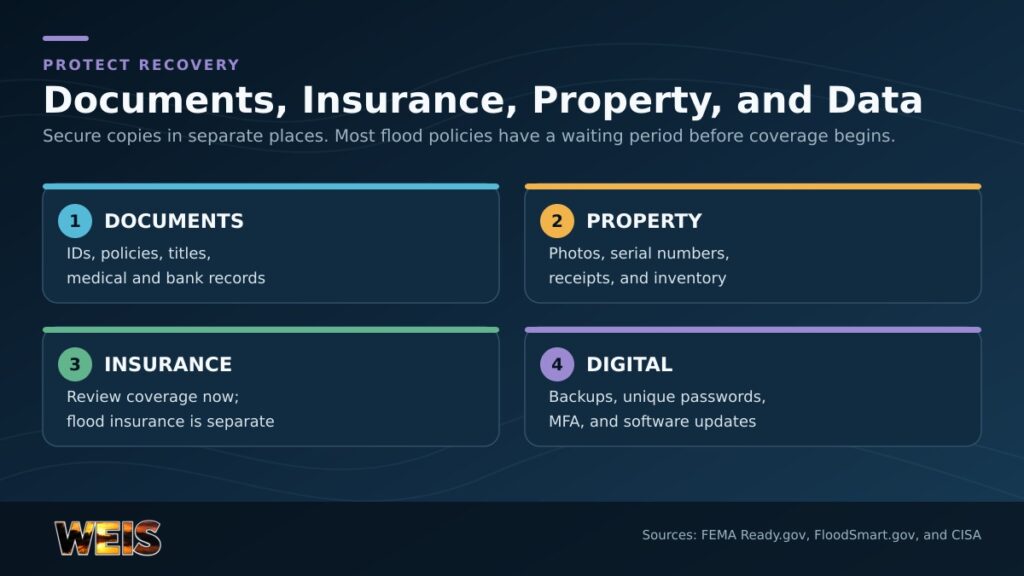
Recovery becomes harder when insurance policies, identification, titles, and account information disappear with the property.
Ready.gov’s financial preparedness guidance recommends safeguarding identification, insurance policies, income information, tax records, medical documents, banking information, and household contacts. Store protected paper copies and encrypted digital copies in separate locations.
Photograph every room, major appliance, electronic device, tool, and valuable item. Record serial numbers and save receipts when possible. A current home inventory can support an insurance claim.
Review homeowners, renters, vehicle, health, life, and business coverage before a disaster. Most standard homeowners and renters policies do not cover flood damage. National Flood Insurance Program coverage usually begins 30 days after purchase, with limited exceptions.
Alabama also offers a state income tax credit for qualifying storm shelters. The credit is the lesser of $3,000 or 50% of the construction, acquisition, and installation cost. It remains subject to certification, annual funding limits, and state rules.
Prepare the Home, Workplace, and Digital Life
Preparedness includes reducing damage before an emergency occurs. Trim hazardous limbs, clean gutters, secure outdoor objects, and learn how to shut off water, electricity, and gas safely. Never shut off a utility unless officials instruct residents to do so or an immediate danger requires it.
Businesses should identify essential operations, employees, suppliers, records, equipment, and customers. A Ready Business continuity plan should name backups for key jobs, protect data off-site, establish alternate work locations, and explain how leaders will communicate during a closure.
Digital emergencies also belong in an all-hazards plan. The Cybersecurity and Infrastructure Security Agency recommends strong, unique passwords, multifactor authentication, prompt software updates, and caution with phishing messages. Back up important files so a stolen device, ransomware attack, or power surge does not erase essential records.
Help Build a Prepared Community
Preparedness works best when neighbors know who may need help and which skills or equipment are nearby.
Check on older adults, people living alone, families with young children, and neighbors with medical or transportation needs. Agree on how the neighborhood will share verified information and who will call for help.
Residents can learn first aid, CPR, and how to use an automated external defibrillator. They may also volunteer with local emergency-response organizations or ask about Community Emergency Response Team training.
Cherokee County EMA can be reached at 256-927-3367 for local preparedness information. During an immediate emergency, call 911.
A Four-Week Preparedness Plan
The work does not have to happen in one day. Families can use September to complete one set of tasks each week.
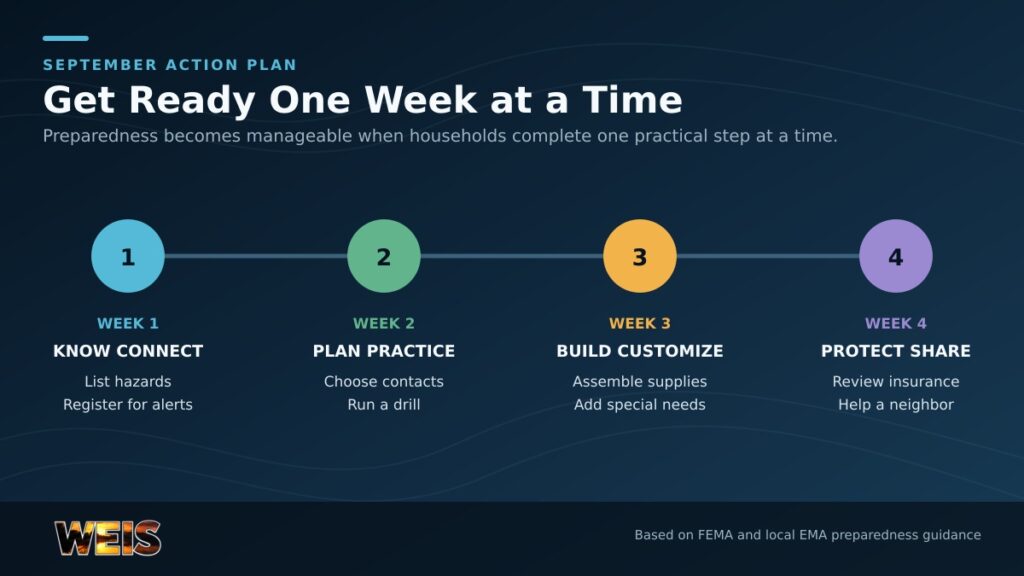
Week One: Know and Connect
- List the hazards most likely to affect the household.
- Register for Alabama and local alerts.
- Program a NOAA Weather Radio.
- Follow official local information sources.
- Identify tornado shelter and flood-prone routes.
Week Two: Plan and Practice
- Choose meeting places and an out-of-area contact.
- Map evacuation routes.
- Review school, workplace, and caregiver plans.
- Assign responsibilities to each household member.
- Practice sheltering and evacuation.
Week Three: Build and Customize
- Assemble food, water, first aid, lighting, and communication supplies.
- Add medicines, medical equipment, child, pet, and livestock needs.
- Prepare smaller kits for vehicles and workplaces.
- Test batteries, chargers, smoke alarms, and carbon monoxide detectors.
Week Four: Protect and Share
- Review insurance and make a home inventory.
- Protect documents and keep emergency cash.
- Back up digital records.
- Learn a lifesaving skill or connect with a volunteer organization.
- Check the plan with neighbors and relatives who may need help.
Preparedness cannot prevent every disaster. It can, however, reduce confusion, shorten response time, protect health, and give families more options when conditions change quickly.
The most useful plan is one that everyone understands, can reach, and has practiced before the warning arrives.



You must be logged in to post a comment.