

CENTRE– August is National Emergency Management Awareness Month, recognizing professionals who help communities prepare for disasters and recover afterward.
The Cherokee County Emergency Management Agency is using the observance to highlight its staff and year-round responsibilities. Those duties extend far beyond responding after an emergency occurs.
Emergency managers develop plans, organize training, coordinate resources, educate the public, and build partnerships. They also support first responders and help guide recovery when disasters affect a community.
Cherokee County EMA prepares for severe weather, flooding, hazardous materials incidents, public health emergencies, and other threats. The agency describes itself as an all-hazards organization serving the entire county.
The International Association of Emergency Managers established the nationwide observance in 2025. The annual August campaign promotes greater understanding of emergency management and its role in protecting communities.
Preparing Before an Emergency
Much of an emergency manager’s work happens before any warning, evacuation, or response begins.
Agencies study local risks and create plans for different emergencies. They also organize exercises that test how departments would communicate and work together.
Emergency management does not replace fire departments, law enforcement, emergency medical services, or public works. Instead, it helps those organizations operate within a coordinated system.
The State of Alabama Emergency Operations Plan assigns local emergency management offices a central coordination role. Their responsibilities cover prevention, protection, mitigation, response, and recovery.
Prevention and protection efforts address threats before they become disasters. Preparedness includes planning, training, public education, equipment, communications, and exercises.
Mitigation focuses on reducing future damage. That work can include identifying repeated hazards and supporting projects that make communities more resilient.
Response begins when an emergency occurs or becomes imminent. Recovery may continue for months or years after the immediate danger ends.
Alabama law requires political subdivisions to establish local emergency management organizations. Those agencies operate under their local governing bodies and coordinate with state and federal plans.
The law also allows local governments to establish emergency command centers. Additionally, governments may assign personnel, equipment, and other resources during a disaster.
Coordinating People and Resources
Emergency management becomes especially important when an incident crosses departmental or jurisdictional lines.
A large disaster may require fire departments, police, emergency medical services, public works departments, utilities, hospitals, schools, nonprofit organizations, and government leaders. Neighboring counties and state agencies may also provide assistance.
Emergency managers help those organizations share information and identify unmet needs. They can also request resources that one department or jurisdiction cannot supply alone.
Mutual-aid agreements establish how agencies assist each other during larger emergencies. These agreements are particularly important in rural counties with limited personnel and equipment.
Cherokee County EMA Director Shawn Rogers discussed that coordination during a 2021 interview with the First Responder Network Authority.
Rogers said emergency managers from Etowah and Calhoun counties assisted Cherokee County during the historic 2019 flooding. Those personnel worked alongside local officials inside the emergency operations center.
Cherokee County shares borders with several Alabama and Georgia counties. Therefore, relationships with surrounding jurisdictions remain an important part of local planning.
Turning Information Into Assistance
Emergency managers also document damage after storms, floods, fires, and other disasters.
Those assessments help determine damage to homes, businesses, roads, utilities, and public property. Accurate documentation can also support requests for state or federal assistance.
Cherokee County EMA adopted FirstNet-connected equipment and damage-assessment software in 2018. The system replaced much of the agency’s former paper-based process.
Field teams can enter information, take photographs, and upload reports from affected areas. State emergency officials can then review that information as it arrives.
According to Rogers, the system covers damage to public infrastructure, private homes, and businesses. It also allows local first responders to help collect information from the field.
Faster assessments can shorten the time required to assemble disaster reports. As a result, affected communities may begin seeking eligible assistance sooner.
Planning for Hazardous Materials
Emergency management responsibilities also include planning for hazardous-materials incidents.
The Alabama Emergency Management Agency says local governments must incorporate hazardous-materials response into their emergency plans. That includes studying local risks, evaluating response capabilities, training personnel, and exercising those plans.
Local Emergency Planning Committees bring government, public safety, and industry representatives together. Businesses handling regulated chemicals also provide information needed for local emergency planning.
This process helps first responders understand potential hazards before an accident occurs. It also improves coordination among industries, fire departments, medical services, and government agencies.
Keeping the Public Informed
Public information is another major emergency management responsibility.
Before an emergency, agencies share preparedness information and explain local hazards. During an incident, they distribute warnings, protective instructions, road closures, shelter information, and other updates.
Cherokee County provides a mass-notification registration option through its official EMA webpage. The county also maintains a mobile application for emergency information.
The Cherokee County EMA application includes National Weather Service alerts, shelter information, school closings, road closings, damage reporting, and county contacts. However, the agency advises residents that the application does not replace 911 or a primary warning method.
Cherokee County has also distributed weather radios to residents. During a 2025 Emergency Awareness Day, Rogers said the county began that program in 2018.
Rogers told WBRC that the county redirected funding from its former outdoor warning sirens. The agency instead focused on providing warnings that residents could receive inside their homes.
Building Community Partnerships
Recovery requires more than repairing roads, restoring utilities, and documenting property damage.
Families may need shelter, meals, clothing, financial assistance, or help navigating available services. Government agencies often work with nonprofit and volunteer organizations to meet those needs.
Cherokee County EMA expanded that approach in 2026 by seeking partnerships with churches and faith-based organizations. The effort connects disaster survivors with organizations already providing community assistance.
Rogers told WBRC that churches may provide shelter, food, clothing, financial help, or private gathering space. Those services can support residents during the earliest stages of recovery.
Cherokee County EMA says its partnerships also include public safety agencies, volunteer organizations, elected officials, and community groups.

Cherokee County EMA Recognizes Its Team
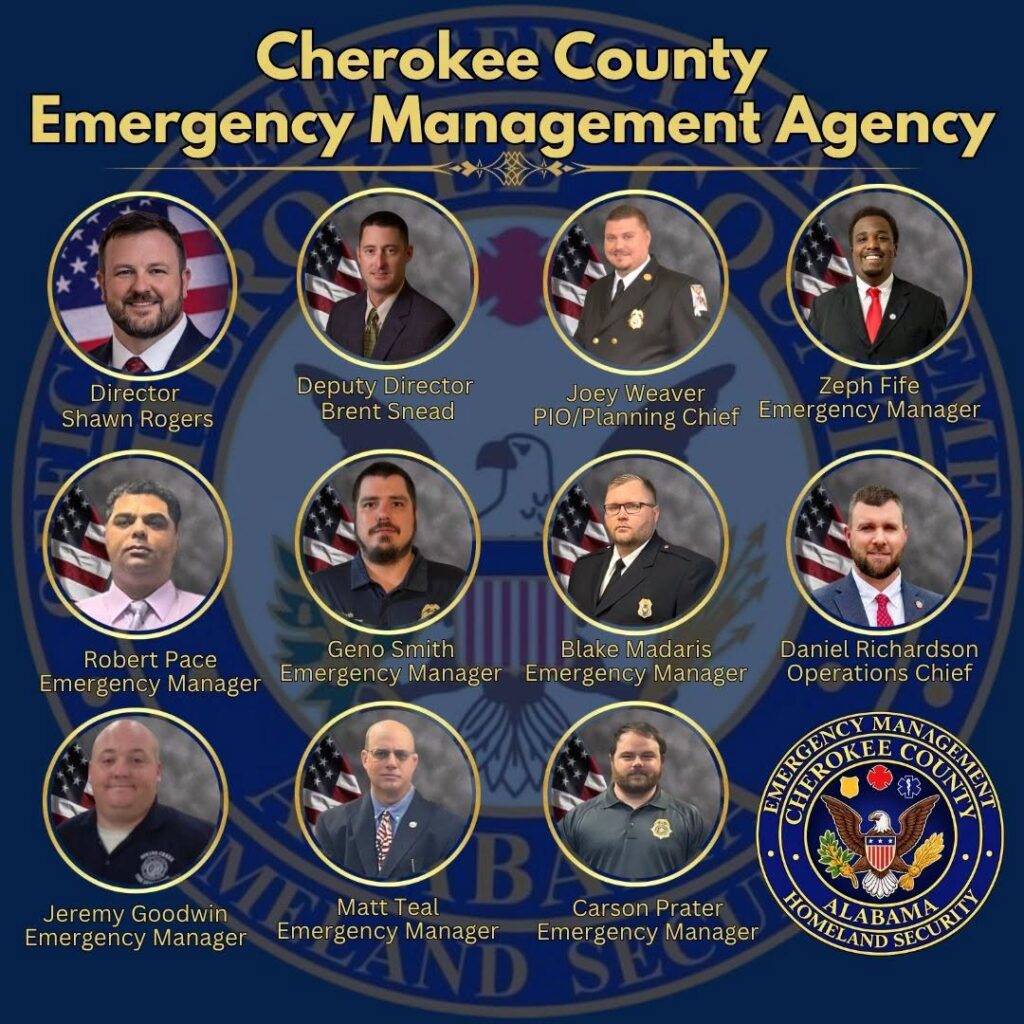
Cherokee County EMA recognized the following members during National Emergency Management Awareness Month:
- Shawn Rogers — Director
- Brent Snead — Deputy Director
- Joey Weaver — Public Information Officer / Planning
- Daniel Richardson — Operations Chief
- Matt Teal — EM Officer
- Robert Pace — EM Officer
- Carson Prater — EM Officer
- Blake Madaris — EM Officer
- Geno Smith — EM Officer
- Jeremy Goodwin — EM Officer
- Zeph Fife — EM Officer
The agency also thanked its partner organizations and public safety personnel. It described emergency management as a team effort involving the entire community.
Emergency managers may become most visible during major storms and disasters. However, their work begins long before an emergency and continues well after the response ends.
Planning, training, coordination, communication, mitigation, and recovery often happen behind the scenes. Together, those efforts help Cherokee County respond more effectively and recover more quickly.
RELATED ARTICLES:
Honoring Our Heroes Ceremony Celebrates Those Who Answer the Call in Cherokee County


You must be logged in to post a comment.