

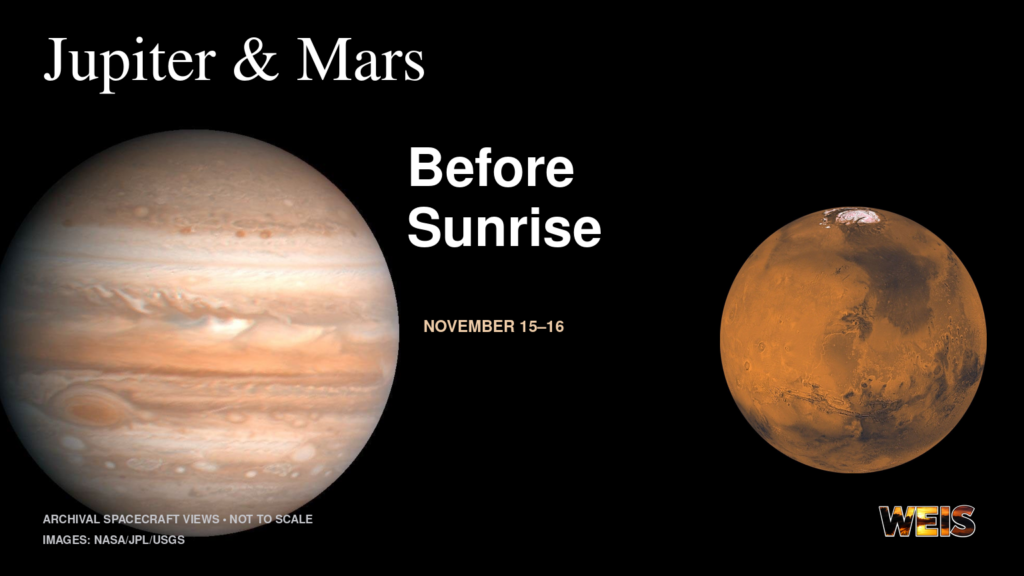
CENTRE– Jupiter and Mars will offer early risers a two-planet sight before sunrise Sunday and Monday, November 15–16, weather permitting.
NASA’s November skywatching guide highlights the close pairing in the southeastern sky. Both planets should be visible without a telescope, giving families and casual skywatchers an accessible reason to look up.
Jupiter should be the brighter point of light. Meanwhile, Mars should appear nearby with a reddish tint.
When and Where to Look
First, plan to look southeast before sunrise on either morning. Then, choose a safe viewing spot with an open sky, away from bright lights and obstructions.
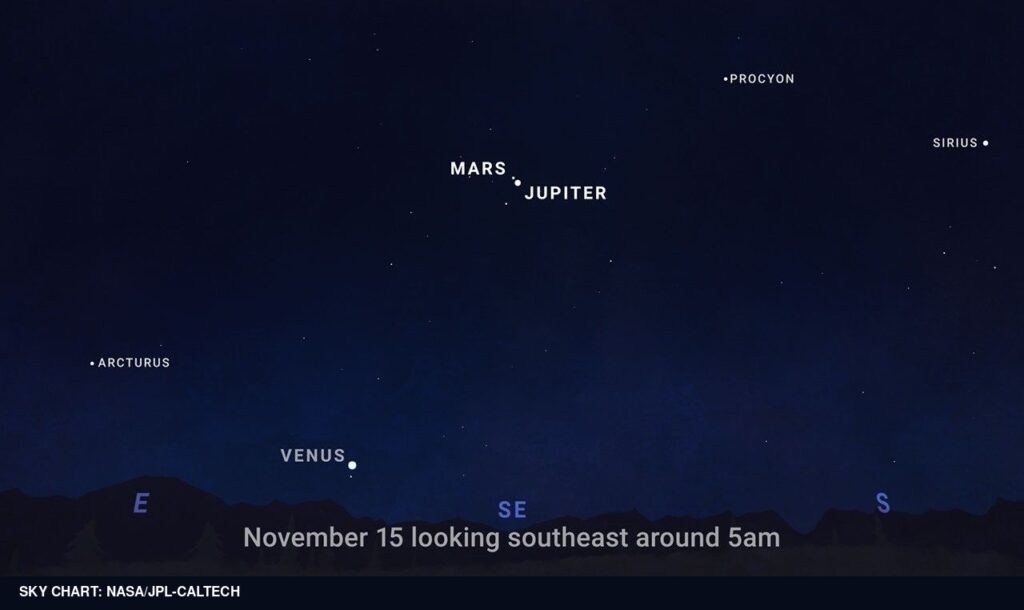
NASA’s accompanying sky chart shows the planets close together above the southeastern horizon. However, their positions relative to nearby trees and buildings will depend on your location and viewing time.
A skywatching app can also help identify the pair. NASA recommends entering your location, date, and time to see which objects should be visible.
The pairing offers two mornings to try, so viewers have another opportunity Monday if clouds interfere Sunday.
Close in the Sky, Far Apart in Space
NASA says Mars and Jupiter will appear about 1.2 degrees apart. That is slightly more than the width of two full Moons placed side by side.
However, that measurement describes their apparent separation in our sky. The planets remain far apart in space.
This kind of close appearance is called a planetary conjunction. As NASA explains in its skywatching coverage, planets can seem to gather together from Earth’s viewpoint while remaining millions of miles apart.
Two Very Different Worlds
Jupiter is the solar system’s largest planet and the fifth planet from the Sun. It is a gas giant, made mostly of hydrogen and helium, without a solid surface like Earth’s.
Its atmosphere also contains alternating cloud bands and enormous storms. Meanwhile, Jupiter takes about 12 Earth years to complete one orbit around the Sun.
Mars is the fourth planet from the Sun and a rocky world about half Earth’s diameter. Because iron minerals in its rocks and dust have oxidized, or rusted, Mars has a reddish appearance.
The contrast makes the pairing especially interesting: one point of light represents a giant planet, while the other represents a smaller, rocky world.
No Telescope Required
Start by finding the pair with your eyes. NASA says both planets should be easy to see without optical equipment.
However, binoculars or a small telescope can add another layer to the experience. According to NASA’s skywatching FAQ, those tools can reveal details such as Jupiter’s large moons.
The planets will still look much smaller than the detailed spacecraft portraits commonly used to illustrate them. Those images reveal features that an unaided observer cannot see.
Also, use a safe observing location and keep binoculars and telescopes away from the Sun as dawn approaches.
Dress for a Cold Morning
Local skywatchers should also prepare for chilly conditions. The National Weather Service in Birmingham expects freezing temperatures and widespread frost through the weekend.
Check the latest local forecast before heading outside, and dress warmly for time outdoors before dawn. Cloud cover will determine whether the planets are visible from any particular spot.



You must be logged in to post a comment.