
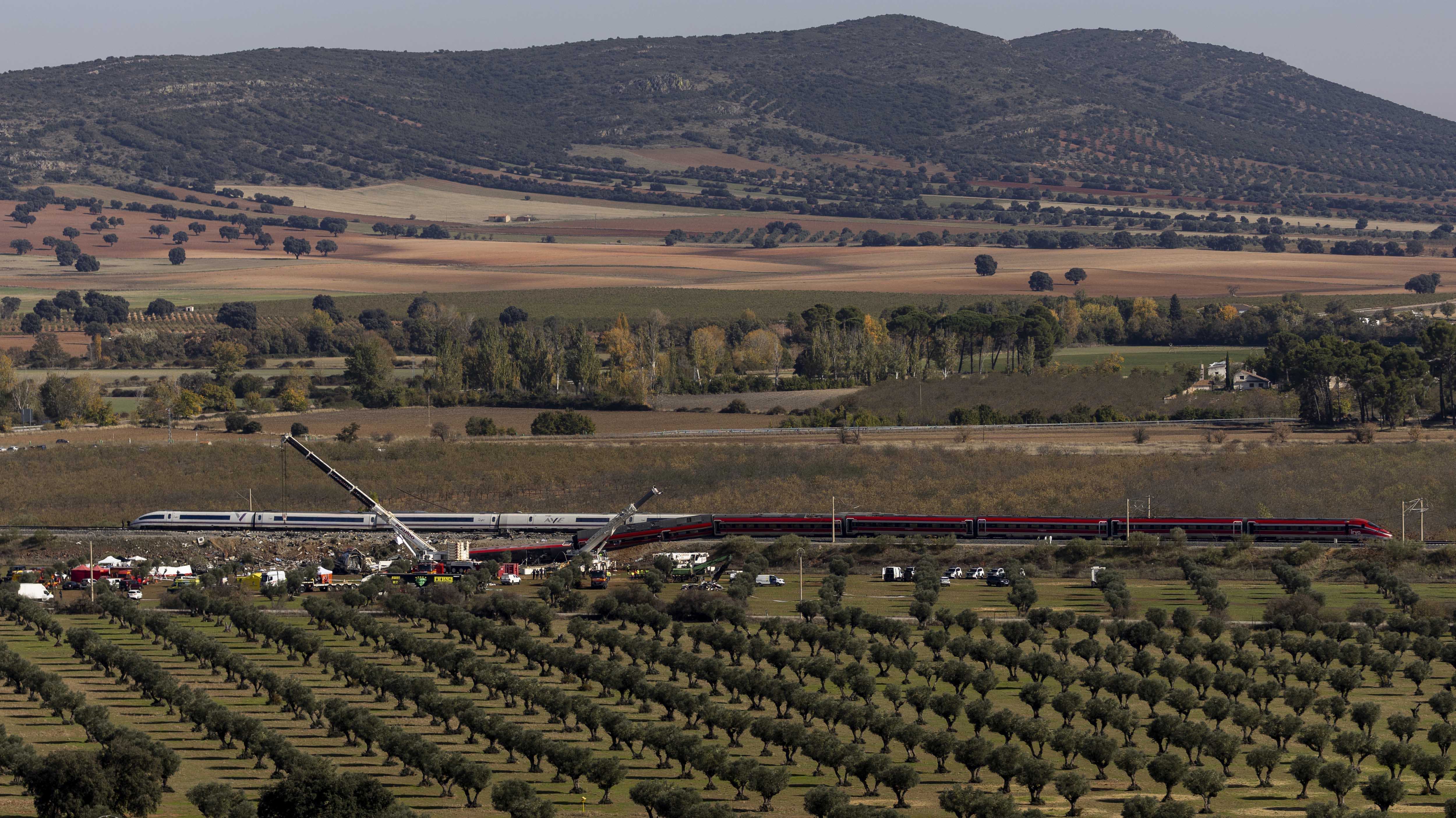
As the death toll rose to at least 69 in the second major high-speed train collision in Spain this year, investigators continued to focus on what they described as an “inexplicable” human error that led to Wednesday’s catastrophe.
Spanish authorities said the deadliest train crash in Spain in 13 years occurred Wednesday morning when a train packed with passengers was going more than 120 mph when it rear-ended another passenger train that was stalled on the tracks.
The Spanish Interior Ministry said in a statement Thursday that six more victims were added to the death toll overnight, bringing the total number of people who perished in the crash to 74. The office of the president and the Transportation Ministry later revised that number downward to 69 dead.
The Interior Ministry further said that it had received 67 reports from families still looking for their loved ones and that officials are still in the process of identifying 52 bodies.
Emiliano Garcia-Page, leader of the Castilla-la Mancha region, said at a press conference Thursday that of the 110 injured survivors initially admitted to hospitals, 60 have been discharged. He said 50 victims remained hospitalized, including 15 in critical condition.
Spanish Prime Minister Pedro Sánchez, who declared three days of national mourning for the crash victims, also spoke at Thursday’s press conference, saying the Spanish government is taking steps to ensure “this never happens again.”
Sánchez’s statements came after a night of unrest in the nation’s capital of Madrid, when protesters clashed with police outside the Ministry of Transportation.
“The entire General State Administration – all the institutions that form part of the state, from the smallest local council to the Spanish Government – are working day and night not only to provide support to the victims’ families, but also, of course, to get to the bottom of every last detail of this tragedy and, naturally, to strengthen security measures so that this never happens again,” Sánchez said.
The prime minister said the government is “fully committed” to a three-pronged response to the crash, including “establishing and clarifying the causes that led to this terrible rail accident” and compensating the victims and their families.
On Thursday, large cranes continued to move parts of the twisted metal and other wreckage from the tracks as search-and-rescue crews combed through the debris for victims.
Some family members of those still unaccounted for in the crash expressed growing frustration with the the government.
“At least let them tell us about the people who are not identified. At least we can start ruling out hospitals because we don’t know anything. This is chaos,” César Vicente, who is awaiting word on the fate of his missing father, told the Associated Press. “I don’t know where he is. I hope to find him, oh my lord. I don’t want this to happen to anyone. This is unbearable. This is hell.”
Carmen Bejarano told the Associated Press that she is searching for her missing husband, whom she said was on the train, operated by Spain’s state-owned Renfe railway company.
“The problem is the uncertainty we have, that we don’t know anything and that we’re here,” Bejarano said. “Renfe people can’t tell us anything unless it’s official. Do you understand? So that’s the issue.”
The collision occurred around 8:30 a.m. local time Wednesday on Spain’s Madrid-Seville high-speed line near the town of Urda.
During a news conference Wednesday, Spain’s Transport Minister Óscar Puente called the crash “truly unbelievable.” He said the preliminary investigation indicates the crash was caused by an “inexplicable” order by the central rail command to allow one train to proceed at normal speed despite a safety failure that halted a train on the tracks further ahead.
According to Puente, a computer failure led to the initial halt of six moving trains, including the two trains that subsequently collided.
“In the event of a system failure, the control center takes over,” Puente said, adding it was the control center that decided to allow the trains to move again without any speed restrictions. That decision, Puente said, resulted in the Renfe train crashing into the Iryo train, which was stationary on the tracks farther ahead.
One of the key questions investigators are working to answer is why the control center appeared to be unaware that a train remained stalled on the tracks ahead of a train moving at 120 mph.
The collision was the second major train crash in Spain this year on the same high-speed train line and involved trains from the same rail operators, Renfe and Iryo. In January, two high-speed Iryo and Renfe trains collided near Adamuz in the province of Cordoba, killing 46 people. Authorities said one of the trains derailed and another train collided with the derailed cars.
Copyright © 2026, ABC Audio. All rights reserved.