

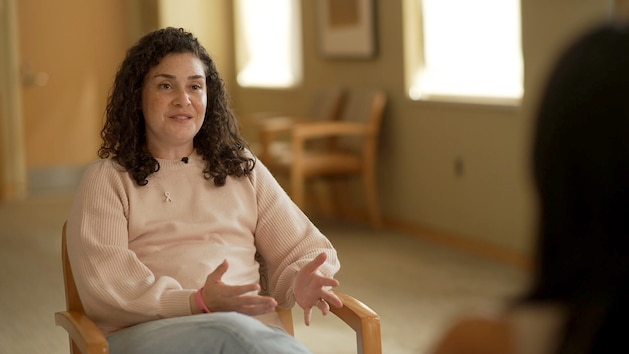
At just 34 years old, New York resident Sarah Sanders thought she was in her prime.
“I was in peak health. I mean, I worked out five days a week, super active, ready and willing to go do everything,” Sanders told ABC News.
Although she felt her best, her annual gynecology visit in 2020 proved otherwise when Sanders’ doctor found a lump in her breast. Over a dozen scans later came the news she never wanted to hear.
“My diagnosis was triple negative invasive ductal carcinoma. And it’s unfortunately one of the more aggressive types of cancer. And at that moment, my whole world just stopped,” she said.
Breast cancer in women under 50 is considered rare, but cases in younger women are becoming more common with diagnoses rising at about 1.4% per year, according to the Breast Cancer Research Foundation. In fact, breast cancer is currently the leading cause of cancer deaths in U.S. women aged 20 to 49 years old.
Even with the support of loved ones, Sanders says she felt extremely alone — a feeling compounded by the isolation of the COVID-19 pandemic.
Dr. Shari Goldfarb, Sanders’ oncologist at Memorial Sloane Kettering in New York City, told ABC News that this is a common feeling for young cancer patients. She started the “Young Women with Breast Cancer” program at MSK.
“I take care of a lot of women in their 20s and 30s and 40s. Sometimes a cancer diagnosis at a young age can make someone feel very lonely,” she said. “So part of what we do with our program is we have monthly networking events where we introduce people to other people going through the same thing at the same time.”
Goldfarb says women may want to consider getting a mammogram earlier than the current recommended age of 40.
“I do think women in their 30s should probably get one baseline mammogram that can be compared to subsequent mammograms,” said Dr. Goldfarb. “If something doesn’t feel right, get it checked out. You’re never too young to get a mammogram or imaging.”
As Sanders processed her cancer diagnosis and decided on a treatment plan, she faced another difficult discovery. She tested positive for the BRCA1 gene mutation.
BRCA1 and BRCA2 are tumor-suppressor genes that help repair DNA, decreasing the risk of developing cancer. Women who have the genetic mutation have a higher chance of developing breast, ovarian and pancreatic cancers. Cancer survivors like Sanders also have a higher chance of recurrence.
Sarah discovered that she inherited the gene from her dad’s side of the family. Incidentally, her younger cousin and a stranger at the time, Mable Sanders, had reached out to connect.
“She reached out to me two months prior to me being diagnosed saying, ‘Hi, I’m your cousin,'” she said. “And I’m like, ‘Who are you?'”
Just weeks after the two had connected for the first time in their lives, Sanders shared the news of her genetic predisposition and that there was a 50% chance Mable Sanders and her sister, Norely Sanders, also had the BRCA1 gene mutation.
Following Dr. Goldfarb’s guidance, Sanders encouraged her cousins to consider genetic testing.
“I told them, this is what it is. Here are choices you have if you wanna get tested. And turns out, not only did both of them get tested, but they both tested positive for the BRCA 1 genetic gene,” Sanders said.
She noted how breast cancer is “extraordinarily tough,” and being diagnosed in younger people more often.
“To know my cousins in particular, who I’ve grown extraordinarily close to, have a predisposition to it, it’s hard not to cry sometimes,” she said.
Mable and Norely Sanders, who were all the way on the other side of the country in Denver, were caught by surprise.
“I had no idea what this gene was before her diagnosis and before she told me. So this was all news to me,” Mable Sanders told ABC News. “I remember thinking that it’s so bizarre that there is a gene mutation that can cause cancer.”
Norely Sanders remembered feeling scared.
“I never thought that it would affect me because I think being someone in your mid-20s, truthfully you just kind of don’t think about those things,” she said. “Initially my mind just kind of did the thing it does and it spiraled and just thinking of, you know, worst-case scenario.”
Thanks to their cousin, Mable and Norely Sanders are able to take action.
For Norely Sanders, in her early 30s, that means annual breast exams, appointments with her genetic counselor and mammograms. Mable Sanders, 27, plans to get a prophylactic mastectomy — a preventative operation to remove healthy breasts to greatly lower the risk of developing breast cancer.
“I’ve talked to my doctors, I have done a lot of research,” she said. “So knowing that that’s an option, it just felt like a no-brainer for me to lower my risk as much as I possibly can.”
Both sisters are hoping to become mothers and plan on doing IVF to reduce the risk of passing the gene mutation to their future children. Using pre-implantation genetic testing, doctors can identify mutations and implant only healthy embryos. This reduces the likelihood of BRCA mutations being passed on.
Now, Sarah, Mable and Norely Sanders are forever bonded by their experience.
“I get chills thinking about I might have gone the rest of my life without knowing,” Mable Sanders said. “She’s definitely someone that I consider a guardian angel in my life.”
“My heart is so full knowing that I have two people that now have the opportunity to decide how they want to progress,” Sarah Sanders said. “Knowledge is power, and [being] proactive about your health is so key.”
She recently reached five years of being cancer-free.
Copyright © 2026, ABC Audio. All rights reserved.