

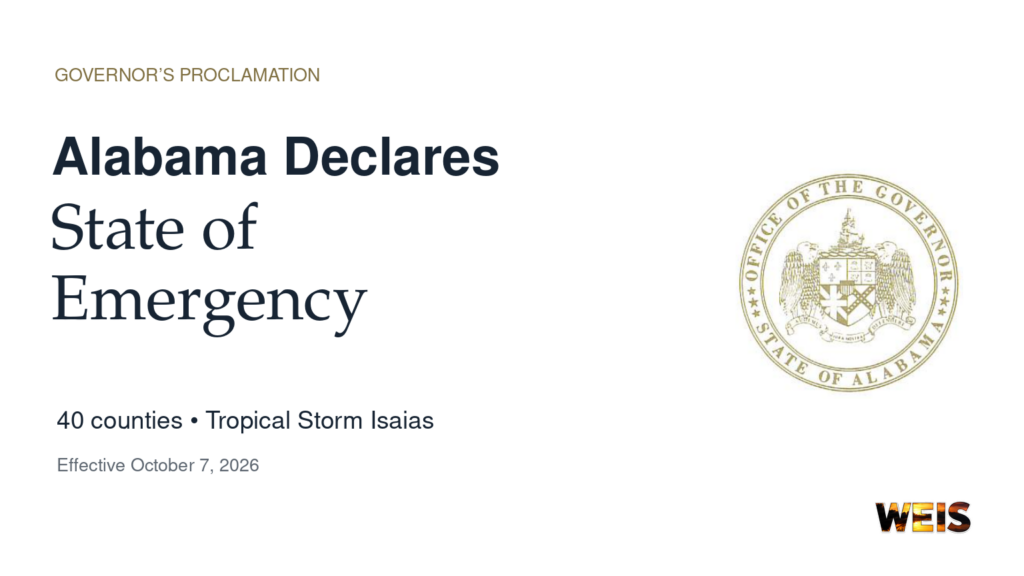
MONTGOMERY– Gov. Kay Ivey has declared a state of emergency in 40 Alabama counties ahead of potential impacts from Tropical Storm Isaias.
The proclamation took effect at 4 p.m. CDT Wednesday, October 7. It cites a National Weather Service forecast for strong winds, flooding, and tornadoes in coastal and central counties beginning Friday evening, October 9.
In addition, the document warns of possible property damage, utility disruptions, injuries, and loss of life. The declaration activates Alabama’s Emergency Operations Plan and directs state agencies to prepare for response and recovery.
Counties Covered by the Declaration
The proclamation covers Autauga, Baldwin, Barbour, Bibb, Bullock, Butler, Chambers, Chilton, Clarke, Choctaw, Coffee, Conecuh, Coosa, Covington, Crenshaw, Dale, Dallas, Elmore, Escambia, and Geneva counties.
It also includes Greene, Hale, Henry, Houston, Lee, Lowndes, Macon, Marengo, Mobile, Monroe, Montgomery, Perry, Pickens, Pike, Russell, Sumter, Tallapoosa, Tuscaloosa, Washington, and Wilcox counties.
Cherokee, Etowah, DeKalb, Calhoun, Marshall, and Jackson counties are outside the proclamation’s designated emergency area. However, that list defines the declaration’s coverage, rather than the full area that could experience storm impacts.
Response Preparations and Consumer Protections
Ivey directed the Alabama National Guard to prepare for activation if she orders it. She also directed state agencies to assist affected communities with response and recovery.
The Alabama Emergency Management Agency must assess storm damage and seek necessary state and federal assistance for affected areas. In addition, the proclamation invokes Alabama’s price-gouging protections in the 40 designated counties during the declared emergency.
Those protections prohibit unconscionable prices for goods, facility rentals, and services. The proclamation also provides temporary regulatory relief for qualifying motor carriers and drivers transporting emergency supplies or providing disaster assistance.
That relief includes certain hours-of-service rules and ends when the applicable emergency-relief conditions expire. However, carriers under an out-of-service order cannot use the relief.
Emergency Transportation and Local Closures
The order also directs agencies to expedite transportation of emergency equipment, supplies, storm debris, construction materials, and temporary emergency buildings.
The Alabama Department of Transportation and Alabama Law Enforcement Agency must approve transportation documents covering designated state routes. ALDOT may also issue certain weight and size waivers for vehicles supporting the response.
Transporters must maintain required oversize signs, markings, flags, and escorts. However, insurance requirements and posted weight limits on bridges remain in place.
State and local agency heads may decide whether to close offices based on local weather conditions. Similarly, local educational authorities may close schools or offices when conditions warrant.
Affected school systems that lose instructional or employee workdays may request calendar relief from the state superintendent of education. The proclamation also provides for no loss of income to employees under that provision.
The declaration expires at 11:59 p.m. Wednesday, October 14, unless another proclamation changes its expiration time.
Meanwhile, Alabama EMA advises residents to follow updates from emergency management officials, the National Weather Service, and the National Hurricane Center. The agency notes that storm impacts can extend beyond the forecast track of the storm’s center.


You must be logged in to post a comment.