

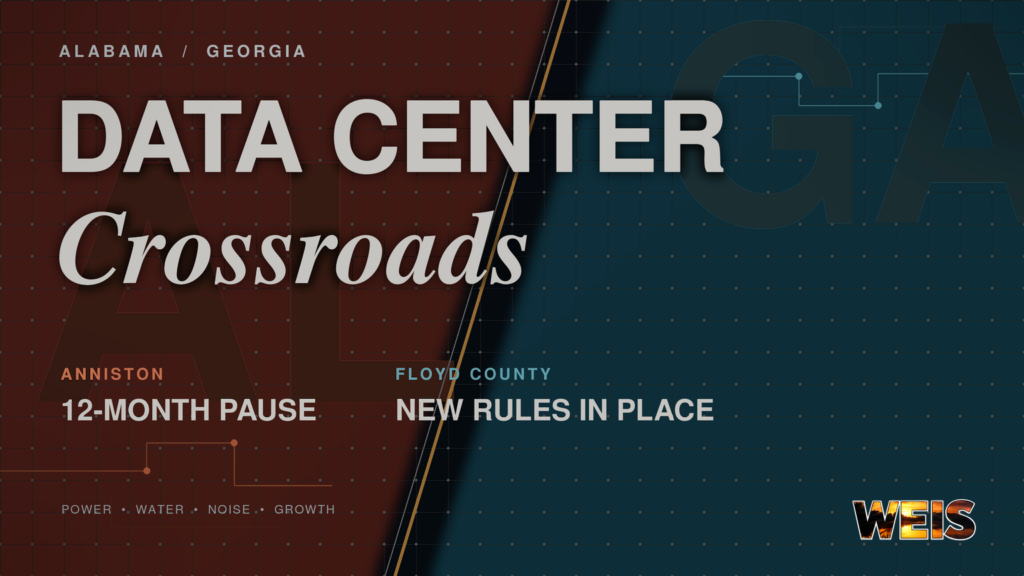
ANNISTON-Communities on both sides of the Alabama-Georgia state line are moving to regulate large data centers as rapid growth in artificial intelligence and cloud computing drives demand for facilities requiring substantial amounts of electricity, water and land.
However, the two governments are at different stages.
The Anniston City Council has imposed a 12-month moratorium while officials study potential zoning and infrastructure safeguards. Meanwhile, the Floyd County Commission has completed a temporary review period and adopted detailed regulations governing future data centers in unincorporated areas of the county.
The actions reflect a wider effort by local governments to establish rules before developers seek approvals—or before proposed projects advance beyond the planning stage.
Anniston Begins Yearlong Review
The Anniston City Council adopted Resolution No. 26-R-97 on Aug. 18, temporarily stopping the permitting, development, expansion and licensing of data centers within the city’s regulatory jurisdiction.
The moratorium will remain in effect for 12 months unless the council shortens or extends it. Existing data-center businesses are not intended to be affected unless they cease operating for at least 60 days or allow their business licenses to expire without timely renewal.
Anniston officials emphasized that the action does not represent opposition to data centers. Instead, the city called it a temporary planning measure intended to provide clear and enforceable standards before it receives a proposal.
“This moratorium is not a position for or against data center development,” the city said in its public explanation of the measure.
The resolution directs the Anniston Planning Commission to study the issue and present recommendations to the City Council within six months.
According to the city, that review may address appropriate locations, minimum property sizes, separation from residential neighborhoods and the capacity of existing electrical, water and wastewater systems. Officials will also consider stormwater and transportation effects, backup generators, emergency-response needs, noise, lighting, landscaping and screening.
Notification requirements for neighboring property owners could also become part of the city’s eventual regulations.
Anniston has not publicly identified a pending data-center proposal in connection with the moratorium. The city described its action as an effort to prepare before an application arrives rather than attempting to establish protections after a project is underway.
Floyd County Moves From Moratorium to Regulation
Floyd County followed a similar process, although its deliberations occurred amid documented interest in developing multiple data-center sites.
The Floyd County Commission approved an 80-day moratorium on June 9. County officials said the pause would provide time to draft specific requirements and establish a public-review process for future projects.
Commissioners then approved a comprehensive data-center ordinance on Aug. 25 following a public hearing. The regulations apply to future projects in unincorporated Floyd County and do not automatically govern property located inside the City of Rome.
Under the new ordinance, data centers may operate only in areas zoned Heavy Industrial. Developers must satisfy requirements involving utility capacity, water consumption, noise, environmental effects, emergency planning, neighborhood compatibility and eventual site cleanup.
Before the county can issue permits, a developer must submit an impact study identifying the project’s anticipated electricity, water and broadband requirements at full development. The study must also identify construction phases and any off-site infrastructure improvements needed to serve the facility.
Affected utility providers must confirm in writing that sufficient electricity, water, sewer and natural-gas capacity will be available when the project is completed.
Additionally, developers must enter binding agreements to pay for necessary utility extensions or improvements. Those agreements must contain provisions for monitoring, reporting and enforcement.
Facilities expected to consume more than 10 megawatts of electricity must submit an energy and sustainability plan. The plan must explain how the operator intends to improve energy efficiency, reduce carbon intensity and limit environmental effects.
Water and Cooling Requirements
Floyd County’s ordinance gives preference to closed-loop cooling systems, which recirculate water instead of continuously drawing a new supply.
A developer proposing water-cooled equipment must install a water reclamation and reuse system. The company must also demonstrate that its proposed system represents the least water-intensive cooling technology feasible for the property.
Data centers must follow water-use limits and efficiency requirements established by the utility serving the site.
The ordinance prohibits the use of private wells and septic systems. It also prohibits direct withdrawals from surface-water sources and direct connections to aquifers. All facilities must use public sewer service.
Those provisions place responsibility on developers and utility providers to document available capacity before construction begins.
Noise Limits and Residential Setbacks
Every data-center applicant must conduct an acoustic study examining anticipated noise from cooling systems, normal operations, backup generators and other equipment.
Outdoor generator areas must have sound-reducing walls. The primary buildings must also use materials designed to control noise. Metal-panel construction is permitted only if an acoustic analysis demonstrates that the building can meet the county’s property-line limits.
When a facility borders residentially zoned property, noise at the property line cannot exceed 65 decibels between 7 a.m. and 11 p.m. The nighttime limit is 55 decibels between 11 p.m. and 7 a.m.
The limit along property in other zoning districts is 70 decibels.
Data-center buildings must remain at least 600 feet from an existing residence. The ordinance also requires a 300-foot setback and landscaped buffer when a facility borders residentially or agriculturally zoned property.
Generators and related equipment are subject to residential setback requirements and must be screened with evergreen vegetation.
Furthermore, outdoor lighting must meet dark-sky standards and limit light spilling across property lines. Publicly visible security fencing cannot consist of chain link, barbed wire, razor wire or solid metal panels unless it is properly screened or replaced with approved decorative materials.
Emergency Planning and Site Restoration
Backup generators generally may operate only during emergencies, required testing and commissioning. They must also comply with applicable performance and emissions-control standards.
Before receiving a certificate of occupancy, each data center must prepare an emergency-response plan in coordination with local fire and emergency agencies. Facilities must install appropriate fire-suppression systems and may be required to participate in emergency drills.
Developers must also prepare for the eventual closure of a facility before receiving their first permits.
Required decommissioning plans must address the removal of buildings and equipment, safe disposal of hazardous materials, soil and groundwater testing, contamination cleanup and restoration of the property.
Companies must provide a bond, escrow account, letter of credit or another county-approved financial guarantee sufficient to cover the full cost of that work. Floyd County may use the guarantee if an operator fails to complete its obligations.
Rome-Floyd County Planning Director Brice Wood said during the Aug. 25 meeting that violations could result in fines of up to $1,000 per day. Continued violations could also lead to the suspension or revocation of a business license or certificate of occupancy, according to local coverage of the public hearing.
Most speakers at the hearing supported adopting regulations, although some residents argued that the ordinance should contain stronger restrictions.
Floyd County Has Already Drawn Developer Interest
Unlike Anniston, Floyd County’s regulatory debate developed alongside several publicly announced projects.
The Rome-Floyd Development Authority previously announced an option involving 114 acres behind Coosa High School. The agreement limited the property’s potential use to a data center, although no operating company was publicly identified at the time.
The authority also announced an option involving 15 acres along Georgia Highway 53 near the Lowe’s Distribution Center. That proposal, known as Project Sassy, was intended to combine the authority-owned land with adjacent property controlled by the developer.
Those announcements followed Microsoft’s 2023 purchase of 347 acres near Huffaker Road for a project carrying a publicly announced investment of approximately $1 billion.
However, not every proposed development has moved forward.
Atlas Development ended a preliminary agreement to purchase approximately 100 acres at Rome’s Battey Business Complex, the former Northwest Georgia Regional Hospital property. The proposed transaction had been valued at $5.7 million. Development Authority Chairman Jimmy Byars confirmed in August that the Battey proposal was no longer active, although officials did not publicly identify a reason for the termination.
Because the newly adopted Floyd County ordinance applies only in unincorporated areas, data-center policies inside Rome remain a separate municipal issue. Rome City Commission minutes show residents have repeatedly asked city leaders to consider safeguards addressing water, electricity, noise and environmental monitoring.
Electricity Demand Drives Wider Debate
The local actions come as data centers occupy a rapidly growing share of the nation’s electrical system.
A U.S. Department of Energy report found that data centers consumed approximately 4.4% of all electricity used in the United States in 2023. The department projected that share could rise to between 6.7% and 12% by 2028.
The department estimated that annual data-center electricity consumption increased from 58 terawatt-hours in 2014 to 176 terawatt-hours in 2023. It could reach between 325 and 580 terawatt-hours by 2028.
That growth is being driven partly by cloud computing and increasingly powerful artificial-intelligence systems. The resulting facilities can bring large investments, construction activity and additional property-tax revenue. At the same time, their electrical demand, cooling requirements, generators and industrial-scale buildings can affect utility planning, neighboring properties and local emergency services.
Floyd County has chosen to address those issues through specific operating and development standards. Anniston, meanwhile, has given itself one year to determine what protections would be appropriate if a developer approaches the city.
Together, the two actions show that data-center development is no longer solely an issue for major metropolitan technology hubs. It has become a land-use, utility and economic-development question for communities throughout Northeast Alabama and Northwest Georgia.
RELATED ARTICLES:
Atlas Development Ends $5.7 Million Battey Data Center Agreement



You must be logged in to post a comment.