

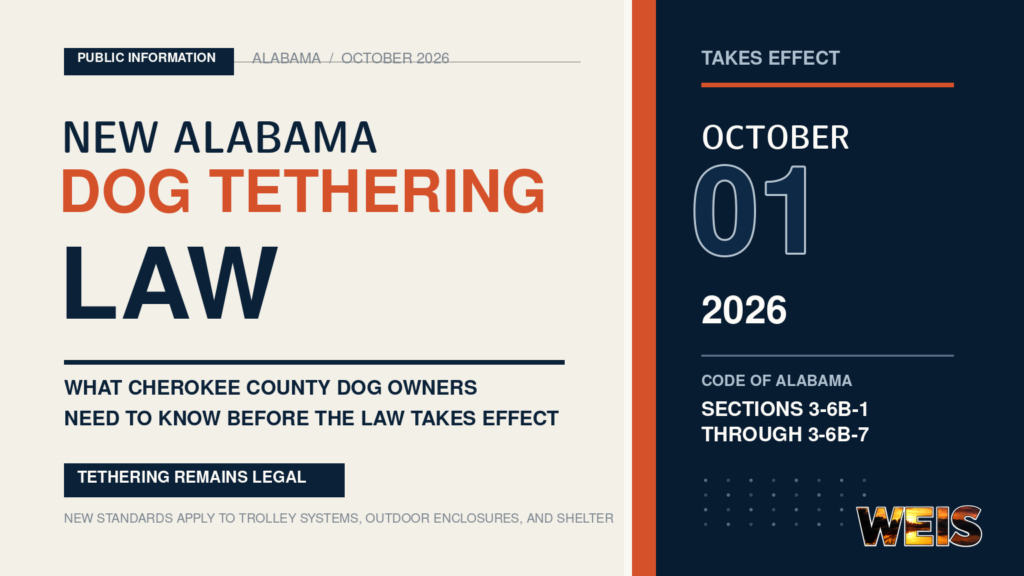
CENTRE– A new Alabama dog tethering law will establish statewide standards for dogs tethered or confined outdoors beginning Oct. 1.
The Cherokee County Animal Shelter is urging owners to review their current setups and make any necessary changes before the law takes effect.
According to the shelter, misinformation has led some residents to believe the law will prohibit tethering altogether. However, the law does not require every tethered dog to come indoors.
Instead, Alabama Senate Bill 361 establishes requirements for tethering, outdoor enclosures, food, water, and shelter. The provisions appear in Sections 3-6B-1 through 3-6B-7 of the Code of Alabama.
Tethering Remains Allowed Under Specific Conditions
When owners tether dogs to stationary objects, the law requires them to use trolley systems. The rules apply to tethers connected to trees, poles, stakes, structures, and similar stationary objects.
Specifically, the tether cannot weigh an unreasonable amount compared with the dog’s weight. It also cannot allow the dog to leave the owner’s property.
Owners may connect only one dog to each tether. In addition, they must attach the tether to a properly fitted collar or harness.
The collar or harness cannot choke the dog or interfere with normal breathing or swallowing. Meanwhile, swivels must appear on both ends of the tether to minimize tangling.
Owners cannot use logging chains, choke collars, or pinch collars for tethering. The tether also cannot extend over an object or edge that could cause injury or strangulation.
Additionally, owners must arrange the tether to prevent entanglement with other objects or animals. Every tethered dog must have continuous access to adequate food, adequate water, and legally compliant shelter.
Outdoor Enclosures and Shelter Requirements
The law also establishes standards for dogs kept outdoors inside enclosures. An enclosure must remain secure, fully fenced, and large enough for the dog to move freely.
Furthermore, the enclosure cannot allow the dog to leave the owner’s property. Owners must provide continuous access to adequate food, water, and shelter.
Proper shelter must protect a dog from the elements and inclement weather. It must provide shade and include bedding during cold weather when necessary.
The shelter must have a solid floor and an adequate opening for entry and exit. It also must contain enough space for the dog to stand, turn around, lie normally, and extend its limbs.
In addition, owners must use durable materials and provide adequate ventilation. The shelter must remain free of accumulated waste, standing water, and debris.
Dogs must have unlimited access to the shelter.
Law Includes Several Exceptions
The law contains exceptions covering certain veterinary practices, boarding kennels, animal shelters, dog shows, service dogs, grooming facilities, and lawful training activities.
For example, separate provisions address dogs used or trained for agricultural, herding, hunting, and retrieving purposes. The law also recognizes certain temporary situations involving businesses, campsites, recreation areas, and homes.
Temporary tethering or confinement must last only a reasonable amount of time based on weather conditions. Walking a dog on a leash does not violate the law.
Certain commercial breeders licensed by the U.S. Department of Agriculture also fall under an exemption.
Investigation and Enforcement Process
The law allows counties and municipalities to appoint animal control officers to investigate alleged violations. Those investigating officers do not have to hold certified law enforcement status.
However, certified law enforcement officers handle enforcement actions authorized under the law. With probable cause, those officers may remove a dog if they believe its life is in danger.
An officer may also order an owner to provide legally required care at the owner’s expense.
The Cherokee County Animal Shelter said its animal control officers will investigate complaints in unincorporated areas. Afterward, they will document their findings and forward them to the appropriate law enforcement agency.
Residents within Centre, Cedar Bluff, or Leesburg should report complaints to their respective municipal police departments. Those agencies include the Centre Police Department, Cedar Bluff Police Department, and Leesburg Police Department.
The new law does not replace Alabama’s existing animal cruelty and neglect laws. Those laws remain in effect and may still apply regardless of the new tethering requirements.
Violations Carry Criminal Penalties
A first violation constitutes a Class C misdemeanor. A second violation rises to a Class B misdemeanor.
Meanwhile, a third or subsequent violation constitutes a Class A misdemeanor. A person who violates the law must also pay the full cost of boarding and veterinary care provided to the dog.
The shelter expressed concern that the new requirements could increase shelter admissions if owners do not prepare. Therefore, officials are asking residents to inspect their outdoor setups before Oct. 1.
The shelter said its goal is to educate owners, keep dogs safely with their families, and prevent unnecessary shelter admissions.
Residents with questions may contact the Cherokee County Animal Shelter at 256-266-1390.



You must be logged in to post a comment.