

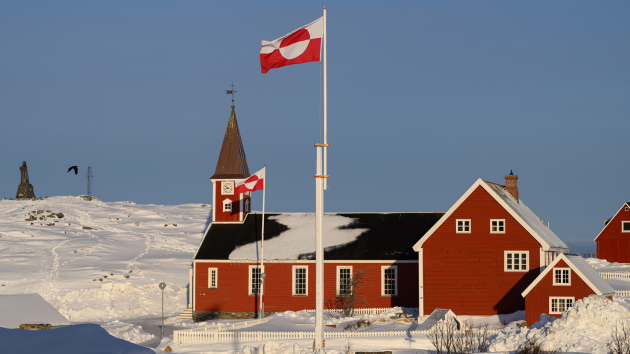
(LONDON) — U.S. officials are expected to meet with Danish and Greenlandic counterparts in Washington, D.C., on Wednesday, amid President Donald Trump’s continued expressions of intent to acquire the semi-autonomous Arctic territory despite collective opposition in both Copenhagen and Nuuk.
Danish Foreign Minister Lars Lokke Rasmussen and Greenlandic Foreign Minister Vivian Motzfeldt are set to lead the delegation to meet with Secretary of State Marco Rubio and Vice President JD Vance. Greenland is a self-governing territory within the Kingdom of Denmark.
In Denmark, “this is the big national news,” Jonas Parello-Plesner, a Danish political analyst and former diplomat, told ABC News. “If in the first Trump period the saying was, ‘You should take him seriously, but not literally,’ I think the saying this time around is, ‘You should both take him seriously and literally.'”
Trump first raised the prospect of acquiring the territory during his first term, when Danish Prime Minister Mette Frederiksen dismissed the idea as “absurd.” Trump’s second term has seen the president speak more aggressively about the proposal.
“Even from a year ago, I see a quite stark difference in both Greenlandic and Danish attitudes that this is actually potentially really serious and life changing for the Kingdom of Denmark,” said Parello-Plesner, who is now the executive director at the Copenhagen-based nonprofit Alliance of Democracies Foundation.
Mikkel Runge Olesen, a senior researcher at the Danish Institute for International Studies, told ABC News that the furor is prompting deeper questions among Danes and Greenlanders about their long-standing ties to the U.S.
“Is this who the U.S. is now? A superpower going around, invading its small democratic allies?” he asked. “That’s scary to think of.”
“Just think of what it will do for the American alliance system worldwide,” he added. “What kind of signal it sends — if you’re allied with the U.S., you may be invaded whenever it suits the U.S.”
‘You need ownership’
Trump has repeatedly suggested that U.S. sovereignty over the world’s largest island is necessary to ensure American security and blunt Chinese and Russian influence in the Arctic region.
As a part of the Kingdom of Denmark, Greenland is covered by NATO’s collective defense clause. Greenland hosts the U.S. Pituffik Space Base and around 150 American troops, the U.S. having significantly downgraded its footprint from its high point during the Cold War.
A 1951 defense agreement grants the U.S. military access to Greenland, and Danish politicians have repeatedly expressed willingness to work with Washington to expand the American and NATO presence there.
Danish officials have also sought to head off concerns about the supposed vulnerability of the Arctic. Last year, Copenhagen announced a $6.5 billion Arctic defense package in response to U.S. criticism that it had failed to adequately protect Greenland.
But Trump and his administration appear undeterred. “One way or the other, we’re going to have Greenland,” the president told reporters aboard Air Force One this weekend.
“If we don’t take Greenland, Russia or China will and I’m not letting that happen,” Trump said, before deriding Denmark’s military strength on the island.
“Basically, their defense is two dog sleds,” Trump said. “In the meantime, you have Russian destroyers and submarines and China destroyers and submarines all over the place.”
Asked if there was a deal to be done to avoid further tensions, Trump said he would “love to” because “it would be easier.”
But when pressed, the president said, “I could put a lot of soldiers there right now if I want. But you need more than that. You need ownership.”
Ahead of this week’s meeting, Danish and Greenlandic politicians issued statements again rebuffing any suggestion of a U.S. acquisition of the island, statements which were backed by other European leaders.
“If the United States decides to attack another NATO country, then everything would stop — that includes NATO and therefore post-World War II security,” Frederiksen said in a statement.
“Greenland is part of the Kingdom of Denmark. Greenland is a member of NATO through the Commonwealth and therefore the defense of Greenland is through NATO,” the government in Nuuk said in a statement.
On Wednesday, Greenlandic Prime Minister Jens-Frederik Nielsen posted a photo to social media showing a message sent to him by Frederiksen.
“Greenland will not be owned by the United States,” the message — written in Greenlandic — said. “Greenland does not want to be ruled by the United States. Greenland does not want to be a part of the United States. We want Greenland to continue to function as part of the Kingdom.”
The leaders of all five political parties holding seats in Greenland’s parliament also released a joint statement. “We do not want to be Americans, we do not want to be Danes, we want to be Greenlanders,” they said.
Before heading to the U.S. on Tuesday, Rasmussen — the Danish foreign minister — told reporters in Copenhagen, “Our reason for seeking the meeting we have now been given was to move this whole discussion, which has not become less tense since we last met, into a meeting room where we can look each other in the eye and talk about these things.”
Appealing to ‘the deal-maker’
Olesen, of the Danish Institute for International Studies, said Trump’s most recent comments “should worry Danish politicians.” His apparent dismissal of Copenhagen’s efforts to bolster its Arctic readiness “means that either he hasn’t noticed” or “he doesn’t care. And either way, it’s pretty bad.”
Trump told The New York Times he believed U.S. ownership of Greenland “is what I feel is psychologically necessary for success.” That, too, is “problematic” for Copenhagen, Olesen said. “How do you deal with that?” he asked.
“That’s the conundrum for the Danish and the Greenlandic politicians,” Olesen said, “trying not to provoke Trump too much and trying to give him something.”
“It will be difficult to offer a compromise if all he wants is ownership,” he added.
Parello-Plesner, the former Danish diplomat, said the experiences of other nations during Trump’s second term may offer models.
Trump’s focus on Panama and perceived Chinese overreach produced a proposed deal for a U.S. firm to take control of two ports there owned by a Hong Kong conglomerate. The president described the deal as “reclaiming the Panama Canal.”
José Raúl Mulino, the president of Panama, addressed Trump’s comments about the Panama Canal in a post on X last March, saying in part: “President Trump is lying again. The Panama Canal is not in the process of being recovered, and this was certainly not a topic of discussion in our conversations with Secretary Rubio or anyone else. On behalf of Panama and all Panamanians, I reject this new affront to the truth and to our dignity as a nation.”
In Ukraine, Kyiv alleviated U.S. pressure by agreeing to a rare earth minerals sharing deal as part of the U.S.-Ukraine Reconstruction Investment Fund.
“There’s also a very pragmatic side to Trump — the deal maker,” Parello-Plesner said. “I think our side needs to give him something to work with,” he added.
That could mean fresh commitments on American military deployments in Greenland, a deal related to the territory’s untapped mineral wealth or a pledge to do more to block autocratic states from asserting their Arctic ambitions, Parello-Plesner said.
It is unclear what might appeal to the U.S. side, he continued. “We’ve seen for 30 years that the U.S. has just wanted to cut down on the presence up there and only uses it for limited missile defense purposes,” he said.
Regarding Greenland’s believed mineral wealth, Parello-Plesner said the U.S. government and private companies have been largely uninterested given the territory’s inhospitable weather and terrain, extraction challenges and global market forces.
A symbolic win might be enough to take the heat out of Trump’s push, Olesen said.
“It’s going to be interesting to see how far Danish and Greenlandic politicians feel they can go in order to avoid being humiliated, in order to avoid handing over the Greenlandic underground to a bully,” Olesen continued.
“But then again, the stakes are so high, so I wouldn’t rule it out, and I wouldn’t rule out that if this is something that could solve the crisis.”
In the meantime, both analysts said Copenhagen and Nuuk are likely to focus on bolstering the image of domestic unity, European solidarity, backing from the U.S. Congress and NATO-led Arctic security.
“The Trump policy line is not invulnerable,” Olesen said, noting pushback from U.S. voters and members of Congress — including prominent Republicans.
“At some point, Trump may decide that it’s not worth the bother anymore, and in that case, it would probably be wise to offer him some way to save face and get out of it,” he said.
But months of back and forth over Greenland have already done significant damage to transatlantic sentiment in Denmark, Parello-Plesner said, in a country he said has long prided itself on broad support for NATO and for close relations with the U.S. Danish forces, for example, sustained a comparable per capita casualty rate as the U.S. in the invasion and occupation of Afghanistan.
That strength of feeling, he said, “has dropped tremendously.”
Copyright © 2026, ABC Audio. All rights reserved.