

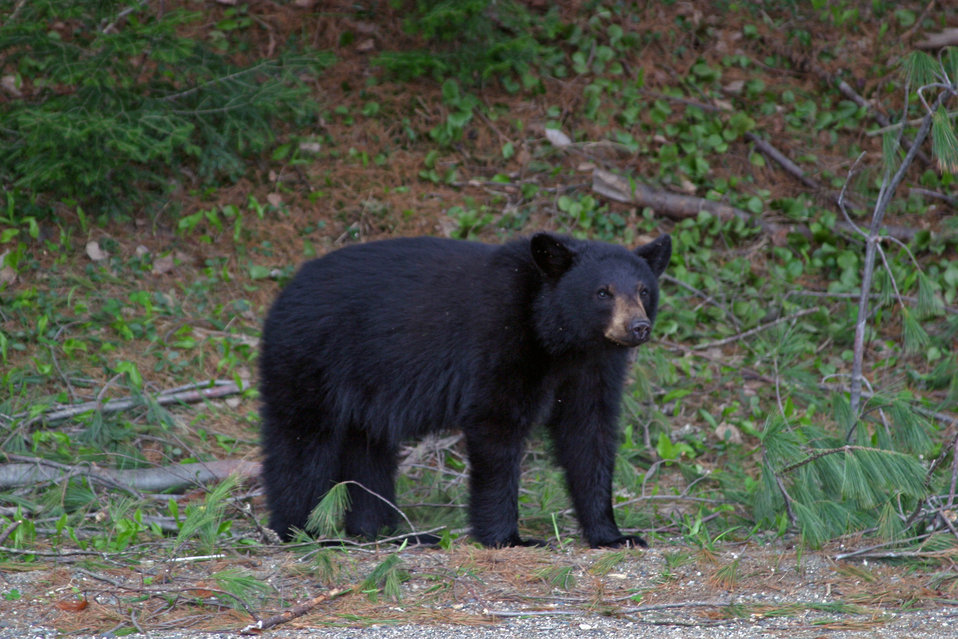
CENTRE– Several black bear sightings were reported over the weekend in Centre and other parts of Cherokee County.
Residents reported seeing bears around Hood Street, Hazle Street, and Hardwood Drive in Centre. Another sighting occurred in the Tates Chapel area of Cherokee County.
Recent sightings have also been reported in Etowah and Calhoun counties, including around Jacksonville State University. The Jacksonville Alabama Police Department recently shared a photograph of a black bear along the Chief Ladiga Trail.
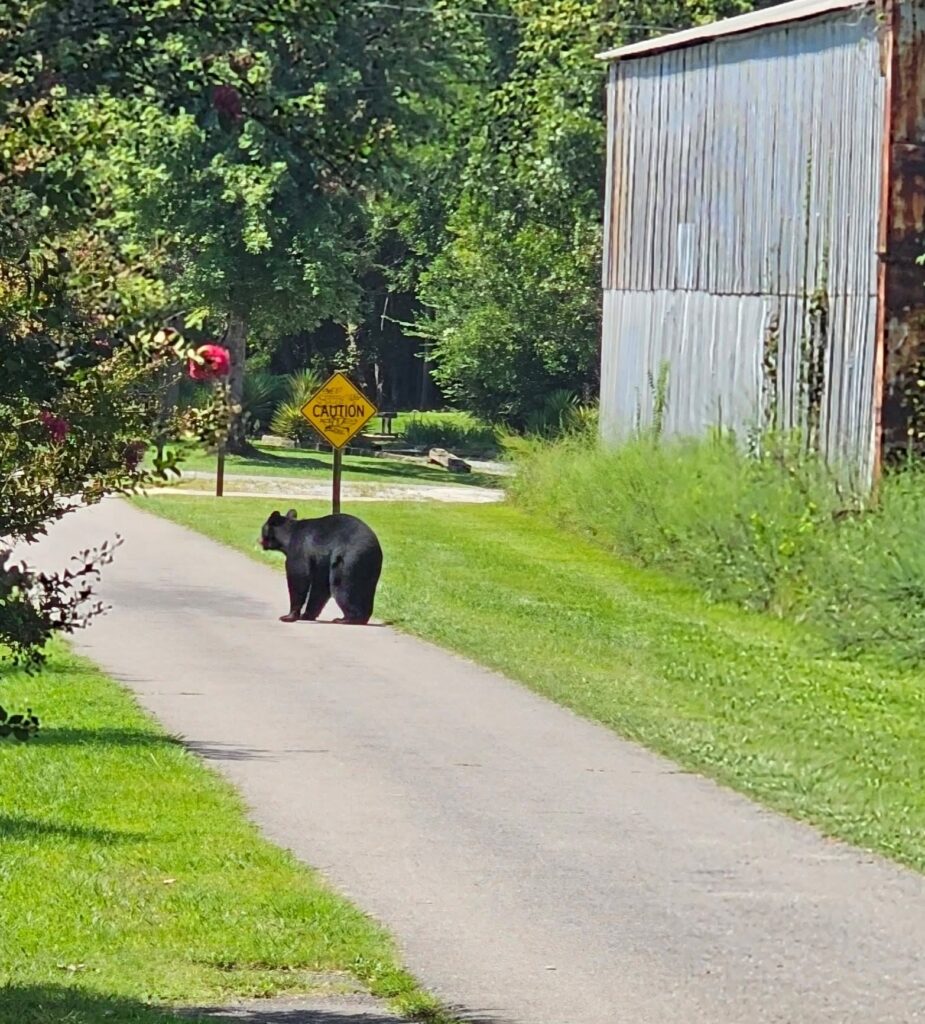
The reports continue a pattern previously documented by WEIS as black bear populations expand across northeast Alabama and northwest Georgia.
State wildlife officials say residents should remain calm when they see a bear. A sighting does not necessarily mean the animal is aggressive or that it plans to remain in the area.
Why Black Bears Are Appearing in Northeast Alabama
The Alabama Department of Conservation and Natural Resources says black bears historically occurred across much of the state. However, hunting and habitat loss sharply reduced their numbers.
Alabama now has two primary black bear populations. One remains in southwest Alabama, particularly around Mobile, Washington, and Clarke counties.
A second population has expanded naturally into northeast Alabama from northwest Georgia. Bears from that population have become established primarily in DeKalb, Cherokee, and Etowah counties.
The state has also documented a small breeding population around the Talladega National Forest in Calhoun and Cleburne counties. Wildlife officials have received occasional reports from many other parts of Alabama.
The northeast Alabama population is small but viable. Continued sightings in Cherokee, Etowah, Calhoun, and surrounding counties are consistent with the population’s expanding range.
Black bear sightings are especially common during spring and summer. Adult males travel farther while searching for mates, while young males leave their mothers and look for new territory.
That movement can bring bears through neighborhoods, farms, college campuses, and other populated areas. In many cases, a bear is simply passing between wooded habitats.
Wildlife officials say a bear will usually continue moving if it cannot find an easy food source.
Black Bear Facts
The American black bear, scientifically known as Ursus americanus, is Alabama’s official state mammal.
According to the Alabama Cooperative Extension System, black bears are opportunistic omnivores. They eat whatever suitable food is readily available.
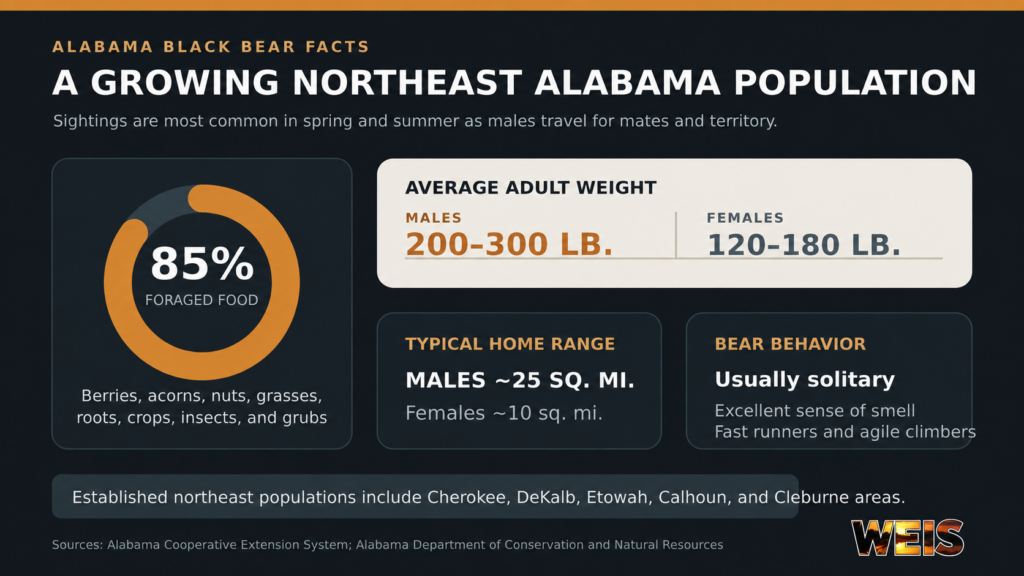
About 85% of their diet consists of foraged food. Common foods include berries, acorns, nuts, grasses, roots, crops, insects, and grubs.
Bears may also eat small mammals, fish, carrion, and other animal matter. However, they generally prefer food that requires less energy than hunting.
Their powerful sense of smell can draw them toward garbage, pet food, birdseed, livestock feed, beehives, compost, fruit trees, and residue on outdoor grills.
Adult male black bears generally average between 200 and 300 pounds. Females typically weigh between 120 and 180 pounds.
Males also maintain larger home ranges. A male may regularly move through approximately 25 square miles, while a female’s home range may cover about 10 square miles.
Black bears are usually solitary. Females and cubs remain together, and bears may briefly gather during breeding season or around concentrated food sources.
Breeding normally occurs during June and July. Females give birth while denning in late January or February.
Cubs usually remain with their mother for about 18 months. Young males often travel long distances after leaving, which helps explain summer sightings outside established bear habitat.
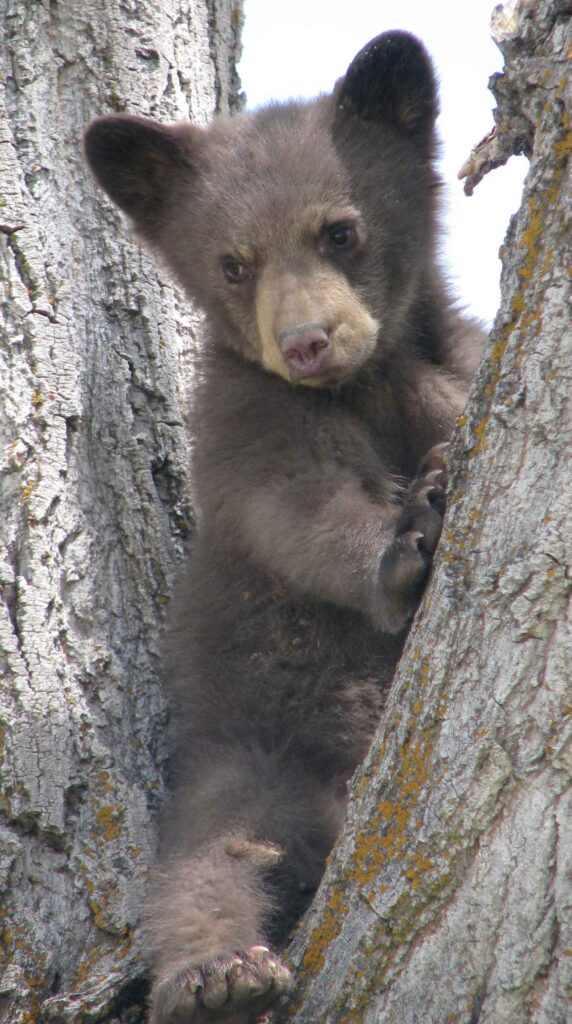
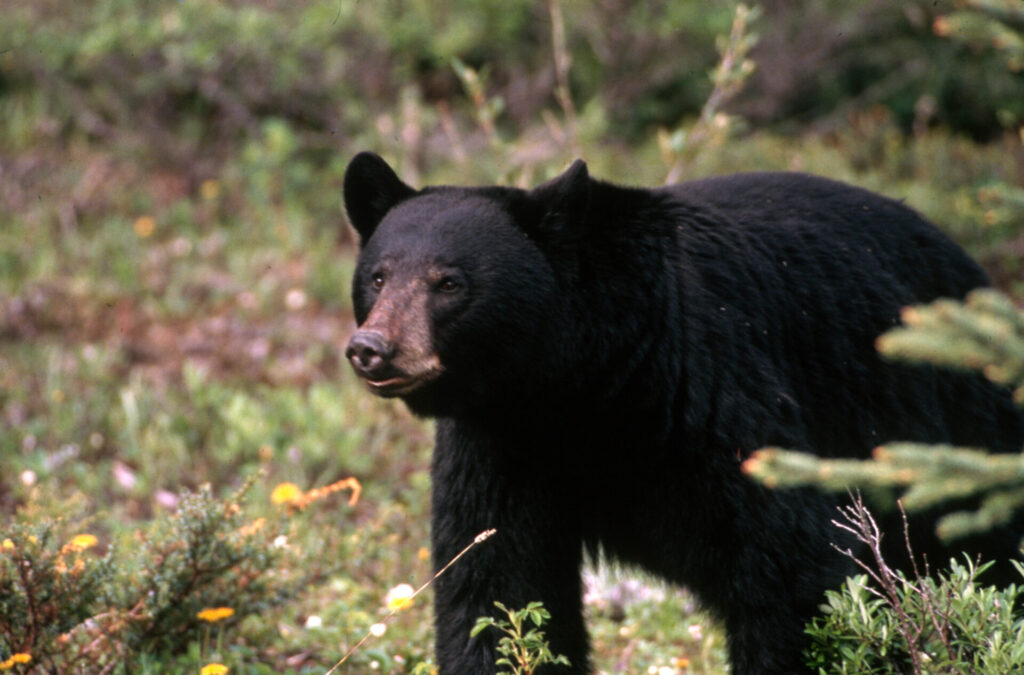
Despite their name, black bears are not always completely black. Their coats can range from black to brown, although color variations are less common in the eastern United States.
Black bears can run faster than 30 mph for short distances. They are also agile climbers with an exceptionally strong sense of smell.
What To Do If You See a Black Bear
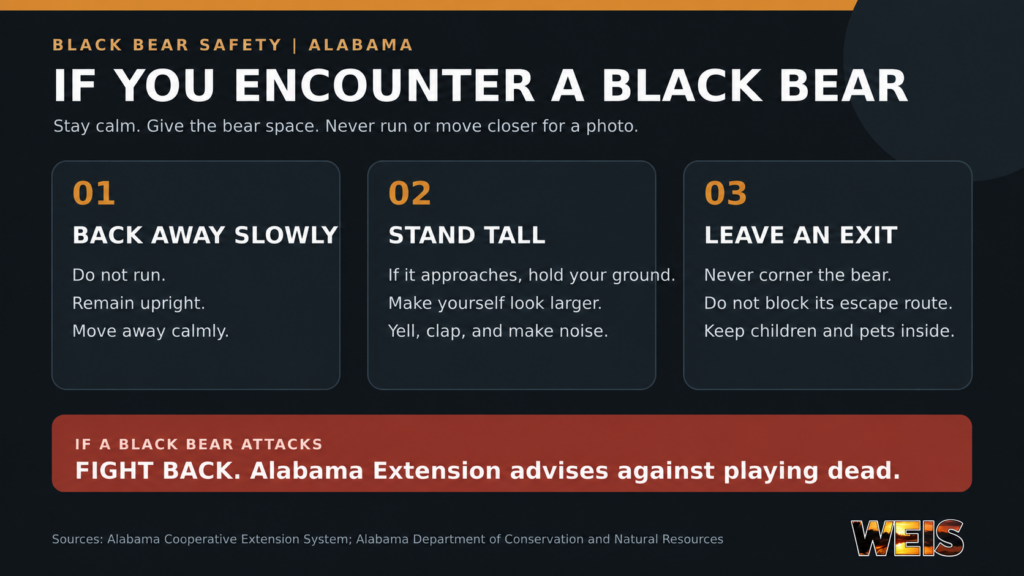
A person who sees a bear from a distance should remain calm and avoid approaching it.
Never move closer for a photograph or video. Do not attempt to follow the bear in a vehicle or on foot.
If the bear has not noticed you, quietly leave the area. Keep plenty of distance between yourself and the animal.
If the bear sees you, do not run. Running can trigger a chase response, and a person cannot outrun a black bear.
Instead, slowly back away while facing the bear. Remain upright, avoid direct eye contact, and give the animal a clear route to escape.
Do not surround or corner the bear. An animal that feels trapped is more likely to react defensively.
If the bear approaches, stand your ground. Make yourself appear larger by standing tall and taking a wide stance.
Use a firm voice, yell, clap your hands, and make other loud noises. The goal is to convince the bear to leave while avoiding any action that blocks its escape.
If several people are together, they should remain together instead of separating or running in different directions.
What To Do If a Bear Enters Your Yard
Keep your distance and move children and pets indoors.
Do not walk outside to investigate, take pictures, or chase the animal. Never allow a dog to pursue or corner a bear.
From a secure location and a safe distance, loud noises may encourage the bear to leave. Make certain the animal has an unobstructed escape route.
After the bear leaves, check the property for anything that may have attracted it.
A bear that repeatedly visits the same home or neighborhood has often found a dependable food source. Removing that food source is the most effective way to prevent future visits.
If a Black Bear Attacks
Black bears normally avoid people, and attacks are uncommon. However, residents should know how to respond during a dangerous encounter.
If a black bear makes physical contact or attacks, Alabama Extension advises fighting back rather than playing dead.
Use bear spray or any available deterrent. Fight aggressively with sticks, rocks, or other objects until the animal leaves.
Anyone facing an immediate threat should call 911 as soon as it is safe to do so.
Never Feed a Bear
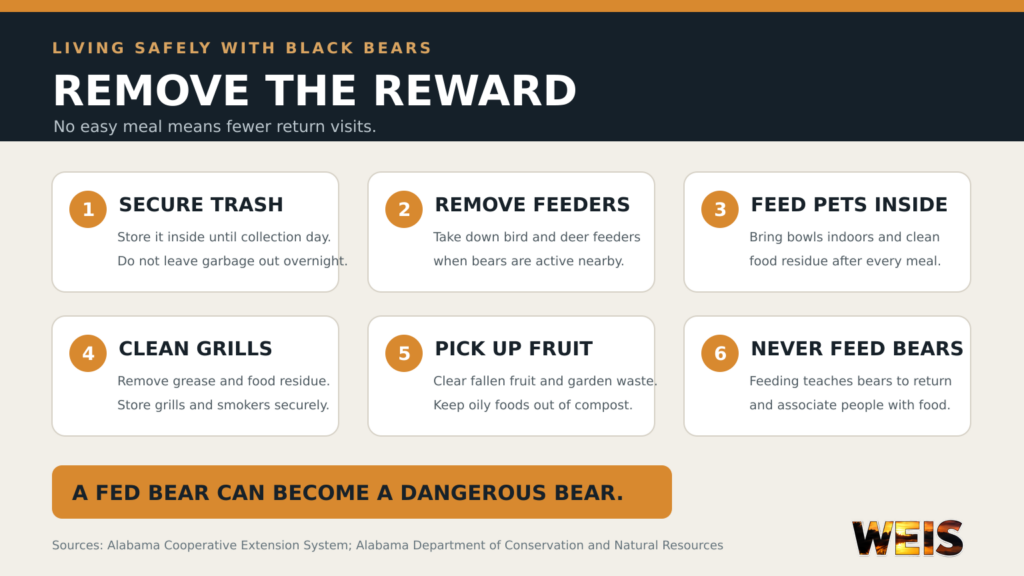
People should never intentionally feed a black bear. Unintentional feeding can be just as dangerous.
A bear that finds food around homes may return repeatedly. It can also lose its natural fear of people and begin associating humans with food.
Food-conditioned bears may damage property, approach people, or become aggressive. Wildlife officials may eventually have to remove or euthanize a bear that becomes a public-safety threat.
Residents in areas with bear activity should:
- Keep household garbage inside a secure building until collection day.
- Use bear-resistant garbage containers when possible.
- Do not leave garbage outside overnight.
- Remove bird and deer feeders when bears are active.
- Feed pets indoors and remove outdoor food bowls.
- Clean grease and food residue from grills and smokers.
- Store grills and smokers inside a garage or shed.
- Pick up fallen fruit around trees and gardens.
- Avoid placing meat, dairy products, or oily food in outdoor compost piles.
- Secure livestock feed, chicken feed, beehives, and other attractants.
- Clean food spills and outdoor eating areas promptly.
Even an empty pet bowl or grill can retain enough odor to attract a bear.
Black Bears Are Protected in Alabama
Black bears are classified as a game species in Alabama, but the state has no open black bear hunting season.
Alabama law prohibits hunting, wounding, injuring, killing, trapping, collecting, or capturing a black bear during the closed season.
Residents should not shoot at a bear merely because it enters a yard or crosses private property.
Violations can result in fines, loss of hunting privileges, and possible jail time.
How To Report a Bear Sighting
Residents can submit sightings through the state’s official Black Bear Observation Reporting system.
Reports help state wildlife biologists document bear movement, population expansion, and the locations where people and bears may come into contact.
Residents should provide the location, date, time, and other requested information as accurately as possible. Photographs can be helpful, but no one should approach a bear to obtain one.
Cherokee, Etowah, and Calhoun counties are served by the Wildlife and Freshwater Fisheries Division’s District II office in Jacksonville. The office can be reached at 256-435-1642.
Residents should contact wildlife officials if a bear repeatedly returns, damages property, appears conditioned to human food, or creates an ongoing safety concern.
A bear simply traveling through an area will generally leave on its own. The safest response is to keep a respectful distance, remove anything that may attract it, and allow the animal a clear path back into the wild.



You must be logged in to post a comment.