

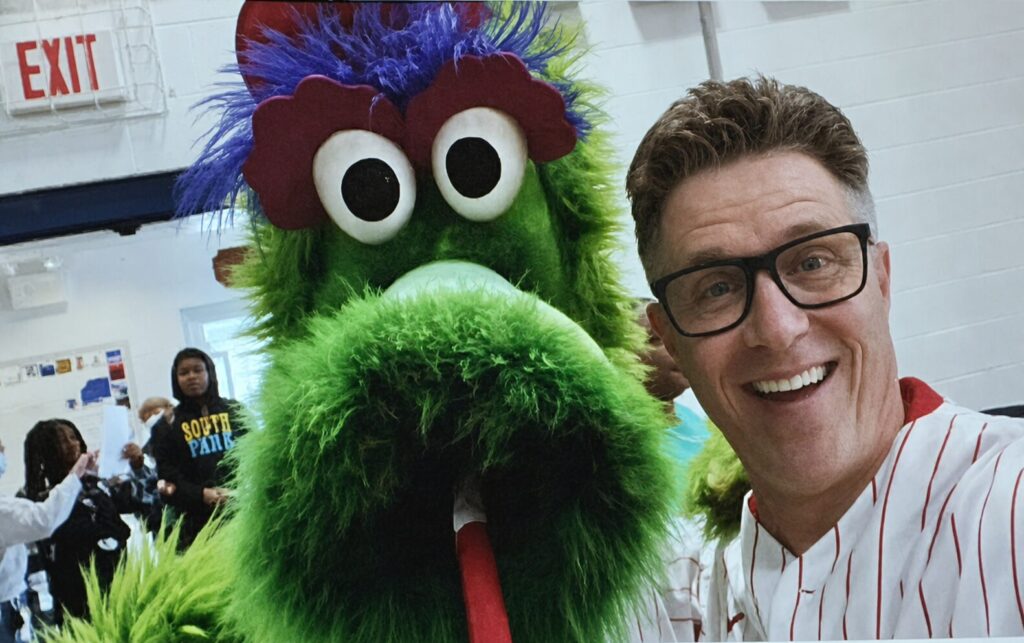
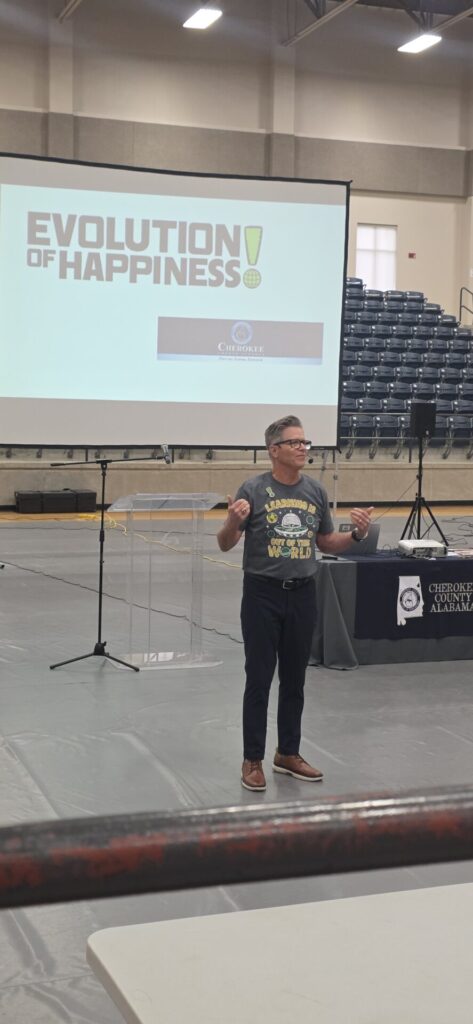
CENTRE– Original Phillie Phanatic performer Dave Raymond brought his “Power of Fun” message to Cherokee County educators Tuesday as they prepared for a new school year.
The annual Cherokee County Schools Teacher Institute brought teachers, administrators and support employees together at Richard Lindsey Arena on the Gadsden State Cherokee campus.
The program focused on school safety, community support and the ability of educators to bring hope, happiness and stability into students’ lives.
Superintendent Michael L. Welsh opened the institute by welcoming employees back from summer break. He said he hoped they returned with excitement for the coming school year.
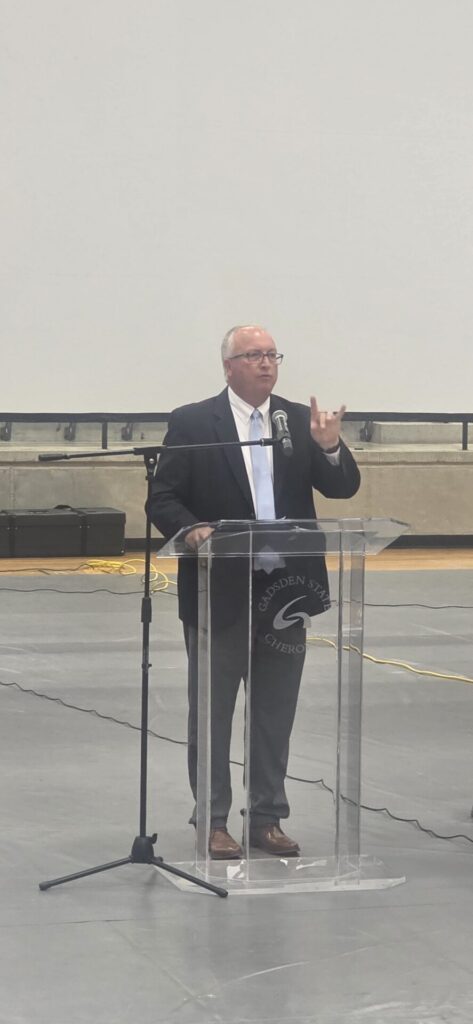
Welsh thanked Gadsden State Community College and the Cherokee County Chamber of Commerce for supporting the institute. He also recognized Gadsden State President Alan Smith, Chamber Executive Director Joy Perry and others who helped organize the event.
Welsh told employees that the energy and enthusiasm they bring to school will help set the tone for students.
He then asked the system’s new employees to stand and be recognized.
“We are very happy to have you as a part of Cherokee County Schools,” Welsh told them.
Teachers Praised for Their Influence
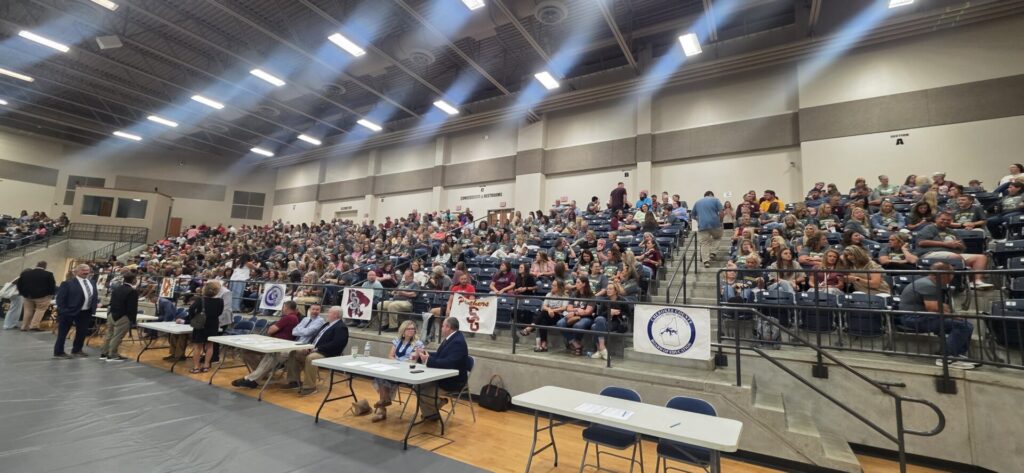
Cherokee County Probate Judge Tim Burgess delivered the invocation. Before the prayer, Burgess praised the county’s educators and spoke about the influence teachers have on children and their families.
Burgess described teaching as a gift and a noble calling. He said educators often see circumstances inside the school system that people outside education may never fully understand.
He also called Cherokee County’s educators some of the best teachers in Alabama.
During the invocation, Burgess prayed for teachers, students, schools, administrators and members of the Cherokee County Board of Education. He asked for patience, wisdom, understanding, strength and rest for those working throughout the system.
Burgess also prayed for school resource officers and the safety of everyone entering the county’s schools during the coming year.
School Resource Officers Emphasize Safety
Lt. Jordan Kelley, supervisor of the Cherokee County Sheriff’s Office School Resource Officer Unit, led the Pledge of Allegiance. He then addressed employees on behalf of the Sheriff’s Office.
Kelley said the county’s school resource officers remain committed to protecting students, teachers and staff members. Officers spent part of the summer completing additional training before the opening of school.
He encouraged teachers to contact an officer whenever they see or hear something that causes concern. Early communication can allow officers and school officials to address a potential problem before it becomes more serious.
The Sheriff’s Office established its full-time SRO Unit in 2019 through a partnership with the Cherokee County Commission and Board of Education. The program’s goal was to place a full-time officer in each of the county’s eight schools.
The National Association of School Resource Officers recently selected the Sheriff’s Office as a 2026 Model SRO Agency. Cherokee County and Vestavia Hills were the only two Alabama agencies to receive the national award this year.
The NASRO recognition honors agencies that meet professional standards for training, policies and school-based policing.
The organization’s model calls on school resource officers to serve in three roles: law-enforcement officer, public-safety educator and informal counselor or mentor.
Kelley also serves as secretary of NASRO and as an instructor for the national organization.
He thanked the county’s school resource officers for their work and welcomed teachers back for another year.
Approximately $57,000 Expected for Classroom Grants
State Sen. Andrew Jones welcomed educators and thanked them for serving Cherokee County students.
Jones said teachers often fill several important roles in a child’s life. In addition to providing instruction, they may become mentors, trusted advisers and another source of parental guidance.
He told educators that it is an honor to represent them in Montgomery and return state tax dollars to the local school system.
Jones announced that approximately $57,000 is expected to become available through classroom teacher grants. He encouraged teachers to watch for application information.
According to Jones, educators will have an opportunity to apply for funding for classroom needs. Any money remaining after those grants are awarded will be divided among the county’s schools for special projects.
Stephen Ingram, Cherokee County Schools’ secondary curriculum and student assessment supervisor, recognized the businesses and organizations that supported the institute.
Ingram thanked teachers for the difference they make in students’ lives each day. He also encouraged employees to reach out to the central office if they need help during the year.
Following the main program, teachers were scheduled to divide into four smaller professional-development sessions.
Original Phillie Phanatic Delivers Keynote Address
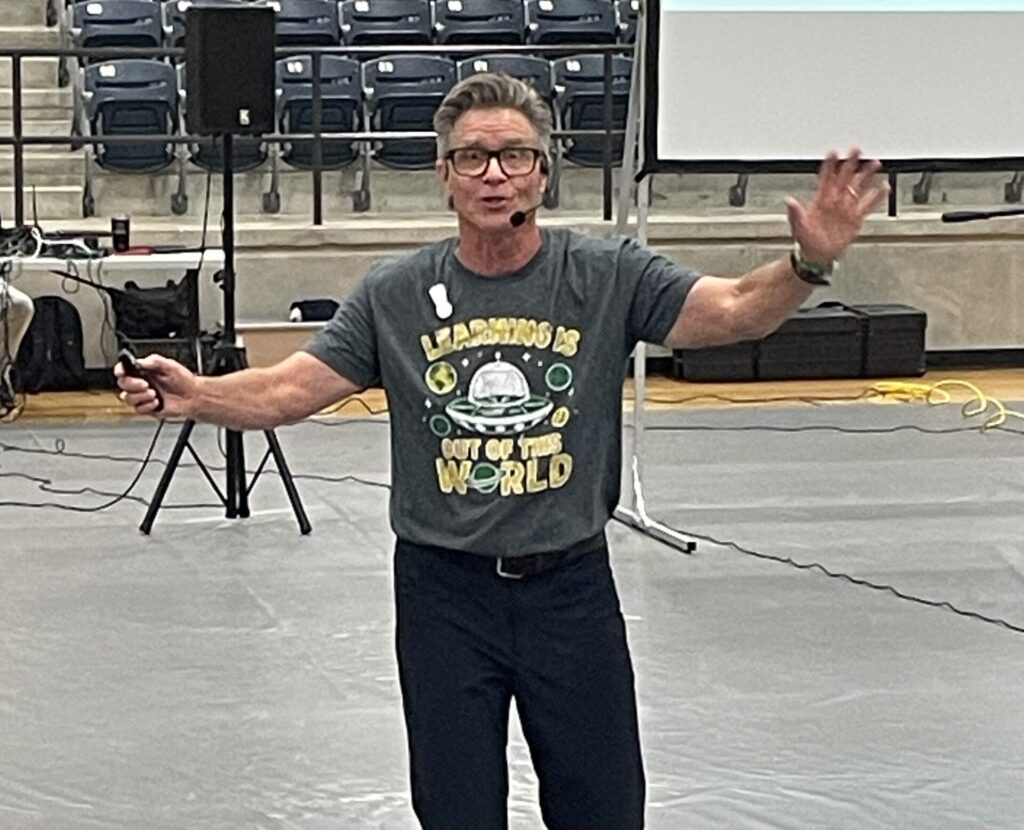
Welsh introduced keynote speaker Dave Raymond, the original performer inside the Phillie Phanatic costume.
Raymond portrayed the Philadelphia Phillies mascot for 16 seasons, beginning with the character’s debut on April 25, 1978. He remained in the role through the 1993 season.
After leaving the costume, Raymond founded a business specializing in mascot development, character branding and performer training. He also became an author, consultant and motivational speaker.
His keynote program, “The Power of Fun,” uses stories from his career to explain how humor, positive relationships and intentional activities can improve morale and help people face difficult circumstances.
Raymond opened with a few references intended to connect with the audience. He predicted success for the Atlanta Braves and offered both “Roll Tide” and “War Eagle” greetings before moving into the central message of his presentation.
Educators Asked to Revisit a Moment of Joy
Raymond began by leading employees through a quiet breathing and reflection exercise.
He asked everyone to close their eyes, take a deep breath and revisit a joyful moment from their lives. For about one minute, the arena became quiet as teachers focused on a personal memory.
Raymond said intentionally returning to a positive memory can affect the brain and improve a person’s mood.
He then asked employees to imagine that they no longer worked for the school system. Instead, he said, they would come to work for him with one primary responsibility: simply showing up.
When they entered a room, he said, other people would feel better because they were there.
“Your presence lifts them up,” Raymond said.
He described that ability as a superpower educators can carry into their classrooms.
Raymond then showed a video of his years as the Phanatic. The highlights included crowd interactions, four-wheeler rides, physical comedy and other stunts that helped make the mascot one of the most recognizable characters in professional sports.
The Phanatic marked its 48th anniversary in 2026.
Raymond joked that his job required him to be as silly as possible. However, he said the work also taught him serious lessons about happiness, communication and human connection.
An Unexpected Career Inside a Green Costume
Raymond said he grew up wanting to follow his father, Tubby Raymond, into coaching. Tubby Raymond became a Hall of Fame football coach at the University of Delaware and won 300 games during his career.
Dave Raymond initially considered becoming a physical education teacher or coach. However, his father helped him obtain an internship with the Philadelphia Phillies.
He recalled receiving advice to complete any job the organization gave him because he could not know whom he might meet or where the opportunity could lead.
Raymond began working for the Phillies in 1976. Later, former Phillies executive Bill Giles invited him to return and sent him to New York to be fitted for a new mascot costume.
The assignment eventually placed Raymond inside the Phillie Phanatic.
He admitted that Philadelphia sports fans’ reputation made him nervous. Raymond referenced the well-known incident in which fans threw snowballs at Santa Claus and joked that they might set the new mascot on fire.
However, Raymond said the organization gave him one central instruction: Go out and have fun. If the person inside the costume did not enjoy the performance, the audience would recognize it.
Raymond said he gradually learned that positive energy could work in almost any setting.
Force, Universal and No
Raymond used the letters in “fun” to explain part of his message.
The “F” represents force. Raymond described fun as a force that can affect emotions, relationships and the atmosphere inside a room.
The “U” stands for universal. He said fun could work with sports fans, children, business leaders, celebrities and people experiencing some of life’s most painful moments.
“Fun works everywhere,” Raymond said. “Fun is universal.”
The “N” stands for no. Raymond said resistance often comes from people who do not understand an unfamiliar idea. He encouraged educators to adapt positive activities to their environment without immediately abandoning them when someone objects.
He distinguished intentional fun from disorder or a lack of structure. The goal, he said, is to create positive connections that help people become more receptive, engaged and resilient.
Hospital Visits Demonstrated the Power of Joy
Raymond recalled visiting hospitals while wearing the Phanatic costume.
He sometimes entered rooms where patients and families were facing tragedy. The atmosphere could quickly change when the mascot appeared.
For a few moments, fear and sadness gave way to smiles, laughter and excitement.
Families sometimes thanked Raymond for giving them that temporary relief. Those experiences convinced him that happiness and humor could act as a form of emotional medicine.
He said fun cannot remove the harsh realities of life. However, it can help people find the strength and purpose needed to face those realities.
Raymond also shared a video about an orphaned child from Savannah who received toys and chose to give them to other people. The child wanted to make people smile because he had grown tired of seeing people feel sad.
Raymond said the child’s decision to create joy for others also helped the child find healing and purpose.
He encouraged teachers to remember that a difficult student may be carrying pain that is not immediately visible. A positive connection could help that student begin moving in a better direction.
‘Tell Me Something Good’
Raymond involved educators in several exercises during the presentation.
At one point, he selected members of the audience and asked them to stand. He then gave them a simple prompt: “Tell me something good.”
Answers included God, a granddaughter’s fifth birthday and a spouse.
Raymond noted that participants needed different amounts of time to identify something positive. He said the human mind can become accustomed to searching for threats, problems and negative information.
People may need to intentionally interrupt that pattern before focusing on something good.
Raymond then gave everyone two minutes to share something positive with the people seated around them.
The arena filled with conversations, smiles and laughter.
Afterward, Raymond asked whether the activity had lifted the audience’s mood.
He suggested that teachers create a “Tell Me Something Good” board in their classrooms. Students could add positive thoughts or experiences when they arrive at school.
The exercise could help start the day with a positive focus. It could also allow teachers to learn more about their students’ lives.
Happiness Requires Intentional Activity
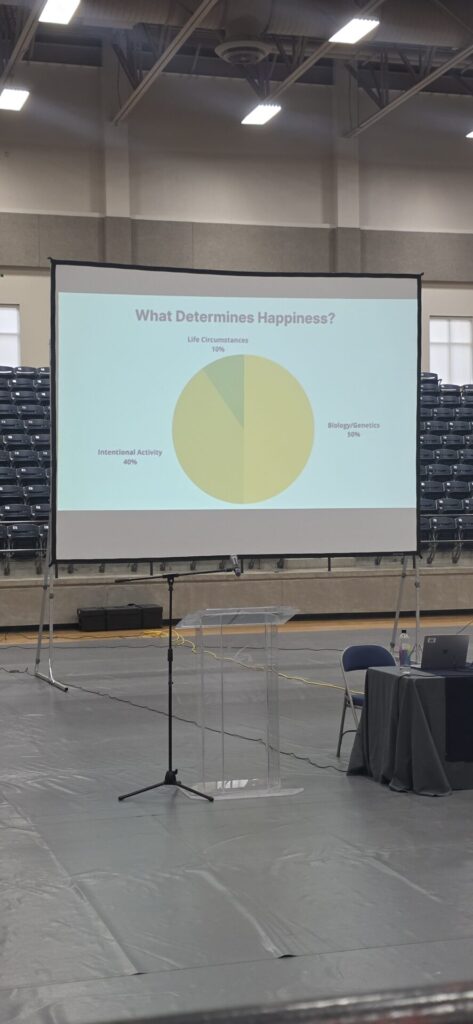
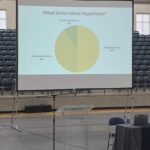
Raymond displayed information describing several factors that influence happiness.
He said biology and genetics can affect a person’s natural emotional outlook. Life circumstances also play a role. However, intentional activities give people an area where they can make meaningful choices.
Raymond emphasized that major life events may create strong emotional changes. Over time, however, people often move back toward their usual emotional state.
Therefore, people should treat happiness as a skill that requires practice.
He encouraged educators to slow their negative mental responses and intentionally decide how they want to approach the day.
“You have to decide to be happy,” Raymond said.
Raymond also discussed meditation. He said the practice does not need to be complicated or consume a large part of the day.
Instead, a person can sit quietly, close their eyes, pay attention and remain present for a short period.
Other recommendations included getting adequate sleep, keeping bedrooms dark and cool, reducing screen use before bedtime, showing kindness and expressing gratitude.
He also encouraged teachers to practice smiling, even when they do not initially feel happy. That physical action, he said, can help change a person’s emotional response.
Personal Loss Changed Raymond’s Message
Raymond said many of his lessons about resilience came from his mother.
After she suddenly became deaf, she refused to allow the condition to end her involvement in life. She eventually became a certified interpreter.
Because she could no longer hear him, Raymond learned to stand where she could see him and communicate through movement and facial expressions.
He said those skills later helped him create the physical personality of the Phanatic. The character communicated entirely without spoken words.
Raymond credited his mother with helping him develop a character that eventually brought happiness to people around the world.
However, when his mother was 59, doctors diagnosed her with a brain tumor. Raymond said physicians told the family that surgery was not possible and that she had about eight months to live.
She died almost eight months later.
Raymond described that loss as part of the “brutality of life.” He also remembered his mother telling him to take care of his family.
During another difficult period, Raymond believed he might no longer be capable of performing as the Phanatic. The Phillies worked with him and encouraged him to continue.
He found that putting on the costume and creating happiness for other people temporarily pulled him away from his grief.
The appreciation he received from fans helped him move from hopelessness toward recovery. Raymond began asking the Phillies to schedule more appearances.
Days became weeks, weeks became months and months became years. Those experiences eventually led to his current mission of teaching others about happiness and fun.
Prepare, Pause and Post
Raymond offered educators a daily practice built around three words: prepare, pause and post.
First, they should prepare themselves for the day ahead.
Next, they should pause during the day and reflect on what is happening.
Finally, they should post, or write down, their thoughts and experiences at the end of the day.
Raymond encouraged educators to work on their happiness every day instead of waiting for happiness to happen on its own.
He also urged them to reach out to people who may not be doing well. A call, message or simple statement that someone is thinking about them can make a difference.
Another part of his message focused on acting instead of reacting.
Raymond encouraged teachers to choose how they want to live and respond rather than allowing every difficult event to control their behavior.
He acknowledged that classrooms can present serious challenges. However, those challenges can help educators develop the patience, strength and character needed to serve their students.
Raymond closed by asking employees to consider how happy they want to be and whether they will make intentional choices to move in that direction.
He reminded them that their work gives them an opportunity to educate, encourage and influence children every day.
For Raymond, making the world better can begin with something as simple as one person giving another person a reason to smile.
RELATED ARTICLES:
Back-to-School Dates Set Across WEIS Listening Area as Buses Return to Roads








You must be logged in to post a comment.