

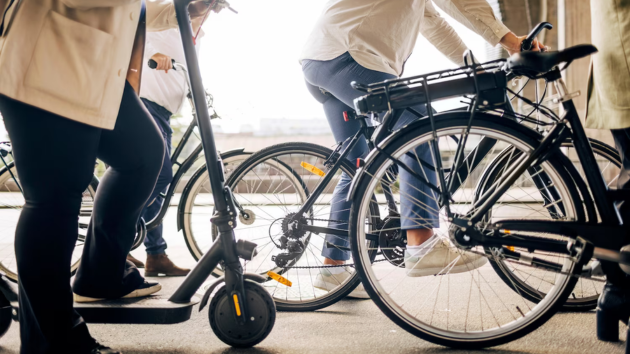
(NEW YORK) — E-bikes and e-scooters led to a growing number of trauma injuries at one New York City hospital, according to a new study published Wednesday.
About 7% of all trauma visits between 2018 and 2023 at Bellevue Hospital Center were due to micromobility injuries. Micromobility is the use of small, lightweight and low-speed modes of transportation such as bicycles, e-bikes and e-scooters.
The study showed a growing share of patients who sustained these injuries had accidents linked to e-bikes or e-scooters.
Hospital data showed that, by 2023, over half of all trauma cases related to bikes or scooters involved an e-bike or e-scooter, an increase from just 8% in 2018, according to the study, published in the journal Neurosurgery.
The most common type of mechanism involved a collision with a motor vehicle followed by falls from the bike or scooter.
Bellevue is a Level 1 Trauma center in a large metropolitan city, designed to treat the worst kinds of injuries. Over the study period, about 30% of patients suffered a traumatic brain injury, 26% had injury to the skull or face and 50% required surgery.
“Our study shows that micromobility injuries are producing serious brain and spinal trauma that demands neurosurgical care at a scale we haven’t seen before,” corresponding study author Dr. Hannah Weiss, a resident in the Department of Neurosurgery at NYU Grossman School of Medicine, said in a press release. “In a busy urban setting, we are seeing more and more of these injuries firsthand.”
Most patients seen for these injuries, nearly 69%, needed to be admitted to the hospital and nearly a third needed intensive care.
The majority of patients stayed at least three days in the hospital. Pedestrians who were struck had higher rates of traumatic brain injuries and were more likely to be admitted for intensive care.
“The data point to actionable solutions — helmet use, safer bike lane design and enforcement — that could prevent many of these injuries and better protect both riders and pedestrians, who in our study often sustained even more severe brain injuries than the riders themselves,” Weiss said.
About 20% of patients were intoxicated with alcohol, only 31% were using a helmet and injuries were more likely to occur in the evening hours, according to the study.
“Our findings make clear that urban infrastructure must continue to improve to keep pace with the rapid rise of electric bikes and scooters,” Dr. Paul P. Huang, an associate professor in the department of neurosurgery at NYU Grossman School of Medicine and chief of neurosurgery at NYC Health + Hospitals/Bellevue, said in a press release.
“Future studies should track these injuries across multiple cities and measure whether protected bike lanes, helmet programs, and speed enforcement actually reduce the number of brain and spine surgeries we perform,” Huang added,
Jade A. Cobern, MD, MPH, is a practicing physician, board-certified in pediatrics and general preventive medicine, and is a fellow of the ABC News Medical Unit.
Copyright © 2026, ABC Audio. All rights reserved.