

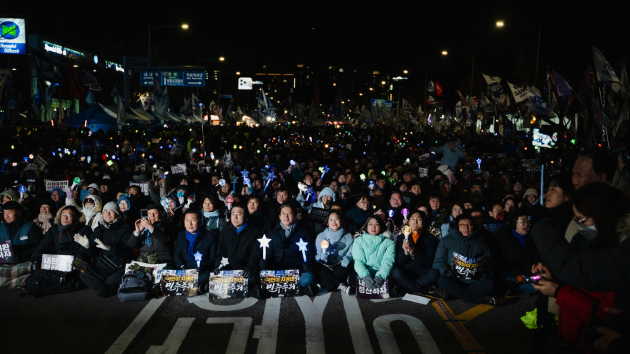
(SEOUL) — Thousands of South Koreans rallied outside the National Assembly on Wednesday, marking one year since former President Yoon Suk-yeol declared martial law — a short-lived, failed attempt that citizens and parliament quickly overturned.
The demonstration was organized to commemorate the public resistance that helped reverse the move and to address the aftermath of what officials now call an insurrection.
As K-pop blasted through speakers, attendees held light sticks and chanted, “Reckon with insurrection!” Police estimated about 11,000 people attended the rally, hosted by progressive civic groups.
“It was the first time in the 21st century that a coup occurred in a democratic country like South Korea. Equally unprecedented, unarmed citizens peacefully prevented it,” President Lee Jae Myung said in a speech marking the anniversary. “Ironically, the Dec. 3 coup became an opportunity to show the world the high civic consciousness of our people and the resilience of South Korea’s democracy.”
Lee referred to the movement as a “revolution of light” powered by “K-democracy,” a phrase his administration has embraced to describe what it views as a uniquely resilient democratic tradition rooted in past movements, including the 1980 Gwangju Uprising.
Across the political spectrum, lawmakers marked the anniversary, with the supermajority Democratic Party celebrating by advancing dozens of bills related to the failed martial law attempt, including legislation that would designate Dec. 3 as Democracy Movement Memorial Day.
At the National Assembly complex — the site where troops attempted to enforce martial law — Speaker Woo Won-shik, who led the motions to repeal the order and impeach Yoon last year, led a “dark tour” highlighting key locations from the night, including the lawn where troops landed and a wall he had climbed to enter the building.
Meanwhile, the conservative People Power Party issued a series of apologies, with party leader Song Eon-seog apologizing on behalf of 107 lawmakers who either supported or did not participate in last year’s impeachment proceedings.
The party initially boycotted the first impeachment vote, blocking the measure, but a second vote passed a week later with more than two-thirds support. In total, 25 first- and second-term lawmakers issued their own statement pledging to sever ties with Yoon.
“Yoon’s failed martial law attempt shows how erratic leadership can throw a country into turmoil,” Jungkun Seo, a professor at Seoul’s Kyung Hee University, told ABC News. “But parliament lifted martial law, Yoon was detained, tried, impeached, and the country elected a new president — all in only six months. This demonstrated to the international community that South Korea’s democracy is rock solid.”
Lee, who was leader of the opposition at the time, said he livestreamed from the National Assembly grounds on the night martial law was declared because he believed citizens were the only force capable of stopping the coup.
Thousands gathered outside the building demanding the repeal of martial law, and peaceful candlelight protests continued until Yoon’s impeachment passed.
Copyright © 2025, ABC Audio. All rights reserved.