

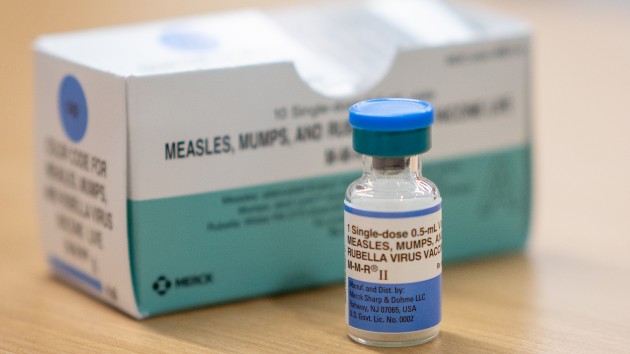
The United States on Tuesday officially lost its measles elimination status, according to the Pan American Health Organization, which is responsible for the decision.
Measles elimination was first declared in the United States in 2000, meaning the virus had stopped spreading continuously. That status is lost when the same strain circulates for 12 months or more.
“Losing measles elimination status is an historic public health setback,” said Dr. John Brownstein, an epidemiologist and ABC News medical contributor. “We spent decades building the vaccination coverage and public health infrastructure needed to stop this virus from spreading continuously in the United States. To see that progress reversed is a stark reminder that these achievements are not permanent and cannot be taken for granted.”
The decision from PAHO, which is part of the World Health Organization, comes as the past two years have seen a notable increase in measles cases across the United States. While the U.S. used to average 180 cases a year, mainly driven by imported cases from abroad, there have been several home-grown outbreaks, including in Texas, Utah, South Carolina and Pennsylvania.
The Centers for Disease Control and Prevention said it is committed to regaining a measles elimination status.
“The measles elimination designation is not what protects Americans. Vaccination does. We know where transmission is occurring and we’ve invested $100 million in state and local health departments to reach those communities,” CDC Director Dr. Erica Schwartz said in a statement. “Losing a designation doesn’t mean we abandon an evidence-based approach. It means we remain focused on stopping outbreaks.”
There have been a total of 5,412 infections reported this year in nearly every state, the latest CDC data shows. State health departments have reported 10 deaths. In 2024 there were under 300 cases.
There have been 48 outbreaks identified in the U.S. in 2026 with large ongoing numbers of cases in Pennsylvania, Wisconsin, Minnesota and Indiana. New York State issued a state of emergency. There were significant sustained outbreaks in South Carolina, Utah and Arizona last year.
“This isn’t just about losing a designation,” Brownstein said. “It means more outbreaks, more hospitalizations, more preventable deaths and greater strain on already stretched public health departments.”
In part of a statement, the Department of Health and Human Services said they “will continue working to stop transmission, close vaccination gaps, strengthen outbreak response, and protect Americans from measles. Secretary Kennedy and CDC Director Dr. Erica Schwartz continue to recommend MMR vaccination as the most effective way to prevent measles.”
Various medical organizations have criticized Kennedy for his prior statements on vaccines, which they say were not rooted in science, including his decision to unilaterally reduce the numbers of recommended childhood vaccines last year. At the time, groups like the American Academy of Pediatrics criticized the move, saying “our immunization system has long been a cornerstone of U.S. public health, but actions by the current administration are jeopardizing its success.”
Many public health experts point to declining vaccination rates as the key culprit for the growing number of cases and outbreaks. CDC numbers show that back in the 2019-2020 school year, 95% of kindergarteners had the MMR vaccine, which dropped to 92% in the 2025-2026 school year. It leaves nearly 300,000 kindergarteners without protection from the virus.
Health officials consider a 95% vaccination rate as herd immunity, reducing the risk of outbreaks and say even a small reduction in vaccination rates can have devastating consequences to the public.
“Measles is incredibly contagious, and once vaccination coverage falls below critical thresholds, the virus can quickly find vulnerable communities,” Brownstein said.
An individual sick with measles can infect 90% of unvaccinated people they come into contact with, according the CDC. The virus lives on surfaces and in the air 2 hours after a sick person leaves the room.
Measles is not just a rash. About 1 in 5 people who are unvaccinated land in the hospital. Complications can include pneumonia, or encephalitis, a swelling of the brain that can lead to seizures, deafness or intellectual disability.
“If there’s any silver lining, I hope this serves as a wake-up call,” Brownstein said. “We’ve allowed vaccination rates to decline while simultaneously underinvesting in the public health systems needed to detect and contain outbreaks. We have an incredibly safe and effective vaccine, so this is entirely preventable. The question is whether we’re willing to make the investments needed to reverse course.”
The measles, mumps, and rubella (MMR) vaccine comes in two doses. The first dose is received between 12-15 months of age followed by second dose between 4-6 years of age. Those two doses are 97% effective at preventing infection, according to the CDC.
Even if still infected, those vaccinated are less likely to become severely ill. Children younger than 12 months old in areas of current outbreaks may be eligible for the vaccine at younger ages, according to the CDC.
Copyright © 2026, ABC Audio. All rights reserved.