
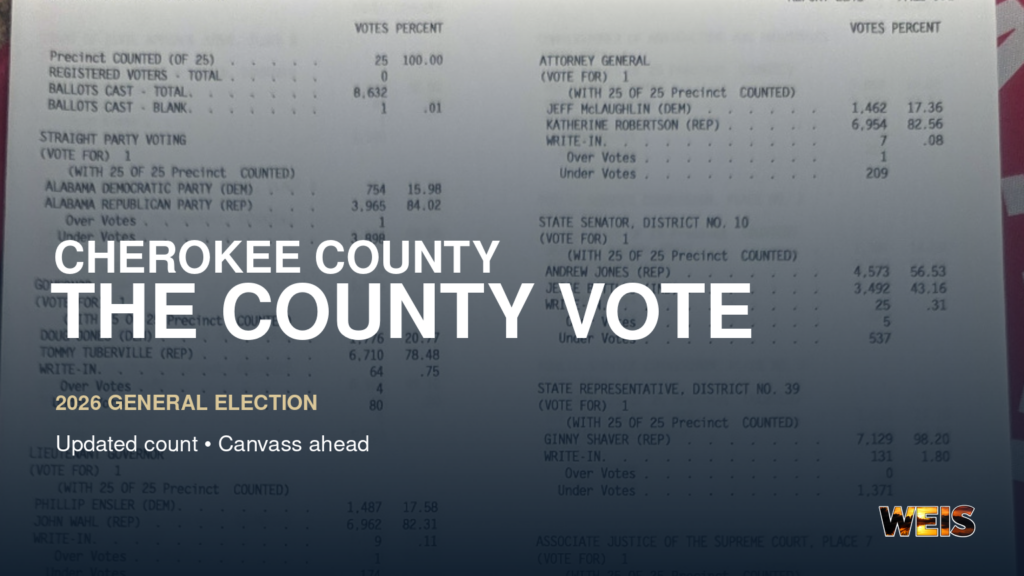
CENTRE– Cherokee County election results now include the provisional ballots and write-in review completed Tuesday, November 10. The county’s updated report lists 8,632 ballots and all 25 precincts reporting in the November 3 general election.
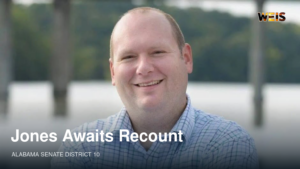
Republican candidates led most races in the county. Meanwhile, Republican Andrew Jones carried Cherokee County in Senate District 10, receiving 4,573 votes to independent Jesse Battles’ 3,492.
Those are Cherokee County’s votes, however, not the districtwide result. District 10 also includes Etowah County and part of DeKalb County.
The updated count provides a fuller picture of how the county voted. However, these totals remain subject to the formal canvass and certification process still ahead.
County and Legislative Results
Jones’ Cherokee County advantage over Battles was 1,081 votes. The report also lists 25 write-in votes in that race.
Meanwhile, Republican Ginny Shaver received 7,129 votes for House District 39, with 131 write-ins. She was the only candidate whose name appeared on the ballot for that office.
The report lists the following results for county offices. In each race, the Republican candidate was the only printed candidate, although voters could also write in a name.
| Office | Republican Candidate | Votes | Write-Ins |
|---|---|---|---|
| District Court Judge | Wes Mobley | 7,151 | 59 |
| County Commission, District 2 | Roger Nichols | 7,071 | 87 |
| County Commission, District 4 | Carlton “Bubba” Teague | 7,105 | 64 |
| Sheriff | Jeff Shaver | 7,126 | 119 |
| Revenue Commissioner | Dustin St. Clair | 7,135 | 66 |
| Coroner | Paul McDonald | 7,097 | 63 |
| County Board of Education, Place N | Randall Davis | 7,108 | 67 |
How Cherokee County Voted in State and Federal Races
Tommy Tuberville received 6,710 Cherokee County votes for governor, compared with Doug Jones’ 1,776. In addition, Barry Moore received 7,037 votes for U.S. Senate, while Everett Wess received 1,420.
The following figures also represent Cherokee County only. Statewide and multicounty contests require returns from all jurisdictions participating in those races.
| Office | Republican Candidate and Votes | Democratic Candidate and Votes | Write-Ins |
|---|---|---|---|
| Governor | Tommy Tuberville — 6,710 | Doug Jones — 1,776 | 64 |
| Lieutenant Governor | John Wahl — 6,962 | Phillip Ensler — 1,487 | 9 |
| U.S. Senate | Barry Moore — 7,037 | Everett Wess — 1,420 | 8 |
| U.S. House, District 3 | Mike Rogers — 7,103 | Lee McInnis — 1,384 | 13 |
| Attorney General | Katherine Robertson — 6,954 | Jeff McLaughlin — 1,462 | 7 |
| Secretary of State | Caroleene Dobson — 6,846 | Wayne Rogers — 1,520 | 10 |
| State Treasurer | Young Boozer — 6,937 | Rosilyn Houston — 1,443 | 8 |
| State Auditor | Andrew Sorrell — 6,957 | Violet Edwards — 1,396 | 10 |
| Agriculture and Industries Commissioner | Corey Hill — 6,760 | Ron Sparks — 1,650 | 10 |
| Public Service Commission, Place 1 | Matt Gentry — 6,959 | James O. Gordon — 1,386 | 9 |
| Public Service Commission, Place 2 | Jim Zig Zeigler — 6,929 | Sheila D. McNeil — 1,431 | 8 |
| State Board of Education, District 6 | Cathi Bradford — 6,897 | Angela Morgan — 1,438 | 8 |
| Alabama Supreme Court, Place 8 | Greg Shaw — 6,946 | Ashleigh Meyer Dunham — 1,424 | 9 |
In addition, five Republican judicial candidates appeared without a printed opponent. Their Cherokee County totals follow.
| Office | Candidate | Votes | Write-Ins |
|---|---|---|---|
| Alabama Supreme Court, Place 7 | Brad Mendheim | 6,999 | 76 |
| Court of Civil Appeals, Place 4 | Benjamin M. Bowden | 6,986 | 67 |
| Court of Civil Appeals, Place 5 | Matt Fridy | 6,969 | 65 |
| Court of Criminal Appeals, Place 4 | Mary Windom | 6,974 | 66 |
| Court of Criminal Appeals, Place 5 | Riggs Walker | 6,960 | 63 |
The report also lists 3,965 Republican straight-party selections and 754 Democratic straight-party selections. Those figures describe use of the straight-party option, rather than every vote cast for each party’s candidates.
County Voters Favored All Four Amendments
Cherokee County voters supported each of the four statewide constitutional amendments. However, the county’s vote alone does not decide whether a statewide amendment passes.
Amendment 2 produced the closest county result, with 3,920 votes in favor and 3,775 against. That gave the “yes” side a 145-vote county margin.
| Statewide Amendment | Yes | No |
|---|---|---|
| Amendment 1 | 5,361 | 2,348 |
| Amendment 2 | 3,920 | 3,775 |
| Amendment 3 | 6,732 | 1,345 |
| Amendment 4 | 6,507 | 1,524 |
What Under Votes and Over Votes Mean
The report also includes “Under Votes” and “Over Votes.” Those terms describe what happened in a particular race, rather than necessarily describing an entire ballot.
An under vote means fewer selections than allowed. In a race allowing one choice, that means no selection registered for that office. For example, someone may vote for governor but leave another race blank.
An over vote means more selections than allowed, such as choosing two candidates when the ballot permits only one. Under Alabama’s vote-counting rules, that contest does not count, but properly marked choices elsewhere on the ballot still count.
For example, the District 10 report lists 537 under votes and five over votes. Neither category represents additional votes automatically available to give a candidate.
The “Write-In” line is separate. It reports the aggregate write-in total shown for an office, rather than identifying a single write-in candidate.
Similarly, the report’s one blank ballot is different from a ballot that leaves only some races unanswered.
What Happens During the Canvass
Before Tuesday’s provisional count, the board of registrars determined which provisional ballots qualified for counting. The canvassing board then counted eligible ballots.
A canvass is the official review and compilation of election returns. It also establishes the results officials formally record and report.
Alabama law sets the county canvass for noon on the second Friday after the election. For this election, that is Friday, November 13.
The county canvassing board generally consists of the probate judge, sheriff, and circuit clerk, with substitutions when required by law. The board checks precinct returns and then makes a written declaration of county results. Officials then record the declaration in the probate office and transmit the required returns to the state.
The Alabama Secretary of State’s election calendar also distinguishes that county step from later state actions. It lists November 23 for legislative and congressional election certificates, under the rule requiring issuance within 10 days of receiving county returns. The calendar lists November 25 as the deadline for the general state canvass.
Certain statewide executive offices, including governor, follow a separate constitutional process. Their formal canvass occurs during the Legislature’s organizational session in January, according to the Alabama Election Handbook.
A recount is another distinct step: officials count votes again under the applicable legal requirements. It is not the same as adding eligible provisional ballots or conducting the regular canvass.
Alabama’s automatic recount threshold is a certified margin of 0.5% or less of votes cast for the office. The law also allows the defeated candidate to waive an automatic recount within the prescribed deadline. In a multicounty race, that calculation uses the complete race, not Cherokee County alone.
For voters, the distinction is straightforward. Tuesday completed the additional count reflected in this report; the canvass and certification process formally records and confirms the returns.
You must be logged in to post a comment.