

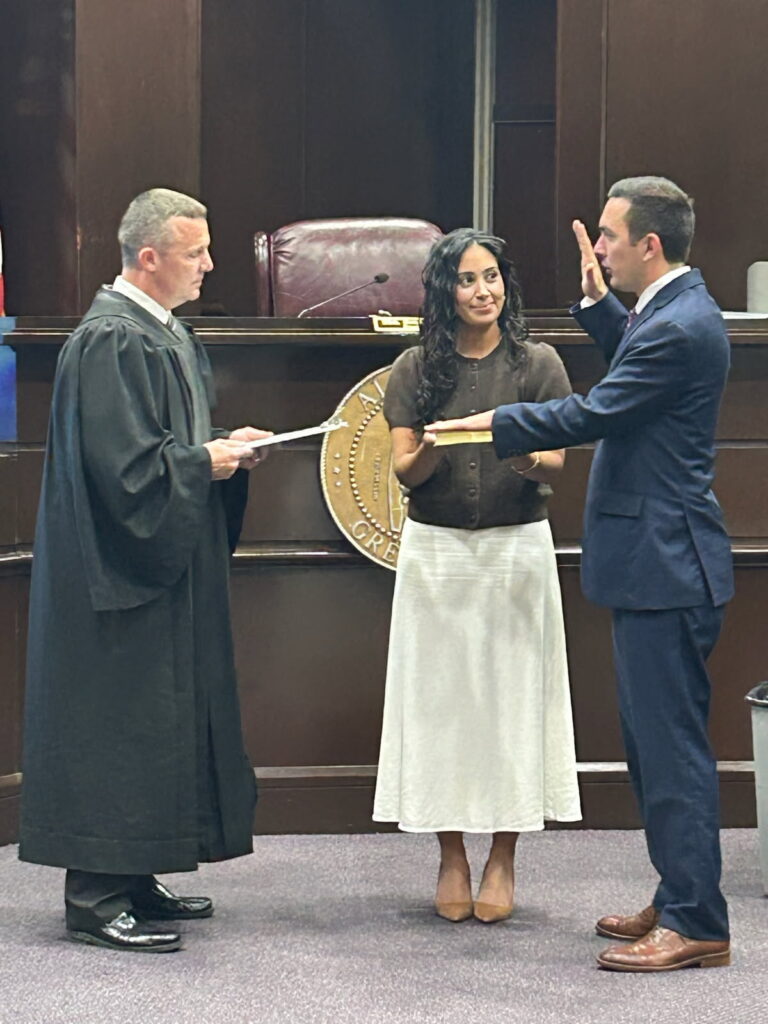
GADSDEN– Jesse Battles has won Alabama’s Senate District 10 race, defeating Republican incumbent Andrew Jones.
Battles’ campaign reported a 74-vote victory margin following the inclusion of provisional and write-in votes. However, the results remain unofficial, with certification and any required recount still ahead.
Etowah County Circuit Judge Sonny J. Steen also administered the oath of office to Battles on Tuesday afternoon at the Etowah County Courthouse.
“I’m humbled and honored to serve the people of District 10,” Battles said. “I look forward to working with Governor-elect Tuberville, Senate leadership, and local leaders across our district to ensure Northeast Alabama is the best place to live, work, and raise a family.”
Battles also thanked the voters, saying the win belonged to the people of District 10.
“This was truly a grassroots campaign, made up of people from all different backgrounds. From the bottom of my heart, thank you to everyone who made this possible. I am humbled by your support. And I promise to be the hardest working Senator our district has ever seen.”
The Vote Count
The provisional-inclusive county totals confirmed to WEIS were 20,377 votes for Battles and 20,319 for Jones:
| County | Jesse Battles | Andrew Jones |
|---|---|---|
| Cherokee | 3,492 | 4,573 |
| Etowah | 15,744 | 12,297 |
| DeKalb — District 10 portion | 1,141 | 3,449 |
| Combined Candidate Totals | 20,377 | 20,319 |
Battles’ Etowah County advantage outweighed Jones’ leads in Cherokee and DeKalb counties. However, only part of DeKalb lies in District 10, so the table includes that portion alone.
The table reflects a 58-vote gap before the campaign’s later report of a 74-vote margin. WEIS is still awaiting the updated candidate totals and county breakdown following the write-in review.
What Provisionals Added
The provisional count added 36 votes for Battles and 30 for Jones:
| County | Added for Battles | Added for Jones |
|---|---|---|
| Cherokee | 7 | 6 |
| Etowah | 28 | 20 |
| DeKalb — District 10 portion | 1 | 4 |
| Total Added | 36 | 30 |
As a result, provisionals increased Battles’ earlier 52-vote lead to 58, before the campaign reported the larger margin.
WEIS reported the contest as too close to call on election night. The updated pre-provisional returns later placed Battles’ lead at 52 votes.
A Campaign That Began With Signatures
Battles reached the general election ballot through an independent petition effort. As WEIS reported in August, Secretary of State Wes Allen formally certified his candidacy on August 26.
The district required 1,142 valid signatures. After reviewing his submission, the state approved his place on the ballot.
According to his campaign biography, Battles is an Attalla business owner who previously worked in the Alabama Secretary of State’s Office. His background also includes leadership in the Gadsden Rotary Club and service on the Gadsden-Etowah Industrial Development Authority board.
During the campaign, he emphasized jobs, roads, skilled-trades education, and cooperation with local governments.
Meanwhile, Jones sought another term in the Senate seat he first won in 2018.
What Happens Next
First, county election officials check the returns at a public meeting called a canvass. Alabama’s election calendar schedules that step for noon Friday, November 13.
The probate judge, circuit clerk, and sheriff or deputy normally make up each county’s canvassing board. The county returns then go to the secretary of state.
Next, state officials certify the result, formally confirming the election totals. State law sets November 25 as the deadline for the state canvass.
Why a Recount Is Expected
Alabama law requires an automatic recount when the certified margin is half a percent or less. The reported 74-vote margin falls well within that limit.
Officials calculate the percentage using all valid votes cast in the race, including write-ins.
However, Jones can waive the recount in writing within 24 hours after certification. He must send that waiver to the secretary of state.
Without a waiver, the recount must start within 72 hours after state certification. That is the deadline to begin the recount, rather than to finish it.
Officials then run the ballots through the counting equipment again. If the machine rejects a ballot that counted originally, officials count it by hand.
The state pays for the automatic Senate recount. Afterward, officials update the certified totals to reflect the recount results.


You must be logged in to post a comment.