

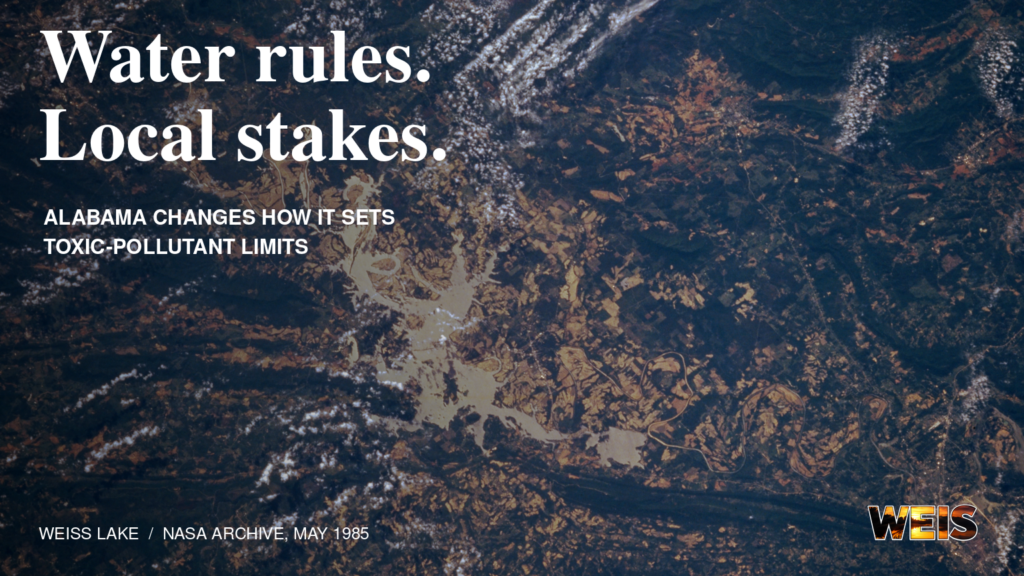
CENTRE– Changes to Alabama water rules remove a requirement to default to certain federal toxicity assessments when calculating pollutant limits. The decision also carries local interest for communities connected to Weiss Lake and the Coosa River.
The Alabama Environmental Management Commission adopted the amendments Friday, October 16, according to Alabama Political Reporter. That report appeared Tuesday morning, October 20.
The Alabama Department of Environmental Management developed the revisions to comply with Act 2026-81. Its official meeting agenda also identifies the affected rules and confirms an August 24 public hearing.
However, the rulemaking concerns how Alabama establishes water-quality criteria. It does not announce a newly discovered contamination incident at Weiss Lake or provide new local water-test results.
What the Water-Quality Amendments Change
ADEM’s published rule proposal deletes instructions requiring certain values from the U.S. Environmental Protection Agency’s Integrated Risk Information System, commonly called IRIS.
First, those instructions addressed reference doses for pollutants classified as noncarcinogens and cancer potency factors for carcinogens. The amendments also delete related instructions directing the use of other EPA calculation inputs.
In addition, the proposal removes a paragraph governing alternative values developed with the Alabama Department of Public Health. That paragraph required formal rulemaking before those alternative criteria or inputs could take effect.
The published proposal leaves the calculation formulas and the existing pollutant-criteria table in place. It also retains references to Appendix A, which lists calculation inputs for specific pollutants.
For example, the framework distinguishes criteria for consuming water and fish from criteria for consuming fish alone. The fish-only criteria apply to all state waters, while the water-and-fish criteria apply to designated public water supplies.
ADEM’s summary of reasons identifies compliance with the new law as the reason for removing the IRIS defaults.
What the New State Law Requires
The Legislature’s enrolled version of Senate Bill 71 sets broader restrictions on environmental rulemaking.
Under the law, agencies generally cannot adopt new or amended numerical standards that exceed comparable federal requirements. When no comparable federal standard exists, the law requires the best available science and the weight of scientific evidence.
For certain human-health rules, it also requires a direct causal link between exposure and demonstrable disease or injury. An increased risk of disease alone does not meet the law’s definition of bodily harm.
However, the law allows qualifying animal or cell studies when voluntary human-study data are unavailable. It also includes exceptions for emergency rules and certain mandatory federal requirements.
In addition, the IRIS provision specifically bars agencies from establishing those values as the default or requiring their use. It also gives agencies nine months after the law’s effective date to revise conflicting rules.
According to ADEM Director Edward Poolos’s explanation in the commission’s April meeting record, the law took effect February 19. As a result, the nine-month deadline falls on November 19, 2026.
Why This Matters Around Weiss Lake
The Alabama Department of Conservation and Natural Resources describes Weiss Lake as part of an interconnected Coosa River system. Water flows downstream from Weiss toward Neely Henry Lake and other Coosa reservoirs.
The department also identifies the 30,200-acre lake as a major fishing destination, almost entirely within Cherokee County. Its Weiss Lake profile describes the fishery as a major economic influence in the county.
Because the state’s criteria address pollutant exposure through fish and, where applicable, water consumption, the scientific inputs matter locally. They help define the protections regulators apply to waters that support fishing and other designated uses.
Still, the records do not establish that this vote immediately increases any particular pollutant limit at Weiss Lake. Nor do they document a new discharge, a drinking-water violation, or a change in local fish-consumption advice.
A separate amendment to the rule for specific lakes corrects Woodruff Lake’s surface area from “12.510” to “12,510” acres. ADEM describes that change as a punctuation correction; it does not concern Weiss Lake’s acreage.
The Decision Follows an Earlier Fight Over Toxicity Values
The commission’s official April 10 meeting record documents a separate proposal to update toxicity inputs for 12 pollutants.
That process followed a June 2025 commission order granting an environmental groups’ rulemaking petition. However, commissioners voted in April to deny adoption of the proposed updates, with no opposition recorded to the denial motion.
The minutes also capture disagreement over public-health protections and regulatory burdens. Environmental advocates criticized the decision, while a manufacturing representative supported it and raised concerns about the proposed changes’ practical effects.
October’s amendments address the required removal of default language. The earlier proceeding concerned updating specific toxicity values, so the two actions should not be treated as the same decision.
Federal Review and Local Advisories Remain Separate
The U.S. Environmental Protection Agency explains that IRIS values support risk assessment and are not necessarily regulatory limits themselves. It also advises users to examine whether an assessment suits its intended purpose and reflects current science.
Meanwhile, state adoption and federal approval are separate steps. Federal regulations generally require EPA approval before new or revised state standards take effect for Clean Water Act purposes.
EPA’s Alabama standards page identifies the provisions currently listed as effective for those federal purposes. The records reviewed did not establish a federal approval date for October’s amendments.
For anglers, the Alabama Department of Public Health’s fish-advisory page remains the source for location- and species-specific consumption guidance. The statewide rulemaking itself does not supply a new Weiss Lake fishing or drinking-water advisory.


You must be logged in to post a comment.