

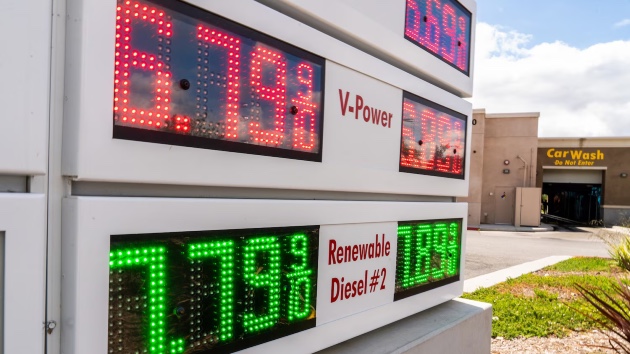
(NEW YORK) — The monthslong war in Iran is inflicting economic pain across the country as many Americans report struggling with higher costs, particularly the record rise in gas prices.
An ABC News/Washington Post/Ipsos poll released last week found that half of Americans expect gas prices to increase more in the next year, and that 4 in 10 Americans say they are not as well off as they were when President Donald Trump returned to office in January 2025.
Nearly a quarter said they are falling behind financially.
In callback interviews with several of the poll’s participants, people emphasized they are struggling to pay for basic necessities and that they are unsatisfied with the country’s leadership.
In an interview with ABC News, Jacob Olson, 28, from Beebe, Arkansas, said rising gas and food prices have made life challenging. After he was laid off from his position as a warehouse manager for a solar company that went bankrupt, Olson became a self-employed maker of custom wood projects like storage racks. He said he spends a lot on gas while driving around to his customers.
“One day at a time,” Olson said. “One foot in front of the other. … That’s about the way to sum it up.”
The ABC/Post/Ipsos poll found that in addition to the 50% of Americans who said they expect gas prices to get worse over the next year, another 15% expect gas prices to stay about the same.
Olson agreed that prices for gas and other goods will continue to go up.
“I don’t really do anything, you know, for leisure or luxury anymore,” Olson said. “It’s all kind of just getting the bills paid … I have a 1-year-old, and I just had another baby about a month ago, so I’ve got two little ones, and every day it’s getting harder.”
Brenda Howard, 66, from Lubbock, Texas, said she can’t afford luxuries like trips or meals out either, and since she does not own a car she has to rely on rideshare services like Uber and Lyft for errands and transport to her job as a cleaner.
She said using Uber or Lyft to take a trip to the grocery store costs her around $30.
“This is not the way I thought my retirement was gonna turn out,” Howard said. “I never dreamed that it would be a day-to-day struggle, sometimes hour to hour.”
The poll found some Americans said they were changing their behaviors because of higher gas prices. Over 4 in 10 have cut back on driving (44%) or cut household expenses (42%). Another 34% said they have changed travel or vacation plans.
Those in lower-income households have been hit even harder by the gas price spike. More than half of people with household incomes of under $50,000 a year said they have cut down on driving and household expenses.
Martha Davis, a 66-year-old Texan who works as a caretaker for her disabled son, said she’s struggling to pay for essentials, including gasoline and rent. She has to travel, sometimes as much as 60 miles from where she lives in Tool, Texas, to get to medical appointments.
“I used to get back and forth on like $20, $25, but now it’s almost 70 bucks,” Davis said.
Four in 10 Americans reported that they are less well off than they were at the beginning of Trump’s second presidential term according to the ABC News/Post/Ipsos poll. Some of those who said they are doing worse still support the president.
Andy Breedlove, 51, from West Virginia said he believes both that Trump is doing well in his second term and that gasoline prices are too high.
“But with the price of everything else, it kind of evens out a little,” said Breedlove, who is not working due to a disability. Breedlove suspects gas prices will continue to climb because of the war with Iran.
The Iranian government’s retaliatory blockage of the Strait of Hormuz, a key shipping lane for the oil market, has led to severe trade disruptions. Around 20% of oil traded on global markets normally passes through the strait.
A 61% majority of Americans said in the ABC/Post/Ipsos poll that the Trump administration’s decision to go to war against Iran was a mistake.
“He hasn’t made a clear statement on why … we’re actually participating at all,” said Olson, the woodworker with a young family. “From what I know, there’s been a lot of just lying and, you know, not being transparent, and … a big lack of professionalism, which I don’t appreciate coming from the president.”
Christopher Mosley, 43, a former Walmart employee from Fort Smith, Arkansas, described Trump as “reckless” on foreign policy.
Trump’s messaging on gas prices has been mixed. When asked in early April whether he thought prices would decrease before the upcoming midterm elections, Trump said they might stay steady or get higher. On May 1, Trump said gas prices would come “tumbling down” once the conflict was resolved. Iran is reviewing the latest proposal from the U.S. government aimed at winding down the war, a spokesman for Iran’s foreign ministry said.
The financial strain felt by voters has the potential to significantly impact the midterm elections, a cycle in which Democrats are already positioned to make gains. Trump has framed the prospect of a change in the power dynamics of Congress as an existential threat to his presidency.
Jim Piper, a 36-year-old from Portage, Indiana, said he wishes Trump had more latitude to pursue his policy goals. Since the start of the second Trump administration, Piper said he has been doing worse financially, but he thinks political deadlock between Democrats and Republicans is to blame for rising prices. Since Piper has a disability and relies on a fixed income, inflation is hard on his wallet.
“I got to pay more, even though I’m not making more,” Piper said.
Copyright © 2026, ABC Audio. All rights reserved.