

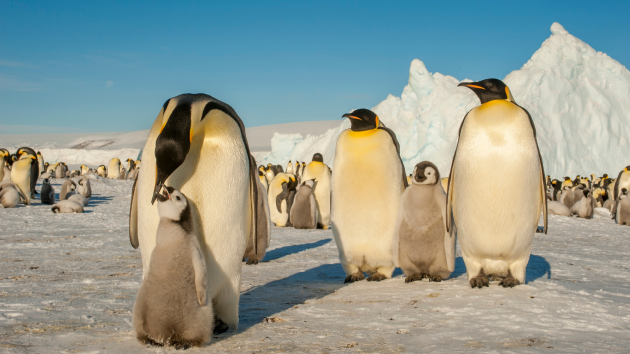
(NEW YORK) — The status of several threatened species has been downgraded to endangered, and climate change is to blame, according to the International Union for Conservation of Nature.
The Red List of Threatened Species, which was updated by the IUCN on Thursday, now includes the Emperor penguin and Antarctic fur seal on its endangered list.
The IUCN is the world’s largest environmental network and provides scientific, data-driven expertise on biodiversity conservation.
The Red List of Threatened Species is a comprehensive information source on the global conservation status of animal, fungi and plant species. The species are listed in nine categories of risk: Not Evaluated, Data Deficient, Least Concern, Near Threatened, Vulnerable, Endangered, Critically Endangered, Extinct in the Wild and Extinct.
Climate change is altering ice conditions and impacting food availability for these species, researchers told ABC News.
Emperor penguins moved from “near threatened” to endangered, according to the IUCN.
Satellite images collected from the region since 2009 indicate that the population of Emperor penguins in Antarctica has been decreasing for about a decade, Phillip Trathan, member of the IUCN’s Penguin Specialist Group, told ABC News.
“Ultimately, there’s only one trajectory, and that’s downwards,” Trathan said.
The main threat the penguins are facing is lack of sea ice due to climate change, Trathan added. Since 2016, sea ice has been diminishing and changing the whole ecosystem in Antarctica, including the molting process — when penguins shed their old feathers — and foraging opportunities, he said. Emperor penguins mainly consume fish, squid and crustaceans in Antarctic waters.
Scientists also are seeing patterns and major population changes in pinnipeds, commonly known as seals, that are making them “very nervous,” Kit Kovacs, Svalbard program leader for the Norwegian Polar Institute and chair of IUCN’s Pinniped Specialist Group, told ABC News.
The Antarctic fur seal has declined “precipitously” — losing about 57% of the adult population in the last three generations, Kovacs said.
The IUCN moved the species from “least concern” in the last pinniped assessment — which happened in 2014 — to endangered.
“That doesn’t happen very often, that you jump so many categories at once,” Kovacs said.
Populations of the krill that Antarctic fur seals subsist on are also dropping, which is likely fueling the decline, she added.
“Krill seems to be the crux of everything in the Southern Ocean,” Kovacs said.
Another Antarctic species — the Southern elephant seal — is also now at risk of extinction due to bird flu, moving from least concern to vulnerable, according to researchers.
Three out of the four big groups of Southern elephant seals have been hit by avian influenza, Kovacs noted. Those seals breed on shore, and 2023 and 2024 saw a 90% pup mortality, according to Kovacs. Breeding females are down about 67%.
There is growing concern that disease-related mortalities of marine mammals will increase due to the climate change, the IUCN said in a release. The organization noted that polar regions, where animals have not had much previous exposure to pathogens, and animals that live close together in colonies, such as southern elephant seals, could be particularly hard-hit.
Antarctic sea ice is declining at record rates, according to climate scientists.
Antarctica has lost enough ice over the last 30 years to cover the City of Los Angeles area 10 times over, glaciologists at the University of California, Irvine, found in a study published in the Proceedings of the National Academy of Sciences last month.
The regions losing ice the fastest are West Antarctica, the Antarctica Peninsula and parts of East Antarctica, the research found.
Glaciers all over the world — especially in Antarctica — are also retreating at a rapid pace, recent research shows.
Scientists have taken a particular interest in Antarctica’s western shelf due to its potential to cause a significant rise in sea levels. Thwaites Glacier, also known as the “Doomsday Glacier,” already contributes to 4% of overall sea level rise due to rapid retreat, while Pine Island Glacier is Antarctica’s fastest-melting glacier and has the potential to raise sea levels by 1.6 feet if melted.
Throughout the globe, climate-driven degradation to ecosystems is accelerating faster than conservation frameworks can respond, according to the IUCN.
Copyright © 2026, ABC Audio. All rights reserved.