

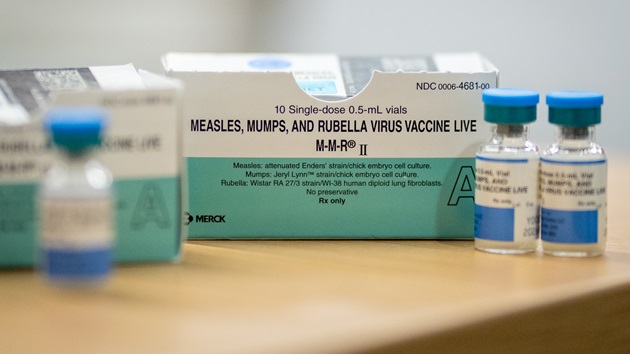
(NEW YORK) — As measles continues to spread across the U.S., with outbreaks popping up around the country, public health experts have been stressing the importance of getting vaccinated to stop the spread of disease.
This has involved local doctors and health department workers going into outbreak areas to offer the measles, mumps, and rubella (MMR) vaccine.
The MMR vaccine is typically a two-dose series given first at 12-15 months old and again at 4-6 years of age. An extra dose can be given as early 6 months old in high-risk circumstances, including during a measles outbreak.
Health experts working in and near measles outbreaks told ABC News that vaccine acceptance has been mixed among these communities, with some people begging to get their kids vaccinated early, while others still refuse an immunization.
“[Measles] can spread so quickly amongst that unvaccinated population,” Dr. Christopher Lombardozzi, chief medical officer at Spartanburg Regional Healthcare System, told ABC News. “And if the number of people who remain unvaccinated stays large, then we could have a real problem, not just this year, but in years to come.”
Vaccine hesitancy in outbreak areas
The upstate region of South Carolina is experiencing a surge in measles cases amid the ongoing outbreak.
The South Carolina Department of Public Health (DPH) reported 223 new cases over the last week, bringing the total number of cases in the outbreak to 434 since October, with over 400 people currently in quarantine due to exposure. Spartanburg County, which borders North Carolina, is currently the epicenter of the outbreak.
A spokesperson for Spartanburg Regional Healthcare System told ABC News that, as of Jan. 9, there have been 77 confirmed measles cases across the system since the outbreak began.
Lombardozzi said the health care system has seen some increased vaccine uptake, but not as much as they hoped for.
“We certainly have had some more uptake of vaccine in the last six months or so, since the outbreak started here in South Carolina, and I’m happy for that,” Lombardozzi said. “I would love to see a higher uptake. There is still quite a bit of vaccine hesitancy around here, and I think it’s unwarranted.”
Lombardozzi added that addressing vaccine hesitancy takes time and support.
“We try to support people, meet them where they are, and hopefully they will change their mind if they’ve been vaccine hesitant for a while,” he said.
Lombardozzi worries that without increasing immunizations, the negative effects could ripple for years.
In a press conference on Wednesday, Dr. Linda Bell, state epidemiologist and health program branch director for the South Carolina DPH, said the lack of vaccine acceptance amid the growing outbreak has been “disappointing.”
Bell said vaccines could have helped prevent a majority of cases, adding, “We have an opportunity to prevent further cases, if people can adopt these available tools and help us stop this outbreak sooner rather than later.”
As of Tuesday, another ongoing outbreak in Utah surpassed 200 measles cases since it began in June of last year. The southwest region of Utah has reported 147 of those cases, which equates to a rate of 25.8 cases per 100,000 people in that region.
David Heaton, public information officer at the Southwest Utah Department of Public Health, told ABC News that cases in southwest Utah and further north have been linked to the same measles virus that spread in Texas and New Mexico last year.
Heaton worries that measles will soon be declared endemic again, ending the decades-long elimination status in the U.S.
“That’s kind of a discouraging threshold that we’re getting closer to. I think [the loss of elimination status] could be recovered, but it could take a couple of years at least,” Heaton said.
In the Southwest region, vaccine acceptance has been highest among people who were on the fence or those who accidentally missed vaccines, but those with strong beliefs against vaccines have been “fairly immovable,” Heaton added.
“We’re just seeing the attitude of, ‘I choose not to get vaccinated. I don’t agree with vaccinations, and I’m not going to do it. I don’t feel the risk is high enough to get the vaccine,'” he said.
Some success in vaccine uptake
But there have been examples of success. Last year, during a large outbreak from February to September, the New Mexico Department of Health (NMDOH) reported that MMR doses administered were nearly 50% higher than the year prior by October.
The largest gains were due to adult vaccination that increased by about 230% in October 2025 compared to October 2024. Children receiving the MMR shot only increased by about 10% compared to that time the previous year.
Andrea Romero, immunization program section manager at NMDOH, told ABC News communication was key during the outbreak. Romero said most of the adults who got vaccinated did so because they were unsure of their vaccination status and felt a strong sense of duty to get the shot, not just to protect themselves but to protect their community.
“When they know that they’re making a difference, it matters,” Romero said. “Every time I take that opportunity [to say], ‘Thank you for being a great community and your response, caring about yourself, your family, your neighbor,’ but it means a lot because it’s their efforts. It was their response that made the difference.”
NMDOH data shared with ABC News shows that 384 children with a vaccine exemption on file received at least one MMR shot between Jan. 13, 2025 and Jan. 13, 2026. This suggests parents of these children changed their minds about the vaccine around the time of New Mexico’s measles outbreak, according to health department officials.
During that same timeframe, at least one MMR dose was the only immunization on record for 189 children in the state, the data shows.
Fears of further measles spread
Doctors near outbreak regions are also experiencing the effects of fears and questions about measles and vaccination from their community.
Dr. Deborah Greenhouse, a spokesperson for the American Academy of Pediatrics and pediatrician in South Carolina, told ABC News that her community hasn’t had a measles case yet, but parents and healthcare providers are increasingly concerned.
“As we all know, and as my patients know, measles virus does not respect county borders, so, as the numbers continue to rise, the likelihood that we start seeing cases here in the midlands of South Carolina increases dramatically,” Greenhouse said.
On Tuesday, health officials announced there was a measles exposure on Jan. 2 in the midlands region at the South Carolina State Museum in Columbia.
“If more families decline the vaccines, our vaccination rates drop and we become an open target, essentially a sitting duck for an outbreak, much like the Spartanburg area,” Greenhouse said.
In her experience, building a foundation of trust has been essential for vaccine acceptance.
“They know me, they trust me,” Greenhouse said. “They know that as a pediatrician, I have no interest here other than protecting the best interests of their children and their family.”
She went on, “Families that I’ve known for years, who I have a very strong relationship with, are coming in and asking for every vaccine that they can get, and asking to get the measles, mumps, rubella vaccine early, because they’re very concerned about their children being exposed to measles and not being protected.”
Greenhouse said trying to build trust among families has been particularly challenging amid changing guidance from federal health agencies and widespread misinformation.
“Unfortunately, some of the awful sources right now are people that you used to think you could trust and, as a new parent, I totally understand why it would be incredibly difficult to be able to figure out right now,” Greenhouse said.
Despite changing guidance and misinformation, doctors say the science hasn’t changed, and vaccines remain safe and effective.
“Amongst the medical community, you’re not going to get much disagreement that the vaccines are safe and that they’re effective,” Lombardozzi said. “The message is, go get your kids their shots if it’s time to get their shots. We certainly encourage folks to go talk to your pediatrician, go talk to your doctor.”
Jade A. Cobern, MD, MPH, is a practicing physician, board-certified in pediatrics and general preventive medicine, and is a medical fellow of the ABC News Medical Unit.
Copyright © 2026, ABC Audio. All rights reserved.