

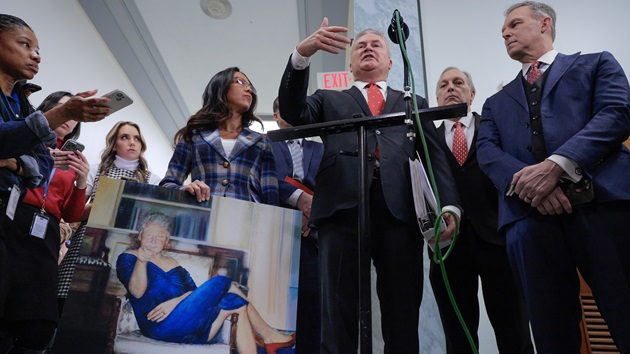
(WASHINGTON) — The chairman of the Republican-led House Oversight Committee said the panel will move forward with contempt of Congress proceedings against former President Bill Clinton after he failed to appear for a subpoenaed deposition on Tuesday as part of the panel’s investigation into convicted sex offender Jeffrey Epstein.
The committee had threatened to hold the former president and former Secretary of State Hillary Clinton in contempt of Congress if they did not appear for separate scheduled closed depositions set for Tuesday and Wednesday, respectively.
“I think everyone knows by now, Bill Clinton did not show up. And I think it’s important to note that this subpoena was voted on in a bipartisan manner by this committee. This wasn’t something that I just issued as chairman of the committee. This was voted on by the entire committee in a unanimous vote of the House Oversight Committee to subpoena former President Clinton and former Secretary of State Hillary Clinton,” Oversight Chairman James Comer said Tuesday morning.
“We will move next week in the House Oversight Committee markup to hold former President Clinton in contempt of Congress,” Comer, a Republican, later added.
A lawyer for the Clintons, David Kendall, has not responded to requests for comment on whether Hillary Clinton will appear on Capitol Hill for her Wednesday subpoenaed deposition.
In a four-page letter posted on social media Tuesday morning, the Clintons publicly called out Comer for threatening to hold them in contempt of Congress.
“Despite everything that needs to be done to help our country, you are on the cusp of bringing Congress to a halt to pursue a rarely used process literally designed to result in our imprisonment. This is not the way out of America’s ills, and we will forcefully defend ourselves,” the letter states.
The Clintons contend in the letter that Comer’s approach to the committee’s work on the Epstein investigation has “prevented progress in discovering the facts about the government’s role” and that the chairman has “done nothing” to force the Justice Department to comply with its disclosure obligations required by Epstein Files Transparency Act, passed late last year.
“We have tried to give you the little information that we have,” the Clintons wrote. “We’ve done so because Mr. Epstein’s crimes were horrific. If the Government didn’t do all it could to investigate and prosecute these crimes, for whatever reason, that should be the focus of your work — to learn why and to prevent that from happening ever again. There is no evidence that you are doing so.”
For months, Republicans on the committee have been demanding that the Clintons provide testimony to lawmakers, citing the former president’s travels on Epstein’s private aircraft in the early 2000s and the Clinton “family’s past relationship” with Epstein and his associate, Ghislaine Maxwell. The panel initially issued subpoenas for the Clintons on Aug. 5 to appear in October.
Kendall has continued to argue that the couple has no information relevant to the committee’s investigation of the federal government’s handling of investigations into Epstein and Maxwell, and should not be required to appear for in-person testimony. Kendall has contended that the Clintons should be permitted to provide the limited information they have to the committee in writing.
“There is simply no reasonable justification for compelling a former President and Secretary of State to appear personally, given that their time and roles in government had no connection to the matter at hand,” Kendall wrote in one of the letters sent to the committee in October of last year. He argued that the committee should excuse the Clintons, as the committee had done for five former attorneys general who were each excused after certifying to the committee that they had no relevant knowledge.
Bill Clinton has not been accused of wrongdoing and denies having any knowledge of Epstein’s crimes. No Epstein survivor or associate has ever made a public allegation of wrongdoing or inappropriate behavior by the former president in connection with his prior relationship with Epstein.
Former Secretary of State Clinton “has no personal knowledge of Epstein or Maxwell’s criminal activities, never flew on his aircraft, never visited his island, and cannot recall ever speaking to Epstein. She has no personal knowledge of Maxwell’s activities with Epstein,” Kendall wrote. “President Clinton’s contact with Epstein ended two decades ago, and given what came to light much after, he has expressed regret for even that limited association,” an Oct. 6 letter to the committee says.
Comer wrote in a letter to Kendall in October that the committee is “skeptical” that the Clintons have only limited information and stated it was up to the committee, not the Clintons, to make determinations of the value of the information.
“[T]he Committee believes that it should be provided in a deposition setting, where the Committee can best assess its breadth and value,” Comer wrote.
Last month, in response to the Epstein Files Transparency Act, the Justice Department released several photographs of former President Clinton apparently taken during his international travels with Epstein and Maxwell from 2002 to 2003, although the released photographs contained no information identifying when or where they were taken. Following that disclosure, a spokesperson for the two-term Democratic president argued that the Trump administration released those images to shield the Trump White House “from what comes next, or from what they’ll try to hide forever.”
“So, they can release as many grainy 20-plus-year-old photos as they want, but this isn’t about Bill Clinton. Never has, never will be,” Clinton’s spokesperson Angel Ureña wrote on X Dec. 22.
Ureña did not respond to an email inquiry from ABC News on Monday.
What is contempt of Congress?
The House of Representatives can hold an individual “in contempt” if that person refuses to testify or comply with a subpoena. The contempt authority is considered an implied power of Congress.
“Congress’s contempt power is the means by which Congress responds to certain acts that in its view obstruct the legislative process. Contempt may be used either to coerce compliance, to punish the contemnor, and/or to remove the obstruction,” according to a report from the Congressional Research Service.
Any person summoned as a congressional witness who refuses to comply can face a misdemeanor charge that carries a fine of up to $100,000 and up to a year in prison if that person is eventually found guilty.
What would the process look like?
To hold someone in contempt of Congress, the Oversight Committee would first mark up and then vote to advance the contempt resolution. Once the committee approves the resolution, which is expected given the GOP majority, the resolution now could go to a vote in the full House.
A simple majority is needed to clear a contempt resolution on the floor. Notably, it does not require passage in the Senate.
The resolution, if passed, would direct the speaker of the House to refer the case to the U.S. Attorney for the District of Columbia — under the Department of Justice — for possible criminal prosecution.
History of contempt
Congress has held Cabinet officials in contempt of Congress for refusing to comply with a House subpoena, including Attorney General William Barr and Commerce Secretary Wilbur Ross in 2019 and then-Attorney General Eric Holder in 2012. The DOJ never prosecuted them even though the House voted to hold them in contempt.
The House held Peter Navarro, a former top trade adviser in the Trump administration, in contempt of Congress in 2022 for defying a subpoena to provide records and testimony to the now-defunct House select committee investigating the Jan. 6 attack on the U.S. Capitol. Navarro was sentenced to jail time.
Steve Bannon, a Trump ally, was also held in contempt of Congress in 2022 for not complying with the Jan. 6 select committee. Bannon was also sentenced to prison time.
The GOP-led House voted to hold Attorney General Merrick Garland in contempt of Congress in 2024 over the DOJ failing to provide audio of then-President Joe Biden’s interview with special counsel Robert Hur. The DOJ did not prosecute the case, but the audio was released.
Copyright © 2026, ABC Audio. All rights reserved.