

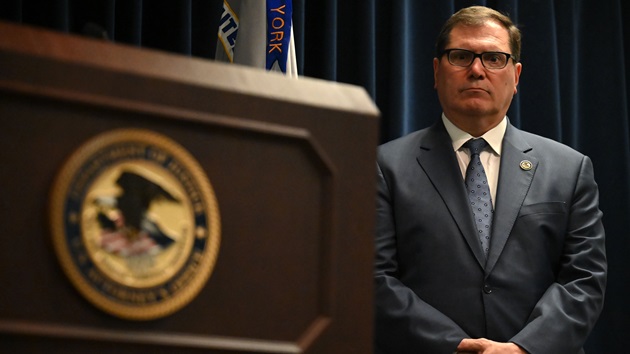
(NEW YORK) — A day after ruling that Trump-appointed U.S. attorney John Sarcone is not lawfully serving in his position, a federal judge has denied Sarcone’s application to release tax information for an investigation his office is conducting.
U.S. District Judge Lorna Schofield on Thursday disqualified Sarcone from serving as U.S. attorney for the Northern District of New York, and quashed subpoenas he had issued as part of an investigation into New York Attorney General Letitia James.
On Friday, Schofield ruled that Sarcone lacks the authority to request a court order directing the Internal Revenue Service to disclose tax return information for a criminal probe.
“The Application is denied because Mr. Sarcone was not lawfully serving as Acting United States Attorney and therefore lacked authority to authorize the Application,” Schofield wrote. “Because Mr. Sarcone was not lawfully serving as Acting U.S. Attorney for NDNY, the Application fails to satisfy statutory requirements and provides no basis to permit disclosure of federal tax return information.”
In disqualifying Sarcone, Schofield joined several other judges across the country who have similarly disqualified federal prosecutors after maneuvers by the Trump administration to bypass the usual way they’re installed into office.
Last month The 3rd U.S. Circuit Court of Appeals sided with a lower court judge’s ruling disqualifying President Donald Trump’s former personal attorney Alina Habba from serving as U.S. attorney in New Jersey, and in November a federal judge in Virginia dismissed criminal cases against James and former FBI Director James Comey after concluding the prosecutor who brought them, former White House aide Lindsey Halligan, was unlawfully appointed.
Neither Sarcone, Habba or Halligan were either confirmed by the U.S. Senate or appointed by the federal judiciary.
It is not clear whose tax return information Sarcone was seeking in his application to the court, only that it is “a limited liability company.”
The October application claimed there was reasonable cause to believe that certain criminal acts have been committed, that the tax return information may be relevant to those crimes, and that the information cannot reasonably be obtained from any other source.
Copyright © 2026, ABC Audio. All rights reserved.