

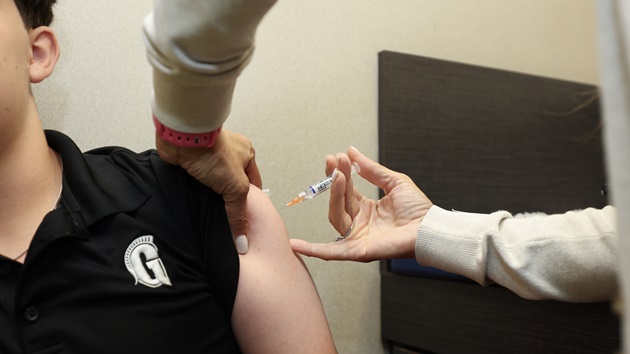
(NEW YORK) — Children who miss early vaccinations are far more likely to miss the measles, mumps, rubella (MMR) vaccine by age 2, a new study found.
The findings come as the U.S. recently surpassed 2,000 measles cases for the first time in more than 30 years, according to data from the Centers for Disease Control and Prevention (CDC).
CDC data shows that MMR vaccination declined over the last several years, but the authors say that factors linked to delayed or missed vaccination since the COVID-19 pandemic have not been well studied.
For the new study, published Friday in the journal JAMA Network Open, the team looked data from Truevata, an electronic health records database that includes several U.S. health care systems.
Participants included more than 321,000 children who received routine care within the first two months, first year and second year of life between Jan. 1, 2018 and April 30, 2025.
The CDC currently recommends that people receive two doses of the MMR vaccine, the first at ages 12 to 15 months and the second between 4 and 6 years old. One dose is 93% effective, and two doses are 97% effective against measles, the CDC says.
Most children during the study period received the MMR vaccine on time, with 78.4% doing so.
About 13.9% of children had delayed vaccination, 1% received the MMR vaccine early and 6.7% did not receive the MMR vaccine by age 2, according to the study.
The strongest predictors for no MMR vaccination was delay in receiving the recommended 2-month and 4-month vaccines, the study noted.
These early vaccines included diphtheria, tetanus, and acellular pertussis (DTaP); Haemophilus influenzae type b (Hib); pneumococcal conjugate vaccine (PCV); and the inactivated poliovirus vaccines (IPV).
Nina Masters, lead author of the study and senior applied research scientist at Truveta, told ABC News that it’s not surprising children who miss early vaccines also miss later vaccines, but it highlights that some parents become vaccine hesitant when their children are young.
“This also means the opportunity for intervention to engage parents and provide more education about the safety and effectiveness of vaccines has to happen very early,” she said. “This may be challenging as parents may have yet had the time to forge a strong bond with their child’s pediatrician, but the study highlights the importance of pediatric providers having vaccination discussions and building trust as early as possible with parents.”
Results from the study showed that those who received their 2-month vaccines on time were seven times more likely to get the MMR vaccine.
The team found that the percentage of children who received the MMR vaccine on time changed over the study period, increasing from 75.6% in 2018 to 79.9% in 2021, and then falling to 76.9% in 2024.
This decrease between 2021 and 2024 was associated with an increase in the percentage of children who did not receive the MMR vaccine by age 2, increasing from 5.3% in 2020 to 7.7% in 2024, according to the study.
Children who were more likely to be unvaccinated for the MMR shot by age 2 were boys, and white and non-Hispanic or Latino, the study found.
Rural residence slightly increased the risk of no MMR vaccination, even among children receiving routine care, according to the study.
The study only included children with regular access to care, so real-world vaccination delays may be worse in the broader U.S. population, the team noted.
The authors added that these results point to increased vaccine hesitancy or unmeasured access challenges, highlighting the importance of timely intervention so children are less likely to delay or miss vaccination.
Dr. Amesh Adalja, a senior scholar at Johns Hopkins Center for Health Security, who was not involved in the study, said the findings have major public health implications because there are questions about whether the U.S. will retain its measles elimination status and increasing vaccination is “the way out of this problem.”
“If you want to live in a society where measles is a problem of the past, where we don’t have to think about it, where schools don’t have to come up with contingency plans, where we don’t have children unnecessarily dying from measles, then that’s a reason to get the vaccine,” he told ABC News.
Adalja added that vaccination doesn’t just protect the individual against infection, but it also has a community benefit.
“The higher the vaccination level is in a given community, the more resilient that community will be to those infectious diseases,” he said. “And if you’re someone that’s immunocompromised, you may want to live in to live in an area that has high vaccination rates because you are at higher risk, and if you’re in a high vaccination area, there’s going to be a lowering of that risk because of the community level immunity that exists in that area.”
Crystal Richards, MD, MS is a pediatric resident doctor at New-York Presbyterian Hospital Columbia University Medical Center and a member of the ABC News Medical Unit.
Copyright © 2026, ABC Audio. All rights reserved.