

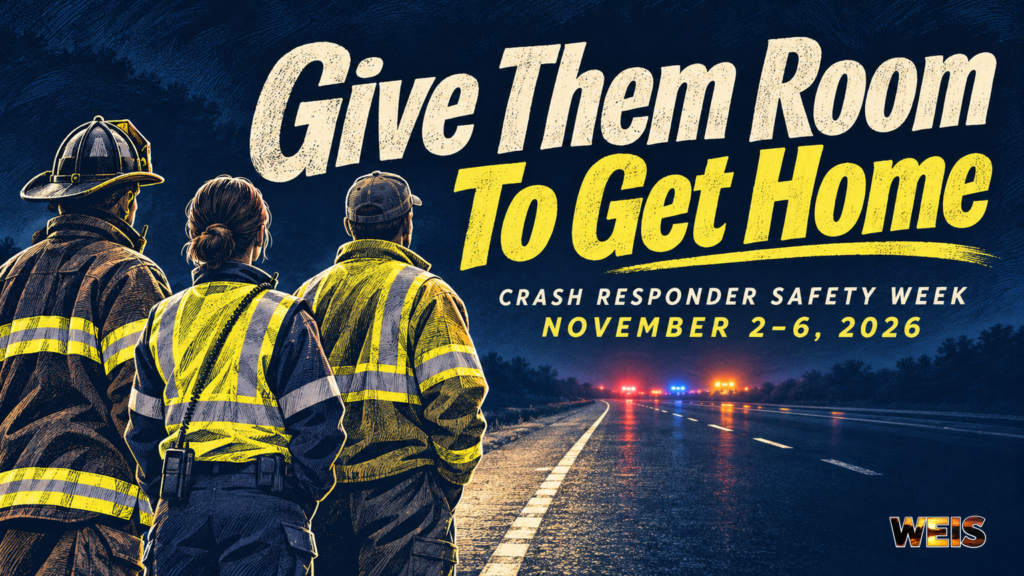
CENTRE– Crash Responder Safety Week, observed Nov. 2–6, reminds drivers to protect the people working beside traffic to help others.
The 2026 campaign carries the message, “Slow Down, Move Over. Lives are on the Line!” The National Operations Center of Excellence identifies the week as an opportunity to recognize responders and improve safety around roadside incidents.
That work involves more than the first emergency vehicle to arrive. Firefighters, law enforcement officers, and emergency medical personnel respond to traffic incidents. Towing and recovery operators, transportation crews, and public works employees also have important roles.
For drivers across Northeast Alabama and Northwest Georgia, that protection begins with attention, patience, and room to work.
A Second Crash Can Make an Emergency Worse
The Federal Highway Administration warns that danger extends beyond the original incident. Drivers approaching a backup can encounter sudden stops, lane changes, and emergency vehicle movements before they can see the scene.
A long line of traffic can also hide the reason vehicles ahead are slowing. Staying alert throughout the backup helps protect other motorists as well as responders farther down the road.
What Drivers Can Do
The Emergency Responder Safety Institute recommends slowing down, moving over safely, avoiding distractions, and following traffic controls. Its driver guidance offers practical steps motorists can use at every emergency scene:
- Slow down as you approach and pass. However, stay alert for changing conditions rather than assuming the lane ahead is clear.
- Move over when safe and lawful. Never force a lane change into another vehicle’s path.
- Put the phone down. Do not take pictures, record video, or livestream while driving past an incident.
- Follow officers, signs, cones, and lane closures. Also, keep the shoulder clear instead of using it to bypass traffic.
- Stay attentive even when traffic stops. Do not make an unauthorized turnaround or drive through a closed scene.
- If possible, choose an alternate route before reaching the incident. That also reduces traffic moving through the response area.
These steps protect crash victims and stranded motorists, too. They also help crews work toward safely clearing the roadway.
Alabama’s Move Over Requirements
The Alabama Law Enforcement Agency publishes the state’s John Hubbard Move Over Act. It covers qualifying emergency, towing, utility, maintenance, construction, and survey vehicles, along with active roadside garbage and recycling collection vehicles.
On highways with multiple lanes in the same direction, drivers must leave the lane closest to covered vehicles when safe. However, if moving over is unsafe, slow to at least 15 mph below the posted limit, unless an officer directs otherwise.
On two-lane roads, stay within your lane but move as far away as possible. Drivers must also slow to 15 mph below the limit when it is 25 mph or higher. When the posted limit is 20 mph or lower, the law specifies 10 mph, unless an officer directs otherwise.
Georgia’s Rule Also Requires Space and Caution
The Georgia Department of Driver Services explains that drivers must move over to the next lane when safely possible for covered roadside vehicles and workers.
If changing lanes is unsafe or impossible, then slow below the posted limit and prepare to stop. The rule protects emergency personnel and other covered roadside workers, including towing, utility, and highway crews.
Honor Their Service by Protecting Their Work
Crash Responder Safety Week also encourages responders to complete free National Traffic Incident Management training. The four-hour course supports a coordinated approach to protecting workers and clearing incidents safely.
For the public, appreciation can also take a practical form. Share reliable safety information with family members, talk with young drivers about roadside emergencies, and practice those habits every day.
WEIS thanks the first responders, recovery operators, and roadway crews who help our communities through emergencies. Their work deserves recognition, and their safety deserves our attention long after this week ends.
When you see emergency lights, slow down and give responders room. Then carry that same care into every trip.

You must be logged in to post a comment.