

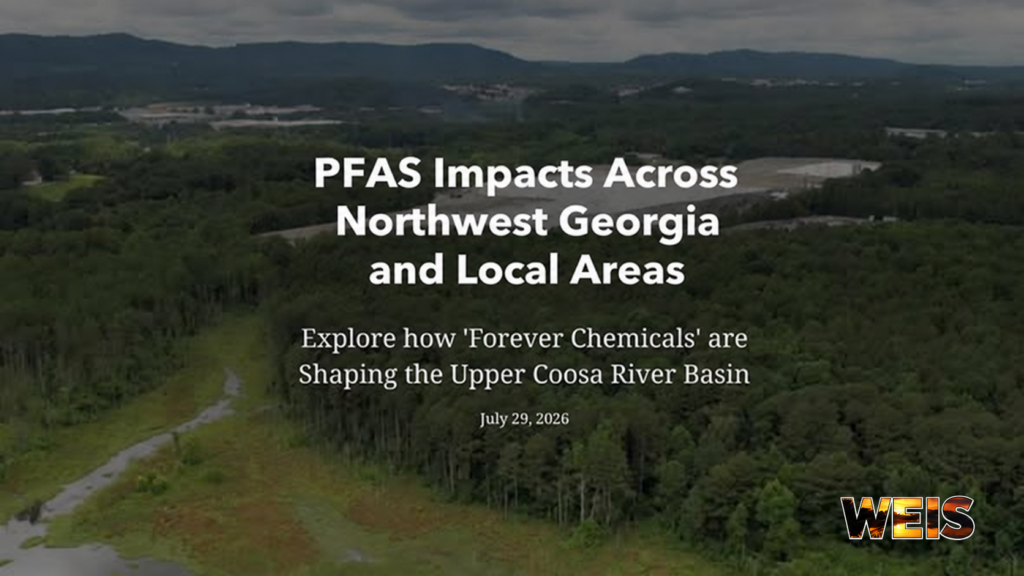
Credit: Coosa River Basin Initiative; headline adapted by WEIS.
CENTRE– An online PFAS resource from the Coosa River Basin Initiative includes a local connection: Centre’s water-contamination litigation.
The organization is asking residents to explore its new PFAS StoryMap and share feedback. The interactive resource explains the chemicals’ history, their use in Northwest Georgia’s textile industry, and responses to contamination.
It also discusses legal action involving Centre, Gadsden, and Rome, placing the regional issue in context for Northeast Alabama residents.
Why the Issue Matters Locally
PFAS stands for per- and polyfluoroalkyl substances. These manufactured chemicals have uses in stain-resistant textiles, nonstick cookware, and some firefighting foams.
Because many persist in the environment, they are often called “forever chemicals.”
The Coosa River basin’s PFAS history includes documented concerns involving Weiss Lake and Centre’s water supply.
In a 2020 update, the U.S. Environmental Protection Agency reported research with Alabama and Georgia on PFAS in Weiss Lake and its tributaries.
Centre also pursued litigation over contamination affecting its water system. In February 2026, Beasley Allen announced a confidential settlement for the Water Works and Sewer Board of the Town of Centre.
The firm said the settlement followed nearly a week of trial testimony in Cherokee County. The StoryMap also includes that settlement in its regional overview.
Separately, the Alabama Department of Environmental Management’s fiscal 2020 report said Centre completed construction of PFAS-removal treatment during 2020.
However, those historical records do not establish current PFAS levels at individual household taps. Residents need recent, system-specific testing information to assess their drinking water.
What Residents Can Do
First, residents concerned about PFAS should contact their water supplier for its latest testing results and information about treatment.
The EPA also recommends asking what actions the utility is taking to address any detections. Private-well owners can also contact their state environmental or health agency for testing guidance and qualified laboratories.
Regional river sampling and household drinking-water testing answer different questions. A river result alone does not establish the quality of treated water delivered to a home.
Explore the Resource and Give Feedback
Residents can view the PFAS StoryMap at coosa.org/pfas.
Afterward, CRBI asks readers to complete its feedback survey. The organization says responses will help make the information more accessible.


You must be logged in to post a comment.