

CENTRE– Halloween safety starts before the first costume goes on or the first car pulls out of the driveway. With Halloween falling on Saturday, Oct. 31, families across Northeast Alabama and Northwest Georgia can plan ahead for a fun evening.
This WEIS Radio guide brings together recommendations from public health, highway safety, fire prevention, pediatric, and animal-care experts. Whether you are collecting candy, handing it out, hosting a party, or driving home, a little preparation can protect your neighbors.
Before You Leave: Make a Family Plan
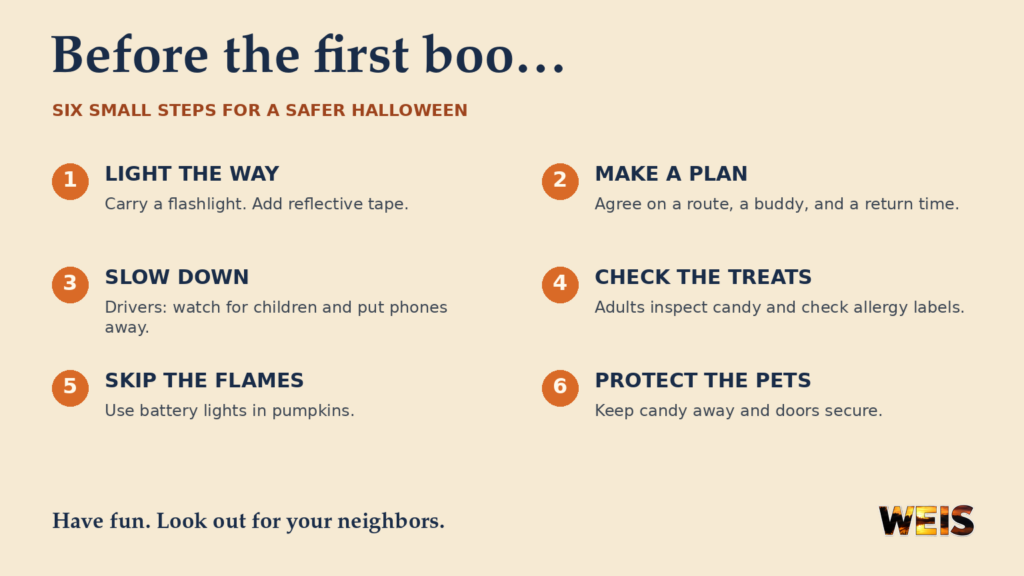
The Alabama Department of Public Health recommends adult supervision for children younger than 12. Older children who are ready for more independence should travel in groups through familiar, well-lit areas.
Before leaving, agree on a route, a return time, and how to reach each other. Also, choose a meeting place in case anyone becomes separated.
Charge phones and carry a flashlight. However, put screens away while walking or crossing streets.
Children should remain outside when collecting treats. Never enter a stranger’s home or vehicle for candy.
Similarly, at a festival or trunk-or-treat, keep the same supervision plan. Parking lots still bring children and moving vehicles close together.
Drivers: Slow Down and Expect the Unexpected
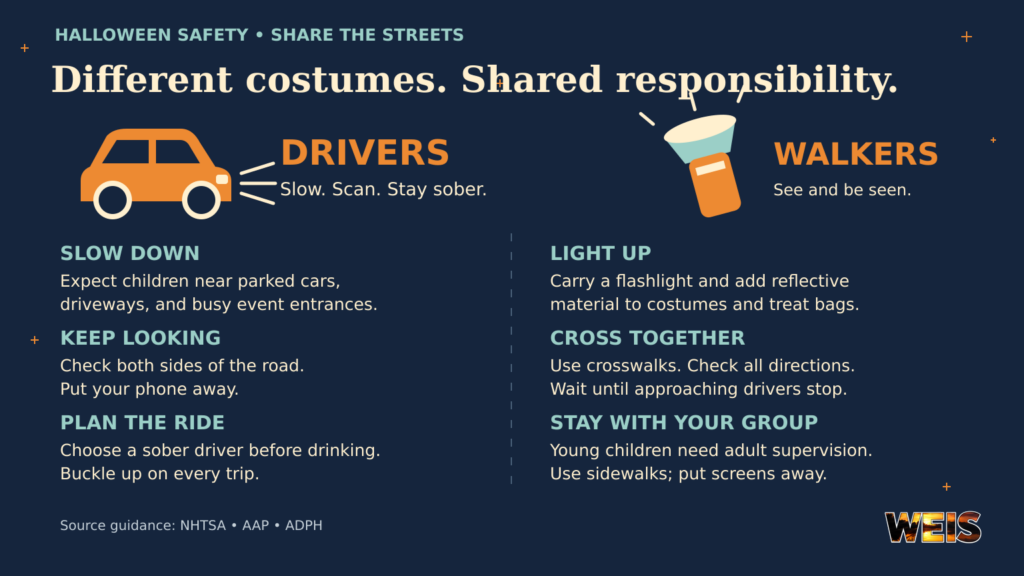
The National Highway Traffic Safety Administration warns that Halloween brings pedestrians into unexpected places. Children may focus on costumes and candy rather than approaching traffic.
- Reduce your speed and scan both sides of the road, especially near homes, event entrances, and intersections.
- Also, watch for children emerging from between parked vehicles or approaching the curb.
- Before entering or leaving a driveway, check carefully for pedestrians.
- Put your phone away. If you need navigation help, let a passenger handle it or pull over safely.
- Meanwhile, give yourself extra travel time so a crowded neighborhood does not become a reason to rush.
- Buckle everyone into the appropriate seat belt or child restraint whenever the vehicle moves.
The Texas Department of Public Safety’s Halloween guidance reinforces an important point: Drivers should never assume children are watching them.
Parents should also review these precautions with teen drivers before handing over the keys.
Trick-or-Treaters: Be Visible and Cross Carefully
According to the American Academy of Pediatrics, families should use sidewalks and cross together at crosswalks when available.
If there is no sidewalk, walk along the far edge of the roadway facing traffic. Avoid routes that do not provide a safe place to walk.
- Stop at the curb and look in every direction, including for turning vehicles.
- Never cross between parked cars or dart out of a driveway.
- Also, wait until approaching drivers stop before stepping into the road.
- Use reflective tape on costumes and treat bags, along with flashlights or wearable lights.
A flashlight helps you see; reflective material also helps drivers see you. Neither replaces careful crossing and adult supervision.
Costumes: Comfortable, Visible, and Clear of Flames
The U.S. Food and Drug Administration recommends costumes with flame-resistant labels. However, that label does not mean a costume cannot burn.
Choose outfits that fit, with hems short enough to prevent tripping. In addition, avoid trailing fabric and oversized sleeves near candles or heaters.
Make sure children can see clearly. Face paint can be an alternative to masks, but check product directions and test it beforehand.
The FDA recommends testing makeup on a small skin area 24 to 48 hours before use. Also, use products only where their labels permit, particularly around the eyes.
Also, keep swords, wands, and other props soft and flexible. Comfortable shoes matter more than completing a costume.
Furthermore, decorative contact lenses require professional fitting and a prescription, even when worn only for appearance. Never buy costume contacts from a seller that does not require a valid prescription.
Candy, Allergies, and Choking Hazards
Give children a meal or snack before heading out. Then, wait until an adult checks their treats before allowing them to eat.
Discard opened, damaged, spoiled, or suspicious items. Also, avoid homemade treats from people you do not know.
In addition, check ingredient labels every time when food allergies are a concern. Do not assume a miniature candy has the same ingredients as a larger version.
For children with allergies, carry prescribed emergency medication and follow their established allergy action plan. Make sure supervising adults understand that plan as well.
Meanwhile, remove hard candy, gum, whole nuts, popcorn, and other choking hazards from young children’s treats. Small toys and loose wrappers also need adult attention.
For neighbors handing out goodies, consider a separate selection of nonfood options such as stickers or pencils. Choose age-appropriate items and avoid small pieces for toddlers.
Decorations, Pumpkins, and Fire Safety
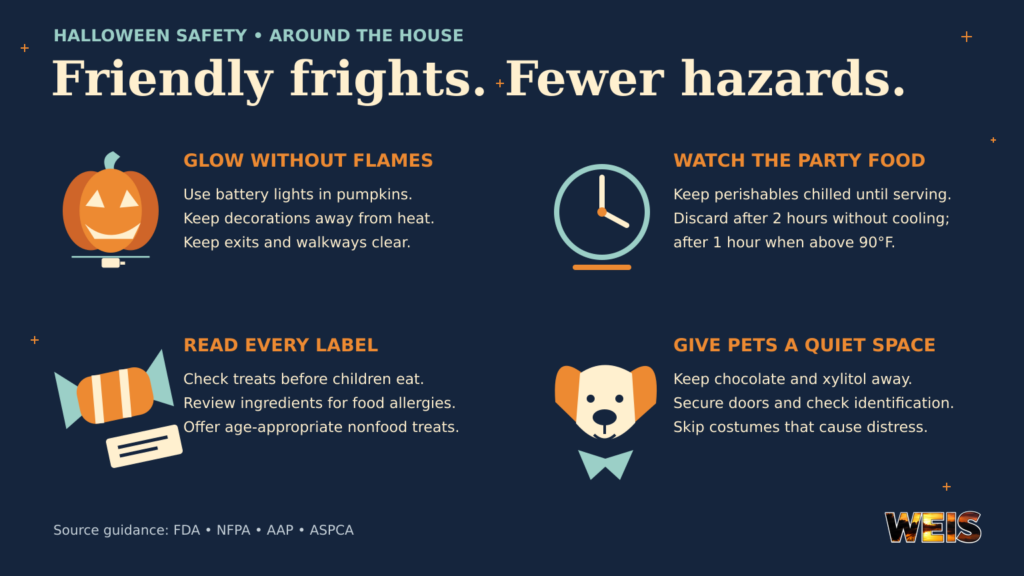
The National Fire Protection Association’s Halloween safety sheet recommends battery-operated candles or glow sticks inside jack-o’-lanterns.
Keep cornstalks, dried flowers, paper decorations, and costumes away from flames, heaters, and other heat sources. Also, keep doors, stairs, and exits clear.
Before visitors arrive, test smoke alarms and identify escape routes. Teach children to stop, drop, and roll if their clothing catches fire.
Meanwhile, remove hoses, loose cords, toys, and wet leaves from walkways. Replace burned-out porch lights so guests can see steps and uneven surfaces.
Check decorative lights for damaged wiring or sockets. In addition, follow their instructions and avoid overloading extension cords.
For safety, adults should handle pumpkin carving. Younger children can draw faces or decorate pumpkins without sharp tools.
Pets: Keep the Candy Away and the Door Secure
The ASPCA warns that chocolate and treats containing xylitol can seriously harm pets. Keep candy and discarded wrappers where animals cannot reach them.
Frequent visitors and unfamiliar costumes can also frighten dogs and cats. Give pets a comfortable, quiet room away from the front door if the activity makes them anxious.
Also, check identification tags and secure doors against escapes. If pets go outside, use a secure leash and suitable identification.
In addition, pet costumes should never restrict breathing, vision, movement, or normal behavior. Also, remove costumes if an animal appears distressed, and avoid loose pieces that pets could swallow.
If a pet eats something potentially toxic, contact a veterinarian promptly.
Hosting a Party: Food, Drinks, and a Safe Ride Home
The FDA’s Halloween food-safety guidance recommends pasteurized juice and cider. Avoid serving raw dough or batter containing uncooked eggs or unbaked flour.
Also, keep perishable food refrigerated until serving. Discard it after more than two hours without temperature control, or one hour when temperatures exceed 90 degrees.
Meanwhile, make transportation plans before anyone drinks alcohol. Arrange a sober designated driver, a ride service, or a place to stay.
In addition, hosts should offer nonalcoholic drinks and help guests get home safely. Never let a costume, mask, or prop obstruct a driver’s vision or movement.
For novelty fog effects, follow product instructions. Poison Control specifically warns against placing dry ice directly into drinks.
Dry ice can cause burns and release carbon dioxide. Therefore, handle it with suitable protective gloves, provide ventilation, and keep it away from children.
Also, store medicines, alcohol, and other adult-only products securely before children visit.
Outdoor Events: Check the Weather and Plan for Shelter
Check the local forecast before leaving and choose clothing suitable for the temperature. Also, know where your family can take shelter if conditions change.
The National Weather Service’s lightning guidance calls for moving into a substantial building or fully enclosed vehicle when thunder is audible.
Then, wait at least 30 minutes after the last thunder before resuming outdoor activities. A tent or open pavilion does not provide equivalent lightning protection.
If Something Goes Wrong
Call 911 for immediate danger or serious symptoms such as collapse, seizures, trouble breathing, or inability to wake someone.
For a possible poisoning, call Poison Help at 1-800-222-1222 promptly. Do not wait for symptoms, and keep the product container available if possible.
Do not make someone vomit unless a poison specialist specifically directs you. Follow emergency personnel’s instructions and explain what happened as clearly as possible.
One Last Check Before the Fun Begins
Before heading out, check your lights, costume fit, route, and family contact plan. After returning, inspect treats and put candy safely out of pets’ reach.
For drivers, keep the evening’s simplest responsibility in mind: Slow down and give every little ghost, witch, and superhero room to get home.
RELATED ARTICLES:
Halloween Events 2026: A County-by-County Guide to Fall Festivals and Trunk-or-Treats



You must be logged in to post a comment.