

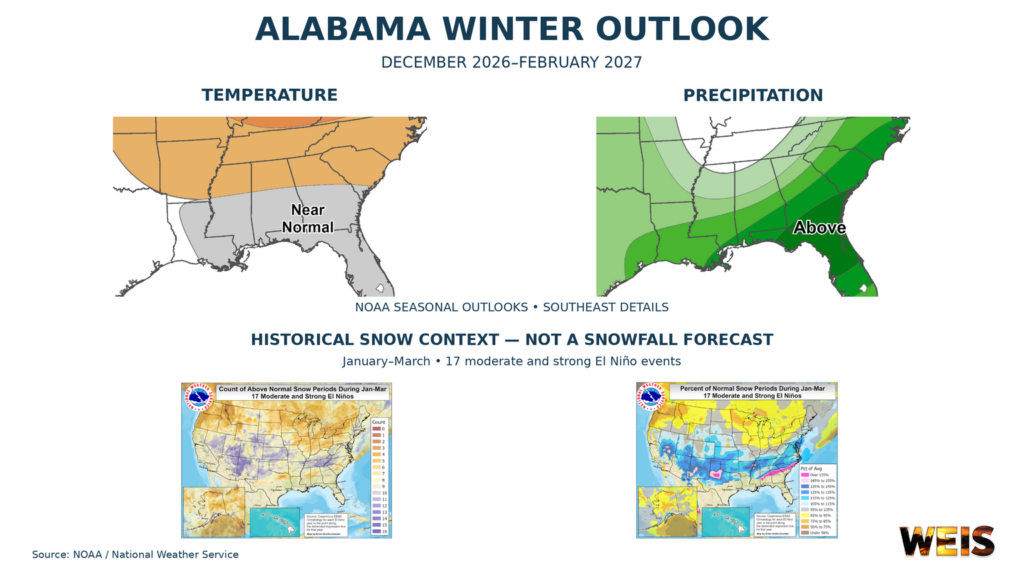
CENTRE– Alabama’s winter outlook favors wetter conditions, with the strongest signal across southern Alabama and a weaker signal farther north.
The outlook covers December 2026 through February 2027. NOAA released its national winter outlook October 15, highlighting El Niño’s expected influence on the season.
Meanwhile, an Alabama briefing shared by Jessica Laws outlines what the pattern could mean closer to home. It points to differing temperature and precipitation signals across the state, while placing historical snowfall patterns in context.
What North Alabama Could Expect
According to the briefing, Alabama has a low to moderate chance for near-normal temperatures. However, northern portions of the state also have a low chance for above-normal temperatures.
For precipitation, the briefing describes a weaker chance for above-normal totals across the northern half of Alabama. By comparison, southern Alabama has a stronger signal, with moderate to high chances for above-normal precipitation.
For readers in Northeast Alabama, that means the wetter outlook carries less confidence than it does farther south. However, these seasonal signals describe broad tendencies rather than conditions on any particular day.
Why El Niño Matters
El Niño can influence the jet stream and shift weather patterns across the United States. NOAA says a strong event can steer the jet stream farther south and east, favoring stormier conditions across the South.
According to the Alabama briefing, El Niño should continue through spring 2027, with high chances of a strong event through late winter or early spring. Afterward, the briefing expects a transition to neutral conditions during late spring and summer.
What About Snow?
The briefing notes that Alabama recorded snow in 50% or fewer of the strong El Niño cases examined, mainly across northern areas. In those cases with snow, amounts were above normal, according to the summary.
However, those historical figures do not establish a snowfall probability for this winter or a particular community.
NOAA’s seasonal outlook does not predict snowfall accumulations. Instead, it addresses the likelihood of above-, near-, or below-average temperatures and total precipitation.
As a result, a wetter seasonal outlook should not be read as a promise of more snow. Residents should also follow local forecasts for the timing and potential effects of individual winter weather systems.


You must be logged in to post a comment.