

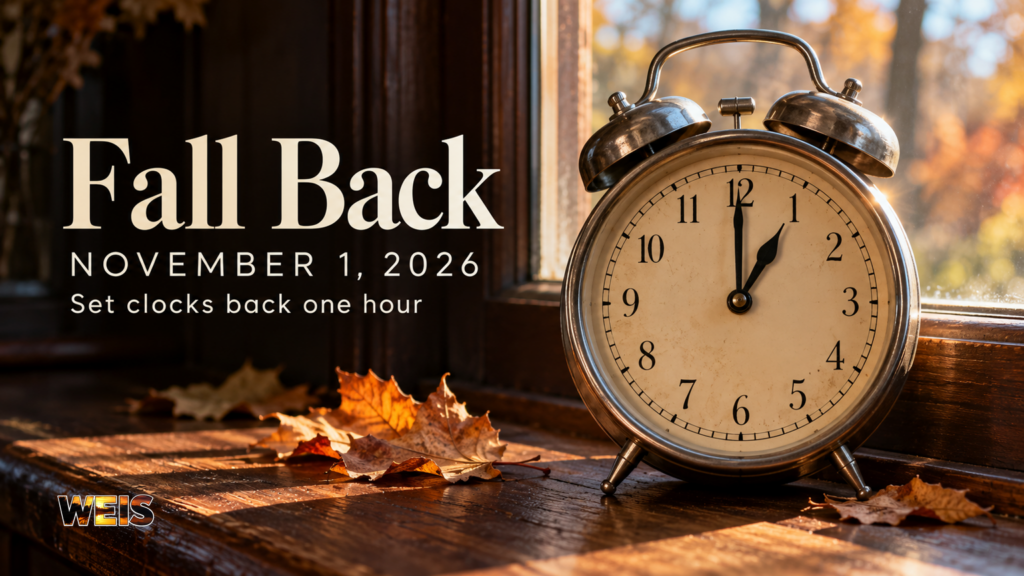
CENTRE– Residents across Alabama and Georgia will turn their clocks back one hour Sunday, November 1, as daylight saving time ends. Meanwhile, legislation to end the twice-yearly clock changes remains stalled in the U.S. Senate.
The change occurs at 2 a.m. local time in each time zone, when clocks return to 1 a.m. Alabama returns to Central Standard Time, while Georgia returns to Eastern Standard Time.
For those following their usual schedules, that means an extra hour overnight, earlier sunrises, and earlier sunsets by the clock. Georgia will remain one hour ahead of Alabama.
The National Institute of Standards and Technology confirms November 1 as this year’s ending date. Residents can set manually operated clocks back before bed Saturday, October 31, and check automatic settings on connected devices.
However, the time change does not reduce the amount of daylight. It shifts the clock labels attached to sunrise and sunset.
Why Congress Has Not Ended the Clock Changes
The U.S. House of Representatives passed the Sunshine Protection Act, H.R. 139, on July 14, 2026. The bipartisan vote was 308-117.
Under the bill, daylight saving time would remain in effect year-round for most of the country. It also preserves standard time for states and areas that qualify for its exemption.
Senators received the measure July 15 and referred it to the Commerce, Science, and Transportation Committee. However, the chamber has not approved the House-passed bill.
President Donald Trump’s administration formally endorsed the measure in July. But presidential support cannot substitute for congressional approval: Both chambers must pass identical legislation before sending it to the president.
As a result, the bill has not reached Trump’s desk for signature. Its current status is stalled, rather than defeated in a final Senate vote.
Why Senators Object
Arkansas Republican Sen. Tom Cotton has been a leading opponent of permanent daylight saving time. His main objection concerns winter mornings, particularly children traveling to school before sunrise.
Cotton argues that winter sunrises would move past 8 a.m. in parts of Arkansas. Some northern communities and places near the western edges of time zones would face even later sunrises.
He also points to consequences for early commuters, construction crews, and agricultural workers. In addition, he cites medical organizations that favor standard time and the country’s unpopular experience with winter daylight saving time in 1974.
That opposition has already stopped one attempt to advance the policy quickly. On October 28, 2025, Cotton objected when Florida Republican Sen. Rick Scott sought unanimous consent to pass the Senate version.
Alabama Republican Sen. Tommy Tuberville supported that effort. He argues that changing clocks disrupts daily life and that families would benefit from more evening daylight.
A single objection blocks a unanimous-consent request. However, it does not permanently prevent the Senate from considering a bill through its regular process.
Senate Majority Leader John Thune also raised doubts in July about whether the proposal could attract 60 votes. The South Dakota Republican cited his northern location and said he had opposed it in committee.
The regular legislative route requires floor time and sufficient support. If opponents prolong debate, invoking cloture on ordinary legislation generally requires 60 senators; final passage ordinarily requires a simple majority.
The dispute therefore involves both procedure and policy. Senators disagree over whether brighter winter evenings justify darker winter mornings.
What Happened to the Earlier Bill?
The 2022 effort followed the opposite path. The Senate approved an earlier Sunshine Protection Act by unanimous consent, but the House never passed it.
That bill expired with the end of that Congress. The Senate’s 2022 action also cannot serve as approval of the House’s 2026 legislation.
Consequently, neither effort completed the full legislative process or became law.
How Daylight Saving Time Began
The U.S. Naval Observatory traces federal daylight saving time to the Standard Time Act of 1918. The United States adopted it during World War I, following wartime use in Europe.
Congress repealed the daylight saving requirement in 1919. However, states and communities continued using different approaches.
During World War II, the country again observed daylight saving time continuously under a policy known as War Time. That national policy ended in 1945, and differing local practices returned.
The Uniform Time Act of 1966 then established consistent seasonal changeover dates while allowing states to opt out.
Congress tried winter daylight saving time again during the 1970s energy crisis, starting in January 1974. However, it amended the experiment that October to restore four months of standard time before daylight saving time resumed in February 1975.
Later changes extended the seasonal schedule. The current March-to-November timetable began in 2007 under the Energy Policy Act of 2005.
The Arguments on Both Sides
Supporters of permanent daylight saving time emphasize brighter evenings after work and school. They also argue that additional evening light could encourage shopping, recreation, and outdoor activity.
House sponsors say ending the switches would simplify schedules for families and businesses. Meanwhile, the White House argues that daylight saving time puts more light into hours when more people are awake.
Critics of permanent daylight saving time focus on lost morning light. The American Academy of Sleep Medicine supports ending seasonal changes, but recommends permanent standard time instead.
The organization says standard time better matches the body’s natural sleep-wake rhythm. It also warns that darker winter mornings could affect sleep, alertness, and safety.
Energy savings remain another disputed issue. A 2008 federal study estimated that extending daylight saving time reduced annual U.S. electricity consumption by about 0.03 percent in 2007.
However, that finding concerned extra weeks in spring and fall, rather than a full year of daylight saving time. Therefore, it does not establish the savings that a permanent policy would produce.
Keeping the seasonal system offers another compromise: later summer evenings, followed by earlier winter morning light. But it also retains the clock changes that critics on both sides want to eliminate.
What This Means for Alabama and Georgia
Alabama enacted a law in 2021 calling for permanent daylight saving time if Congress authorizes it. However, that condition remains unmet.
The U.S. Department of Transportation says states may choose permanent standard time under current federal law. They cannot independently adopt permanent daylight saving time. That federal restriction applies to both Alabama and Georgia.
Hawaii and most of Arizona already remain on standard time year-round.
For residents on both sides of the Alabama-Georgia line, the immediate reminder remains the same: Set clocks back one hour November 1. Under the current schedule, daylight saving time returns March 14, 2027.
STATE NEWS



You must be logged in to post a comment.