
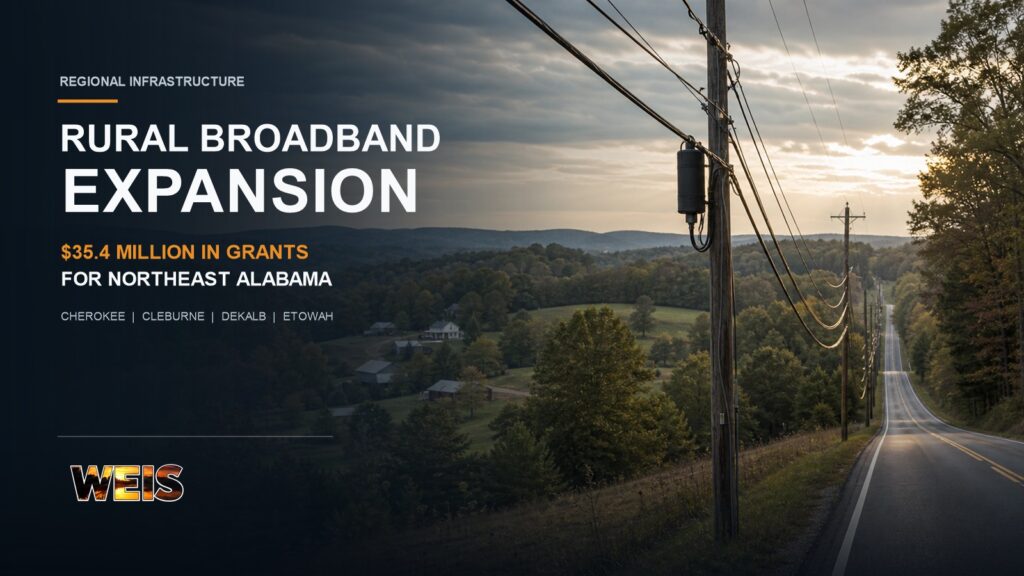
MONTGOMERY – Four broadband projects planned for Cherokee, Cleburne, DeKalb, and Etowah counties are slated to receive nearly $35.4 million through Alabama’s Broadband Equity, Access and Deployment Program, according to final state records.
The providers have committed approximately $15.3 million in matching funds, bringing the combined planned investment in the four counties to nearly $50.7 million.
The projects are part of Alabama’s federally funded effort to extend high-speed internet service to homes, businesses, and community institutions that remain unserved or underserved.
Gov. Kay Ivey announced final federal approval for Alabama’s BEAD plan on March 23. The statewide plan includes nearly $460 million for 63 projects expected to reach approximately 92,000 locations.
Cherokee County
Spectrum Southeast was awarded $606,229.99 for a fiber project serving 142 broadband-serviceable locations in Cherokee County. Spectrum committed $202,076.67 in matching funds, placing the project’s total estimated cost at $808,306.66.
ADECA’s final location records classify 98 of the Cherokee County locations as unserved and 44 as underserved.
The project calls for approximately 13 miles of fiber, including nine miles of aerial lines and four miles of buried lines.
The Cherokee County project was not included in the earlier public intake summary but appears in Alabama’s final approved project list.
It is separate from previous state-supported broadband projects in the county. ADECA’s 2024 annual report listed another Spectrum project in Cherokee County with 9,362 potential new service connections. Those figures should not be added to the BEAD total because the awards involve separate programs and could include different service areas.
Cleburne County
Premier Holdings LLC, operating as Premier Broadband, was awarded $20,547,945 for a fiber project in Cleburne County. The company committed $6,849,315 in matching funds, bringing the project’s estimated total cost to $27,397,260.
Detailed state records identify 2,055 broadband-serviceable locations, including 730 classified as unserved and 1,325 classified as underserved.
The project also includes 11 community anchor institutions, bringing the number of locations listed in the governor’s announcement to 2,066.
The institutions include schools, libraries, public facilities, and housing-related sites in Heflin, Fruithurst, and Ranburne. Among those listed are Cheaha Regional Library, Cleburne County Career Technical School, Cleburne County Elementary School, Cleburne County Middle School, Cleburne County High School, Fruithurst Elementary School, Ranburne Elementary School, and Ranburne High School.
The project calls for approximately 216 miles of fiber, including 181 aerial miles and 35 buried miles. State records estimate the work could support 50 jobs.
ADECA’s intake summary described the proposed service area as including locations near Heflin, Edwardsville, Fruithurst, and Ranburne. Other areas identified included Abernathy, Hollis Crossroads, Muscadine, Trickem, Bell Mills, Belltown, Chulafinnee, Five Points, Hightower, Hopewell, Lebanon, Leota, Macedonia, Mount Pleasant, Piney Woods, and Plainview.
DeKalb County
Farmers Telecommunications Corporation was awarded $2,601,109.45 for a fiber project in DeKalb County. The company committed $867,036.48 in matching funds, bringing the project’s estimated total cost to $3,468,145.93.
The project calls for approximately 49 miles of fiber, including 15 aerial miles and 34 buried miles. State records estimate the project could support two jobs.
The number of DeKalb County locations differs among Alabama’s public BEAD records.
The preliminary intake summary listed 266 locations. The final location workbook lists 263 broadband-serviceable locations, including 249 unserved and 14 underserved locations. However, the governor’s March announcement says the project will serve 322 locations.
Unlike the totals for Cleburne and Etowah counties, the 59-location difference cannot be explained by community anchor institutions because none are assigned to the DeKalb County project in the final community-institution workbook. The public records reviewed do not explain the discrepancy.
The preliminary service-area description included locations near Fort Payne, Hammondville, Mentone, and Pine Ridge. It also identified Adamsburg, Dog Town, Loveless, Sulphur Springs, Bankhead, Blake, and Pumpkin Center.
Etowah County
Comcast was awarded $11,611,650 for a hybrid fiber and coaxial-cable project in Etowah County. The company committed $7,378,960 in matching funds, bringing the project’s estimated total cost to $18,990,610.
The detailed location workbook lists 1,167 broadband-serviceable locations, including 924 unserved and 243 underserved locations.
The project also includes 27 community anchor institutions, bringing the total to the 1,194 locations reported in the governor’s announcement.
Of the residential and business locations, 644 are assigned fiber service and 523 are assigned hybrid fiber-coaxial service. Four community anchor institutions are assigned fiber, while 23 are assigned hybrid fiber-coaxial service.
The project calls for approximately 210 miles of infrastructure, including 84 aerial miles and 126 buried miles. State records estimate the project could support five jobs.
Community anchor institutions include schools, libraries, health facilities, public housing locations, and other public facilities in Altoona, Attalla, Boaz, East Gadsden, Gadsden, Rainbow City, Sardis City, and Walnut Grove. The list includes Carver Memorial Library, East Gadsden Branch Library, and Gadsden State Community College.
The preliminary service-area description also identified locations near Glencoe, Coats Bend, Gallant, Ivalee, Keener, Whitesboro, Bachelors Chapel, Cave Springs, Cox Gap, Daisy, Mays, Moragne, Murrycross, Noble Hill, Owens, Ramsey, Shiloh, Smiths Crossroads, and Sonoma.
What “Unserved” and “Underserved” Mean
ADECA defines an unserved location as one with no broadband access, service below 25 megabits per second for downloads and 3 megabits per second for uploads, or latency exceeding 100 milliseconds. The location also must lack an enforceable commitment for service meeting at least the federal 100/20 Mbps standard.
An underserved location has service above 25/3 Mbps but below 100/20 Mbps, or latency exceeding 100 milliseconds, and lacks an enforceable commitment for service meeting the 100/20 Mbps standard.
The awards apply to specific location identification numbers rather than every address within each county. Residents should not assume that an address is included solely because it is located in one of the four counties.
Construction and Service Timeline
The state’s final project spreadsheet lists a planned performance period ending Feb. 1, 2030. That date represents the program schedule and does not mean customers will have to wait until 2030 at every location.
In March, ADECA said it was developing contracts for the approved projects. By July, the agency had moved into permitting guidance for awarded subgrantees, including a July 22 webinar covering permitting requirements, project milestones, and deployment timelines.
No address-level construction schedules, customer signup dates, or retail prices for the four projects were included in the public award announcement. Residents should wait for announcements from ADECA or the selected providers before treating service as available.
ADECA’s posted monitoring plan calls for financial and performance reports, document reviews, inspections, project closeout reviews, and network acceptance testing. Corrective measures may include repayment of funds or termination of an award if a provider fails to meet program requirements.
Statewide, approximately 71% of the approved BEAD projects will use fiber, 24% will use low-Earth-orbit satellite technology, and 5% will use hybrid fiber-coaxial technology. Alabama originally received a $1.4 billion BEAD allocation, but state officials said the approved deployment plan will save more than $800 million that could later become available for other federally authorized broadband uses.
RELATED ARTICLES:
Cherokee Countywide Grants Celebrated at Spring Garden High School
Etowah County Awarded $350,000 Rebuild Alabama Grant for Whorton Bend Road Bridge Replacement
You must be logged in to post a comment.