
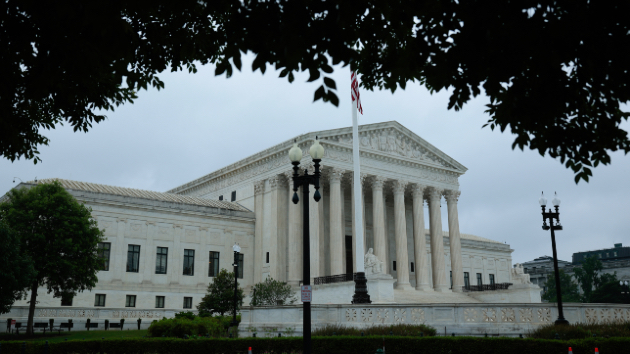
(WASHINGTON) — Next week, the U.S. Supreme Court is expected to weigh in on President Donald Trump’s attempt to end birthright citizenship by executive order, a move which would upend more than a century of legal precedent and a national tradition that have said babies born on American soil are automatically American citizens.
The ruling, one of the most highly anticipated of the year, is a major test of Trump’s unprecedented assertion of presidential power in his second term with major stakes for millions of children and their families.
What is birthright citizenship?
Birthright citizenship is the idea that a child automatically becomes a citizen of the country in which they are born, regardless of the immigration status of their parents.
It reflects the principle of jus soli, or right of the soil, extending citizenship purely on the basis of geographic location.
By contrast, many countries extend citizenship under the principle of jus sanguinis, or right of blood, which is determined by the nationality of a child’s parents regardless of the location of birth.
How does birthright citizenship work in the U.S.?
With few exceptions, all babies born on U.S. soil become U.S. citizens.
For the approximately 3.6 million children born in American hospitals every year, the birth certificate alone has been the key to obtaining Social Security numbers, passports and early life benefits.
Into adulthood, the birth certificate has been universally recognized as proof of citizenship for such things as voter registration, employment, home loans and military service.
What does the Constitution say about birthright citizenship?
The 14th Amendment, which was ratified in 1868 to address the legal status of former slaves and their descendants, says plainly that all “persons born or naturalized in the U.S. and subject to the jurisdiction thereof” are citizens.
Congress later codified the same language in federal citizenship law enacted in 1940.
Courts and the government have repeatedly interpreted the 14th Amendment to unambiguously confer citizenship on all children born in the U.S., including babies of unauthorized noncitizens and temporary residents, such as asylum seekers, international students, tourists and seasonal workers.
Do other countries allow birthright citizenship?
Yes. Thirty-two other countries have citizenship laws nearly identical to the U.S., according to data compiled by the Pew Research Center. Roughly 50 more have limited versions of birthright citizenship.
The most inclusive citizenship policies are in countries in the Western Hemisphere. Brazil, Canada, Argentina and Mexico, for example, closely mirror American law.
Pakistan, Chad and Mozambique are other notable comparators to the U.S.
European countries have historically been more restrictive when it comes to citizenship. France, Greece and Spain extend citizenship at birth only to children whose parents were also born in those countries.
Australia, Germany and the United Kingdom grant automatic citizenship to any child born to a legal resident.
Why does President Trump want to end birthright citizenship?
On the first day of his second term, President Trump signed an executive order purporting to end birthright citizenship by redefining the meaning of the 14th Amendment.
He claims that children born to noncitizen parents who are either unlawfully in the country or who possess temporary legal status, such as tourists or foreign students, are not “subject to the jurisdiction” of the U.S. and therefore ineligible.
The order would restrict citizenship to babies of current American citizens or other lawful permanent residents that have established “domicile” in the U.S.
The president argues the current citizenship policy is a “scam” that has allowed wealthy adversaries to take advantage of American benefits and “ripped off” taxpayers by providing financial assistance to children of undocumented people.
What is the argument in favor of birthright citizenship?
Birthright citizenship has been part of American tradition repeatedly affirmed by courts and legislators for more than a century.
The Supreme Court previously rejected constitutional arguments similar to the ones Trump is making.
“The [14th] Amendment, in clear words and in manifest intent, includes the children born, within the territory of the United States, of all other persons, of whatever race or color, domiciled within the United States,” wrote Justice Horace Gray in 1898 in the landmark Wong Kim Ark v. U.S. decision, addressing the status of children born to noncitizens.
Immigrant advocates and civil liberties groups have warned that ending birthright citizenship would harm hundreds of thousands of children born every year to noncitizen parents and create a bureaucratic nightmare for older Americans who would no longer be able to prove citizenship simply with a birth certificate.
An estimated 255,000 children born every year to noncitizen parents would have lost legal status under the order, according to the Migration Policy Institute. Some may have faced difficulty establishing citizenship in any country, effectively being born as “stateless.”
What happens if the Supreme Court allows Trump to end birthright citizenship?
The Trump administration says federal agencies have prepared guidelines for implementing a new process of conferring citizenship to children born after the order takes effect.
Federal agencies — by electronic databases or otherwise — would evaluate the legal status of a child’s parents first before making a determination of eligibility for citizenship and, in turn, for a Social Security number, passport and other benefits.
A U.S. birth certificate alone would no longer be sufficient proof of citizenship for any child going forward, including those born to American parents.
Immigrant advocates have warned of a “bureaucratic nightmare” for all parents of newborns, with vulnerable low-income children being particularly at risk of not getting necessary health care or nutrition assistance.
Some children who would not qualify for U.S. citizenship may be rendered “stateless” since several countries, particularly in southeast Asia, do not confer citizenship automatically to children born to their nationals abroad. That lack of legal status might make some newborns immediately eligible for deportation.
Can birthright citizenship be stripped if the court upholds Trump’s order?
The Trump administration says the executive order is not retroactive and would only apply to babies born after it takes effect.
However, some legal experts fear that any legal reasoning upholding Trump’s reinterpretation of the 14th Amendment could potentially be used by a future administration to pursue efforts to strip citizenship from some people if it wanted to.
“The government could move to unnaturalize people who were born here of illegal residents,” Justice Sonia Sotomayor said during oral arguments in April.
When will the Supreme Court issue a ruling?
The justices are expected to rule in the case — Trump v. Barbara — before adjourning for their summer recess in early July.
Copyright © 2026, ABC Audio. All rights reserved.