
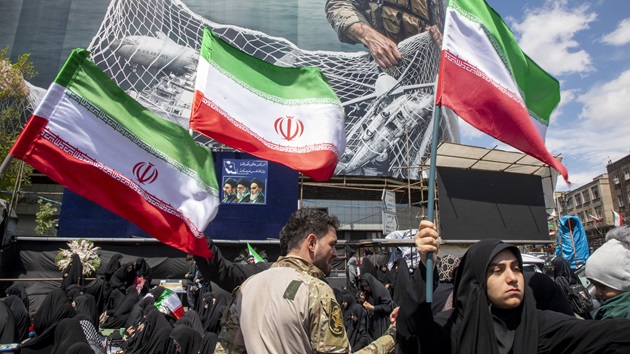
(LONDON) — As President Donald Trump pulled back from threats to annihilate “a whole civilization” when the Iranian regime agreed to a ceasefire and open the critical Strait of Hormuz, some people in the Islamic Republic expressed relief after juggling feelings ranging from despair to doom.
Trump had given the Iranian regime a deadline of 8 p.m. ET Tuesday — which would have been Wednesday, April 8, at 3:30 a.m. in Tehran — for the Iranian government to strike a peace deal or risk the destruction of all bridges and power plants in Iran.
He later extended the deadline to two more weeks as Iran agreed to open the Strait of Hormuz and work to forge a peace deal.
Sohreh, a 33-year-old journalist and resident of Tehran, told ABC News she felt an immediate sense of “relief” when she heard that a ceasefire agreement had been brokered.
“My heart was about to stop,” Sohreh said in a written message to ABC News of the hours she and other Iranian citizens spent on Tuesday bracing for the massive U.S. to strike on its power plants, bridges and infrastructure before the attack was called off. “I cried all day for Iran and prayed to a God I don’t believe in: ‘A miracle, please, send a miracle. I can’t live after the destruction of Iran.'”
Leading up to the ceasefire announcement, Iranians who have been in contact with ABC News throughout the conflict, which began with a Feb. 28 U.S.-Israel joint attack, recalled moments of joy as it appeared the Iranian regime was about to be toppled and disappointment that the Islamic Republican Guard Corps (IRGC) had refused to give up the fight.
An internet blackout imposed by the regime has made it challenging to communicate with people inside Iran, so it’s difficult to gauge how people in the country are feeling. Some have managed to get messages to ABC News.
“I am against the regime and I want them gone with every cell of my body. I have participated in the protests against the regime. But by no means I agree with a foreign power destroying what has been built by my people, for my people, and for the future of our children,” Fatemeh, a 40-year-old engineer who lives in Tehran, told ABC News in a written statement on Monday.
Citing security reasons, Iranians like Fatemeh and Sohreh who have communicated with ABC News, spoke on condition that their real names not be used.
Sohreh recalled a rollercoaster of emotions since the conflict began, from hope that the regime would be toppled to despair that it was hanging on and prolonging the pain of regular Iranians.
“I danced so much to the news of Khamenei’s death, so much that my legs hurt and I fell,” Sohreh said in a message to ABC News on Monday, referring to Ayatollah Ali Khamenei, the country’s supreme leader, who was assassinated in a strike on the first day of the conflict.
But as the war dragged on, Sohreh said she battled doubts that the U.S.-Israel attacks would bring the regime to its knees. “We ask ourselves what if the war continues?” she said.
“When they hit Asaluyeh, everyone was feeling terrible,” Sohreh said of Monday’s strike by Israel Defense Forces on Iran’s southern petrochemical infrastructure in the Persian Gulf port city of Asaluyeh. “We wonder what to do if they hit the infrastructure. They don’t belong to the Islamic Republic. They are built by our own children. They belong to Iran and the future of Iran.”
On Tuesday morning, Trump posted an ominous message on his social media platform, saying, “A whole civilization will die tonight, never to be brought back again.”
“I don’t want that to happen, but it probably will,” Trump wrote. “However, now that we have Complete and Total Regime Change, where different, smarter, and less radicalized minds prevail, maybe something revolutionarily wonderful can happen, WHO KNOWS?”
During a news conference on Wednesday morning, Defense Secretary Pete Hegseth declared “a historic and overwhelming victory on the battlefield.
“A capital V military victory,” said Hegseth, adding that the U.S. military had “achieved every objective.”
Hegseth said that prior to the ceasefire being announced, the U.S. military was prepared to carry out the threat Trump made on Tuesday morning.
“Had Iran refused our terms, the next target would have been their power plants, their bridges and oil and energy infrastructure, targets they could not defend and could not realistically rebuild. It would have taken them decades. And we were locked and loaded,” Hegseth said.
He added, “President Trump had the power to cripple Iran’s economy in minutes, but he chose mercy. He spared those targets because Iran accepted the ceasefire under overwhelming pressure.”
Trump’s ominous statement on Tuesday came after he told reporters on Monday during the annual White House Easter Egg Roll, “The Iranian people, when they don’t hear bombs go off, they’re upset.”
“They want to hear bombs because they want to be free,” Trump said without attributing where he was getting his information from.
He went on to claim that the only reason Iranian civilians have not taken to the streets en masse to demonstrate against the regime is that “they will be shot immediately, and that’s an edict. That’s in writing.”
Leila, a 36-year-old resident of Tehran who works as a manager of a shipping company, said she agreed with Trump, telling ABC News on Monday that when she doesn’t hear bombs, she feels “upset.” Leila, who described herself as anti-regime, said she longs for the day she sees American soldiers in Iran to save them.
In an earlier message Leila sent to ABC News on March 30, she said, “We don’t have fear from the missile attacks, we just get very happy to watch them burning the bases of the IRGC.”
Darius, a 38-year-old anthropologist from Tehran, told ABC News in a message sent on March 25 that he was initially anti-regime, but as the bombing continued, his opinion of the regime had started to change.
“The noise of the bombs and the fact that they are actually killing a lot of civilians pushes us more towards let’s say rallying around the flag,” Darius wrote. “We are fighting this war as a country and even though the Iranian state is not my cup of tea and even though I detest many of the things they do, still, I prefer to stand by their side against a Nazi in the White House.”
At least 3,546 people, including 244 children and 1,616 other civilians, have been killed in Iran due to the U.S.-Israeli strikes since the war began, the U.S.-based Human Rights Activists News agency reported on Sunday.
Copyright © 2026, ABC Audio. All rights reserved.