
Attorney General Issues Cease-and-Desist Order Over Products Containing Illegal Kratom Compounds

MONTGOMERY — Alabama Attorney General Steve Marshall announced this week that the Alabama Attorney General’s Office has issued a cease-and-desist order to businesses across the state currently possessing or selling products containing mitragynine or hydroxymitragynine, compounds commonly associated with kratom.
Under Alabama law, both substances are classified as Schedule I controlled substances and are illegal to possess, sell, or offer for sale in the state.
The order follows independent laboratory testing conducted by an internationally accredited lab, which confirmed that several products currently being sold on store shelves contain kratom compounds despite not disclosing them to consumers. Among the products identified were items marketed under the names “Boujee Bliss,” “Better Weather,” and “Happy Hour,” which were promoted as products for pain relief and relaxation.
According to the Attorney General’s Office, the presence of kratom in these products was not clearly indicated on product labels, raising concerns that consumers may unknowingly purchase and possess illegal substances.
“Alabama will not be a marketplace for dangerous, illegal substances regardless of what they are called or how they are packaged,” Marshall said in a statement. “These products prey on unsuspecting consumers, including children, who have no way of knowing what they are purchasing. We are putting every retailer on notice that they need to remove these products immediately. Those who choose to ignore this order will face the full force of the law, including seizure of assets and felony prosecution.”
Businesses that continue to sell or possess the products could face significant legal consequences. These include seizure and forfeiture of contraband and related property under Alabama law, felony criminal prosecution, and potential civil liability under the Alabama Deceptive Trade Practices Act.
Officials also warned consumers that labels on some of these products may not fully disclose their ingredients, meaning individuals could unknowingly possess a controlled substance or experience adverse health effects after consuming them.
The Attorney General’s Office is working with district attorneys and law enforcement agencies across the state to identify and remove these products from the marketplace.
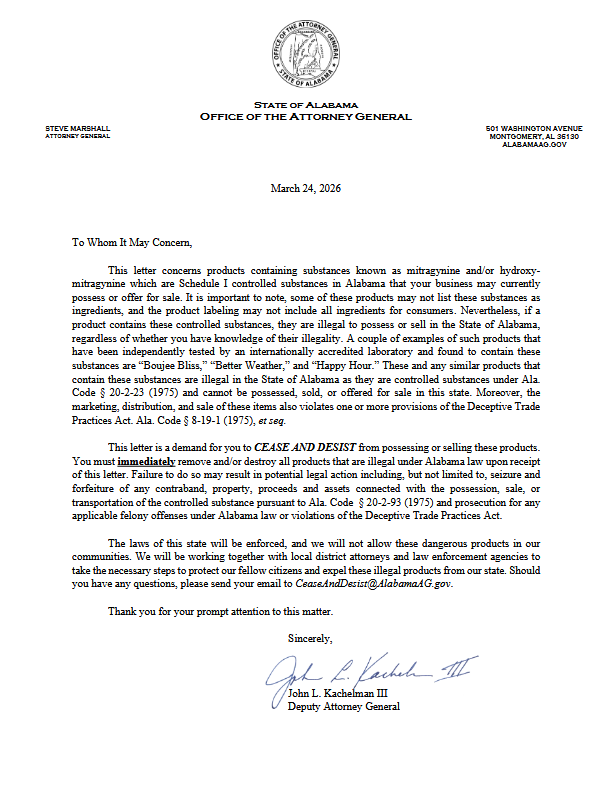
Businesses with questions about compliance with the cease-and-desist order are encouraged to contact the Alabama Attorney General’s Office at CeaseAndDesist@AlabamaAG.gov.