

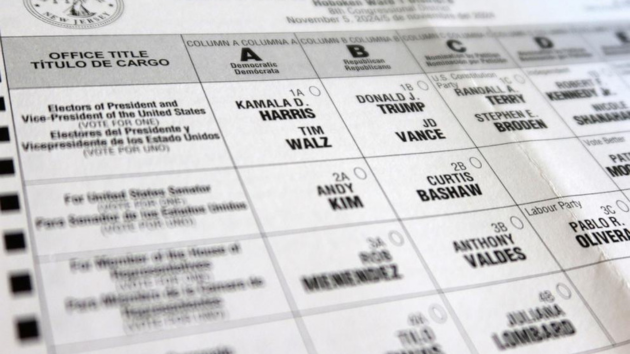
(WASHINGTON) — The Supreme Court’s conservative majority on Monday appeared sympathetic to arguments by the Republican National Committee seeking to limit the counting of mail-in ballots that arrive after Election Day, even if they were postmarked on or before.
Many justices voiced concerns about a Mississippi law being challenged by the RNC for allowing tabulation of absentee ballots that arrive as late as five days after polls close. “Both sides agree there needs to be a final decision by the voter and receipt [of the ballot] — by somebody — by Election Day,” said Justice Neil Gorsuch. “I think the disagreement is receipt by whom.”
For more than a century, Congress has established the Tuesday after the first Monday in November as the day for election of members of the House, Senate, and presidential electors, in specified years.
Republicans argue that the term “election” means both “ballot submission and receipt” by state election officials. Mississippi and several voter advocacy groups defending the state law insist “election” means when voters make their “choice” by marking and submitting their ballots to a mailbox, drop box, or polling place.
“I think if you were looking at the text in isolation — day for the election — your first instinct might be in-person voting on that day, is what that text literally meant,” posited Justice Brett Kavanaugh, who sounded skeptical of the state law.
Thirty states plus D.C. have measures providing a grace period for voters, including military service members overseas, who rely on the Postal Service or other commercial letter carriers, according to the National Conference of State Legislatures.
Justice Samuel Alito suggested that allowing each state to set its own policy for late -arriving ballots has created challenges for administering a national election. “We don’t have Election Day anymore. We have election month or we have election months,” he said, skeptically.
Justice Amy Coney Barrett raised the potentially thorny prospect of states allowing voters to recall — or, change — their ballots once mailed. “Would that be illegal?” she asked Mississippi Solicitor General Scott Stewart. He said he was unaware of any instance of that happening.
The court’s three liberal justices were largely united in support of states’ ability to develop their own voting guidelines, pushing back on claims by lawyers for the RNC and Trump administration, which has advocated for “getting rid of mail-in ballots” altogether.
“The Constitution vests the issue of elections in states, unless superseded by Congress,” said Justice Sonia Sotomayor. “If there is a policy he people who should decide this issue is not the courts.”
Justice Ketanji Brown Jackson noted that, despite decades of precedent of states counting some timely-cast but late-arriving ballots, Congress has never sought to override the laws. “The idea of votes being cast and counted after an election is not new,” she said.
Justice Elena Kagan warned that the Republicans’ rationale for eliminating some mail-in ballots could also implicate early voting. “How are you not taking issue with early voting?” she asked RNC attorney Paul Clement. “You say casting and receipt [of ballots] has to be on Election Day.”
“These things have to be consummated by Election Day,” Clement replied.
“Once we go down this road,” said Kagan, “where are we going to end up?”
Most Americans, 58%, support allowing any voter to cast a ballot by mail, according to a Pew Research Center survey late last year. But there is sharp division among parties, with 83% of Democrats and Democratic-leaning voters favoring mail-voting with 68% of Republicans and Republican-leaning voters opposed.
In March 2025, President Donald Trump signed an executive order that attempted to cut federal election funding to states that have mail ballot receipt grace periods, but it has largely been blocked by federal courts for now.
Trump has also been pushing Republicans in Congress to approve the Safeguard American Voter Eligibility (SAVE America) Act, which would — in part — outlaw voting by mail for anyone without a legitimate excuse, such as military service, illness, or disability, making it impossible to vote in person.
In a nod to Trump and fraud concerns raised by many conservatives, Justice Kavanaugh suggested late-arriving ballots might “open up a risk of what might destabilize election results” — namely, a swing in election outcome as tardy votes are tabulated.
“Is that a real concern?” Kavanaugh asked Stewart. “Does that factor into how we think about how to resolve the scant text and the maybe conflicting or 21 evolving history here?”
“I certainly respect the perception,” replied Stewart, a Republican. “I think one thing notable in this case and I think helpful is that there has not been much of a showing about actual fraud from post-Election Day ballot receipt itself.”
Hundreds of thousands of mail-in ballots in the 2024 general election arrived after Election Day but were still legally counted that year across 22 states and territories with a post-election grace period, according to the U.S. Election Assistance Commssion.
Data on which party benefitted more from those ballots is not clear, neither is the impact of any possible changes to mail ballot rules following a Court decision.
Voting rights advocates warn that an abrupt change in policy could lead to widespread rejection of ballots that were properly cast by well-intended voters but experienced unintended delivery delays by the Postal Service or other circumstances.
Republicans insist there is ample time to educate the public on timely submission of mail-in ballots ahead of the November vote and that limiting late-arriving ballots could bolster election integrity.
A decision from the high court is expected by the end of June.
Copyright © 2026, ABC Audio. All rights reserved.