
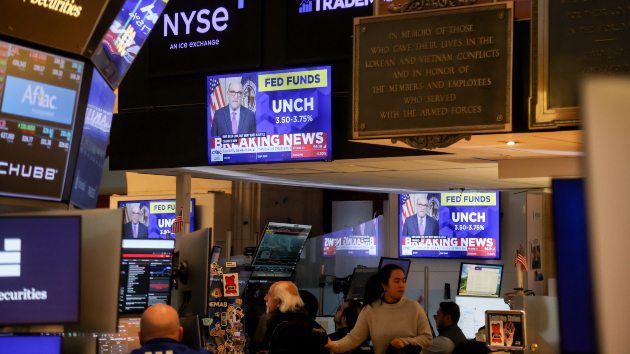
(NEW YORK) — The Federal Reserve held interest rates steady on Wednesday at its first meeting since the U.S.-Israeli war with Iran drove up gasoline prices and risked a wider bout of inflation.
The central bank’s move marked the second consecutive time it has opted to maintain interest rates at current levels since the outset of 2026. Before that, the Fed cut interest rates a quarter-point three straight times. The decision on Wednesday matched market expectations.
“The implications of developments in the Middle East for the U.S. economy are uncertain,” the Federal Open Market Committee (FOMC), a policymaking body at the Fed, said in a statement on Wednesday.
Elevated price increases have coincided with a slowdown of economic growth, threatening to intensify an economic double-whammy known as “stagflation,” which poses difficulty for the Fed.
If the Fed opts to lower borrowing costs, it could spur growth but risk higher inflation. On the other hand, the choice to raise interest rates may slow price increases but raises the likelihood of a cooldown in economic performance.
The benchmark rate stands at a level between 3.5% and 3.75%. That figure marks a significant drop from a recent peak attained in 2023, but borrowing costs remain well above a 0% rate established at the outset of the COVID-19 pandemic.
A lackluster jobs report last week showed the U.S. economy lost 92,000 jobs in February, which marked a reversal of fortunes for the labor market and erased most of the job gains recorded in 2026.
The unemployment rate ticked up from 4.3% in January to 4.4% in February, the BLS said. Unemployment remains low by historical standards.
A revised government report last week on gross domestic product (GDP) showed the economy grew at a sluggish annualized pace of 0.7% over the final three months of 2025.
Those economic headwinds helped set the conditions before the outbreak of war with Iran, which spiked oil prices and risked price increases for a host of diesel-fuel transported goods.
U.S. crude oil prices rose to about $97 per barrel on Wednesday, marking a surge of more than 50% since a month earlier.
Since the military conflict began, U.S. gas prices have gone up 86 cents to an average of $3.84 per gallon as of Wednesday, according to AAA.
The rate decision on Wednesday marked the first such move since a federal judge blocked Justice Department subpoenas to the Federal Reserve’s Board of Governors after determining the government “produced essentially zero evidence” to support a criminal investigation of Fed Chair Jerome Powell, according to an unsealed court opinion.
“A mountain of evidence suggests that the Government served these subpoenas on the Board to pressure its Chair into voting for lower interest rates or resigning,” U.S. District Judge James Boasberg said in his opinion on Friday.
Acting U.S. Attorney Jeanine Pirro blasted Boasberg as an “activist” judge and pledged to appeal his ruling.
ABC News’ Alexander Mallin, Allison Pecorin, and Jack Date contributed to this report.
Copyright © 2026, ABC Audio. All rights reserved.