
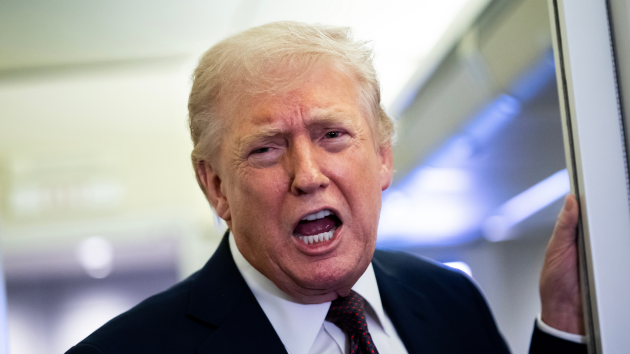
(WASHINGTON) — After NATO allies rebuffed his call to assist the U.S. in securing the critical Strait of Hormuz, President Donald Trump said on Tuesday the U.S. doesn’t need their help after all.
“I think NATO’s making a very foolish mistake,” Trump said, airing out his grievances with the transatlantic alliance during an Oval Office meeting with Ireland’s Taoiseach Micheál Martin.
“This was a great test because we don’t need them, but they should have been there,” the president added.
Trump over the weekend requested U.S. partners in Europe and Asia send warships to help police the strait, where roughly one-fifth of the world’s oil supply is caught in the crosshairs of the U.S. and Israeli war with Iran.
No country has publicly announced plans to send ships or other kinds of assistance to unblock the strait.
“This is not our war; we did not start it,” German Defense Minister Boris Pistorius said on Monday.
“We will not be drawn into the wider war,” British Prime Minister Keir Starmer similarly said.
Despite the cold shoulder from several allies, President Trump on Monday said that “numerous countries” had told him “they’re on the way.” Trump did not identify which countries, and said that Secretary of State Marco Rubio would soon provide a list.
As of Tuesday afternoon, no list had been released.
When asked what countries would join in a coalition to secure the strait, Trump said he’s had “great support from the Middle East” including Qatar, the United Arab Emirates, Saudi Arabia, Bahrain and “of course Israel” — but did not explicitly say what those countries would be doing.
In a social media post on Tuesday, Trump wrote the U.S. military had been “informed by most of our NATO ‘Allies’ that they don’t want to get involved with our Military Operation against the Terrorist Regime of Iran, in the Middle East, this, despite the fact that almost every Country strongly agreed with what we are doing, and that Iran cannot, in any way, shape, or form, be allowed to have a Nuclear Weapon.”
Trump said the U.S. didn’t need the assistance from those countries, or from “Japan, Australia and South Korea.”
“Well, we don’t need too much help, and we don’t need any help, actually,” Trump later said in the Oval Office.
When asked if he would retaliate against NATO countries for not heeding his call or if he was rethinking the alliance, Trump said no.
“I have nothing currently in mind. But I will say that I’m not exactly thrilled,” Trump said.
Trump pointed to the assistance the U.S. provided to help Ukraine fight Russia’s invasion under the Biden administration as he criticized NATO for not stepping in to help with reopening the Strait of Hormuz.
“You would have thought they would have said, ‘We’d love to send a couple of minesweepers,'” Trump said. “It’s not a big deal. It doesn’t cost very much money. But they didn’t do that. So, you know, it’s — I think it’s very unfair to the United States, not to me, but to the United States.”
Meanwhile, the impact of Iran’s stranglehold is being felt abroad and at home. The price of oil has hovered around $100 a barrel this week. In the U.S., the national average for a gallon of gas is $3.79 — up about 88 cents from a month ago.
President Trump had also called on China, which Iran is still allowing to transit the Gulf, to assist in the Strait of Hormuz. The response from China’s foreign ministry was a call for all parties to immediately stop military operations.
President Trump announced Tuesday that his previously planned trip to China is now postponed for five to six weeks. Trump didn’t provide details on why, only that he was “resetting the meeting” originally scheduled for early April.
“I look forward to seeing President Xi. He looks forward to seeing me, I think,” Trump said.
Copyright © 2026, ABC Audio. All rights reserved.