
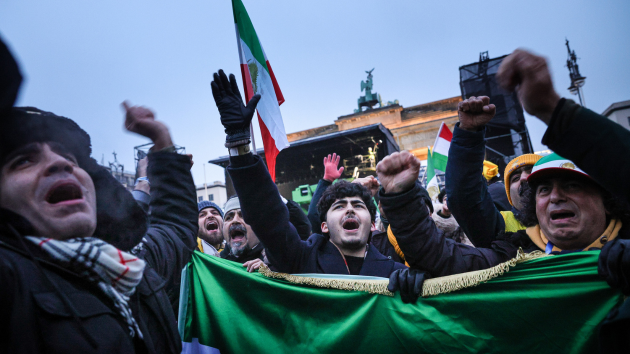
(LONDON) — One month after Iran was rocked by the beginning of the deadliest crackdown in its modern history, the full toll of the regime’s response to nationwide protests is still coming into focus.
On Jan. 8 and 9, Iranian security forces launched what activists describe as the most brutal assault yet on citizens who had poured into streets across the country, chanting for regime change.
While international media coverage has gradually shifted toward renewed negotiations between the United States and the Islamic Republic over Tehran’s nuclear program, human rights groups and Iranians inside and outside the country warn that repression on the ground has intensified. They describe an atmosphere of fear, torture, and systemic violence ruling the country.
As of Monday, more than 6,400 protesters have been killed and over 51,500 arrested on charges linked to the demonstrations, according to the U.S.-based Human Rights Activists News Agency (HRANA). Over 11,000 more related deaths remain under review. ABC News cannot independently verify these numbers.
Farsi-language social media remains flooded with images of the dead, missing and detained. Videos show families grieving loved ones killed in the streets, while others are pleas from relatives searching for missing family members in morgues and prisons, or seeking legal support for those behind bars.
Many wounded protesters still seek medical advice from doctors on social media on how to treat their injuries at home, because they fear getting arrested in hospitals by regime forces, who closely monitor hospitals in order to track wounded protesters. An Iranian lawyer told ABC News last week that several of doctors who provided home treatment to wounded protesters have been arrested.
The volume of such social media posts has shown no sign of slowing.
200 students were killed
The Coordinating Council of Iranian Teachers’ Trade Associations (CCITTA) published the names on Sunday of 200 students they said are confirmed killed during the protests.
“Each name carries a wish with it: I wish he were alive; I wish his school was still waiting for him,” CCITTA said in a statement on X, adding that “the empty benches are not just a sign of absence; they are a reminder of a crime that has reached the classroom.”
Mounting concerns over detainees
Over the weekend, in a post on X, the Hengaw human rights organization warned of widespread sexual violence during this wave of arrests, citing interviews with former detainees. Hengaw described the mental condition of those still in custody as “dire,” because of the torture during detention.
Among those arrested is Iranian journalist and activist Vida Rabbani, who was detained after signing a joint statement declaring the downfall of the Islamic Republic “inevitable.” Her husband says she has been tortured after her arrest.
“There were many obvious bruises on Vida’s body. She had been severely beaten,” Hamidreza Amiri wrote on Instagram this weekend after visiting her in prison.
He said that when Rabbani refused to wear the compulsory hijab in prison, guards pulled out her hair.
“The artist girl had made a bracelet from a handful of her own hair,” he wrote. “The bracelet, next to the bruises on her hand, created a strange and deeply moving scene.”
Activists warn that if such abuse is inflicted on high-profile figures with media visibility, the treatment of ordinary protesters whose cases often go unreported may be far worse.
Waves of forced confessions
According to HRANA, at least 331 forced confessions related to the protests have been broadcast so far.
One recent case involves Mohammad Ali Saedinia, a prominent business owner who had supported the protests by closing all branches of his well-known confectionery chain nationwide and joining strike actions.
On Monday, state-affiliated Fars News published a scanned letter allegedly signed by Saedinia, calling his decision to shut down his stores in January a “mistake,” condemning Israel and the U.S., and apologizing to the Iranian people. Earlier this month, the judiciary’s spokesperson confirmed Saedinia’s arrest, and that his properties were ordered seized by the Iranian regime.
Arrests of reformist figures
The Iranian regime also arrested several prominent reformist figures on Monday, according to Fars News, after they allegedly criticized the authorities’ handling of the protests. They face charges including “attacking national unity” and “coordinating with enemy propaganda,” according to Fars News.
Speaking anonymously for security reasons, an Iranian analyst told ABC News on Monday that the arrests are “significant,” since the Trump administration might be weighing the possibility of engaging with some insiders of the Iranian government if the regime collapses.
The analyst added that the move could be hardliners aligned with Iranian Supreme Leader Ayatollah Ali Khamenei tightening their grip on power, given the uncertainty of the future of the ongoing negotiations with the U.S.
Copyright © 2026, ABC Audio. All rights reserved.