
(LONDON) — The Trump administration said Thursday it is sanctioning five top Iranian officials who they say are responsible for the nation’s “brutal crackdown on peaceful demonstrators.”
“Our message to the Iranian people is clear: Your demands are legitimate,” Treasury Secretary Scott Bessent said in a video on social media about the action. “You are protesting for a noble cause, and the United States supports you and your efforts to peacefully oppose the regime’s mismanagement and brutality.“
The targeted security officials include Ali Larijani, the secretary of Iran’s Supreme Council for National Security, who the Treasury said was “one of the first Iranian leaders to call for violence in response to the legitimate demands of the Iranian people.”
Commanders with the Law Enforcement Forces of the Islamic Republic of Iran and Islamic Revolutionary Guard Corps were also targeted, according to the Treasury Department.
“The officials sanctioned today — and their organizations — bear responsibility for the thousands of deaths and injuries of their fellow citizens as protests erupted in each of these provinces,” the Treasury Department said in a statement.
As part of the sanctions, the State Department said the U.S. is also designating the “notorious” Fardis Prison.
“As the brave people of Iran continue to fight for their basic rights, the Iranian regime has responded with violence and cruel repression against its own people,” State Department spokesperson Tommy Pigott said in a statement, which added, “We will continue to deny the regime access to financial networks and the global banking system while it continues to oppress the Iranian people.”
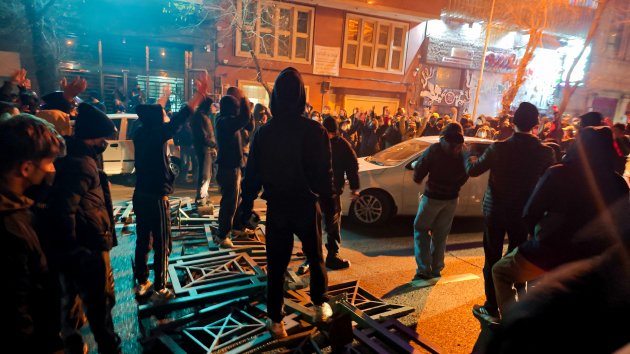
As of Wednesday, 18 days of protests and a resulting crackdown by security forces had seen 2,615 deaths and 18,470 people arrested, according to the U.S.-based Human Rights Activists News Agency (HRANA). Among the dead were 13 children and 14 non-protesting civilians, HRANA said.
On the government side, HRANA said it had confirmed the deaths of 153 members of the security forces.
Another 882 additional deaths remain under investigation, HRANA said.
The HRANA data relies on the work of activists inside and outside the country. ABC News cannot independently verify its numbers.
Iran briefly issued a notice, known as a NOTAM, closing its airspace to most flights, after U.S. President Donald Trump hinted at possible action against Iran and in support of anti-government protests which have roiled the country in recent weeks.
Iran’s Civil Aviation Organization confirmed on Thursday morning that flights were back in operation over the country, according to a statement carried by Iranian state-aligned media.
Protests have been spreading across the country since late December. The first marches took place in downtown Tehran, with participants demonstrating against rising inflation and the falling value of the national currency, the rial. As the protests spread, they took on a more explicitly anti-government tone.
The subsequent security crackdown has included a sustained national internet blackout, which — according to online monitoring group NetBlocks — had been in place for 156 hours as of Thursday morning.
On Wednesday, Cloudflare’s threat-intelligence unit said in a statement that it had “observed Iranian authorities targeting Instagram accounts with tools that perform bulk extraction of follower lists and account activity.”
Estimates of the death toll from the protests have varied, with the internet and communications blackout making it difficult to establish clear figures.
Stephane Dujarric, the spokesperson for United Nations Secretary-General Antonio Guterres, told reporters at a briefing on Wednesday, “We’ve seen numbers vary from 2,000 to 12,000. All of those numbers are horrendous, but I don’t have a number to share with you.”
Trump has repeatedly threatened military action against the government in Tehran — which is headed by its Supreme Leader Ayatollah Ali Khamenei — in response to violence against protesters.
Trump said Wednesday that he had been informed that the “killing” in Iran had stopped and that anticipated executions of arrested protesters would not take place.
The information was coming from “very important sources on the other side,” Trump said during an event in the Oval Office on Wednesday. “We’ve been told on good authority, and I hope it’s true. Who knows, right?” he added.
Asked by a reporter if this means that military action was now off the table, Trump responded, “We’re going to watch and see what the process is. But we were given a very good statement by people that are aware of what’s going on.”
On Tuesday, Trump had addressed protesters on social media, urging “Iranian Patriots” to “TAKE OVER YOUR INSTITUTIONS!!!” He added, “HELP IS ON ITS WAY.”
Khamenei and top Iranian officials have said they are willing to engage with the economic grievances of protesters, though have framed the unrest as driven by “rioters” and “terrorists” sponsored by foreign nations — prime among them the U.S. and Israel — and supported by foreign infiltrators.
Iranian officials have also threatened retaliatory strikes against U.S. and Israeli targets in the event of any outside intervention.
On Wednesday, a U.S. official confirmed to ABC News that some personnel had been advised to leave al-Udeid Air Base in Qatar due to increased tensions in the region.
Meanwhile, Tehran has signaled an intent to proceed with expedited trials and executions for those arrested during the protests.
The head of Iran’s judiciary, Gholamhossein Mohseni-Ejei, said Wednesday, “If we want to do a job, we should do it now. If we want to do something, we have to do it quickly,” in a video shared online by Iranian state television, according to The Associated Press.
“If it becomes late, two months, three months later, it doesn’t have the same effect,” Mohseni-Ejei said.
Speaking to Fox News on Wednesday, Iranian Foreign Minister Abbas Araghchi acknowledged that “hundreds” of people had been killed and again characterized the protests as an “Israeli plot” and a “terrorist operation.”
Araghchi said that the protests had died down and that the government is “in full control.”
ABC News’ Ayesha Ali, Morgan Winsor, Somayeh Malekian and Michelle Stoddart contributed to this report.
Copyright © 2026, ABC Audio. All rights reserved.