

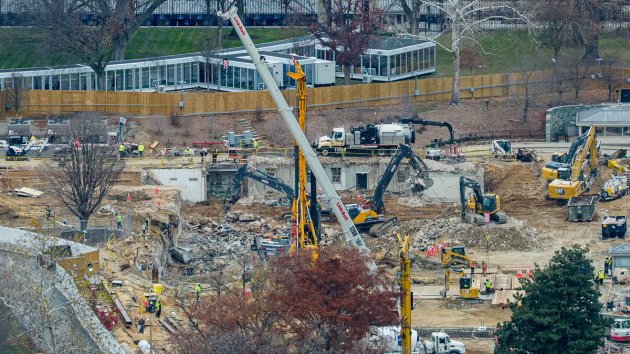
(WASHINGTON) — The White House on Thursday presented the latest plans for the East Wing renovation project, the construction of a 90,000-square-foot ballroom, in a public meeting of the National Capital Planning Commission.
The project’s architect, Shalom Baranes, said during the meeting that the White House is considering adding a one-story addition to the West Wing to restore “symmetry” to the complex after the East Wing ballroom project is complete.
His comments came after announcing a two-story colonnade would connect the East Room in the White House to the new ballroom.
“The White House is therefore considering the idea of a modest one-story addition to the West Wing colonnade, which would serve to restore a sense of symmetry around the original central pavilion.”
Baranes also clarified details about the expansion project, telling commissioners the East Wing expansion would include a second floor, and that the new ballroom would have roughly 40-foot ceilings, be roughly 22,000 square feet of the nearly 90,000 square foot project, and be able to accommodate up to 1,000 seated guests.
Phil Mendelson, the Washington City Council Chairman and member of the planning commission, said he felt the East Wing design could appear to be “overwhelming” the existing White House structure.
Baranes said the 45,000 square foot project would “exactly” match the height of the White House when completed.
President Donald Trump has repeatedly increased the size and cost of the ballroom project. Last month, he said it would cost $400 million, after an initial estimate of $200 million. The White House has said the project will be funded by private donations.
Answering questions from commissioners, Baranes said the potential project would add a story to the West Wing colonnade, and not the West Wing building proper.
He also offered no timetable for the potential addition and did not present any new renderings or drawings.
Josh Fisher, a White House official who also supplemented the presentation, said the Trump administration is also considering changes to Lafayette Park and the visitor screening areas on the White House complex in the future.
Will Scharf, a senior White House official who sits on the Capital Planning Commission, noted that Trump is hosted at Windsor Castle when he visits the United Kingdom, but when the King of England visits the White House, he may be hosted in a “tent” on the White House lawn.
“That, to me, is not a good look for the United States,” he said.
James Blair, another Trump appointee on the commission, said the current White House can’t “accommodate” efforts for the president to “break bread” with groups of lawmakers.
Other commissioners affiliated with the city expressed some reservations about the scale of the project and the fact that demolition started before the plan was presented.
The White House announced the ballroom construction project in late July, and demolition began suddenly on the East Wing in late October, when workers were spotted tearing down the wing of the White House that contained the first lady’s offices.
Scharf pointed out that demolition began at the Smithsonian Air and Space Museum before the renovation plan was presented to local bodies.
In December, the National Trust for Historic Preservation filed a lawsuit to stop the East Wing construction project by claiming the administration had circumvented the required review process for federal projects.
In a hearing in that case, the administration told a federal judge it would submit plans for the project to the relevant federal oversight bodies.
The judge said he would hold a follow-up hearing on the White House’s process in January and declined to stop construction at the time.
Days later, the administration submitted formal applications and plans for the renovation project to the NCPC and the Commission of Fine Arts, a White House official confirmed to ABC News at the time.
In its filing in the case brought by the historic preservation group, the Justice Department argued that without a permanent ballroom, the White House can no longer meet the needs of the president as he fulfills his constitutional duty to “receive Ambassadors and other public Ministers.”
“It is entirely fitting, then, that the presidential residence and workplace be equipped for that purpose. Given modern needs, the White House is not,” the Justice Department argued.
Even as it determined in late August that the White House ballroom would have “no significant impact” on the surrounding grounds, the National Park Service did highlight some of the adverse effects of the project, presaging concerns that have since been echoed by preservationists, architects and designers.
“The new building’s larger footprint and height will dominate the eastern portion of the site, creating a visual imbalance with the more modestly scaled West Wing and Executive Mansion,” the NPS report noted. “Adding a second story to the East Colonnade will further modify the setting, contrasting with the single-story design of the West Colonnade and changing the traditional spatial organization and sightlines of the grounds.”
Such changes, the report indicated, “will adversely alter the design, setting, and feeling of the White House and grounds over the long-term,” while the destruction of the East Wing would result in “the permanent loss of a component that has been integral to White House operations since 1942.”
Still, the “environmental assessment” — prepared by the deputy director of the park service and signed by its comptroller — concluded that the benefits of a new ballroom for state functions would outweigh the adverse effects “by reducing reliance on temporary event infrastructure, minimizing wear on the grounds, and improving functionality for large gatherings.”
The White House announced the ballroom construction project in late July, and demolition began suddenly on the East Wing in late October, when workers were spotted tearing down the wing of the White House that contained the first lady’s offices.
Trump has repeatedly increased the size and cost of the construction 90,000 square foot ballroom project. Last month, he said it would cost $400 million, after an initial estimate of $200 million. The White House has said the project will be funded by private donations.
The president has also moved to fill both advisory boards supervising the ballroom project with his own aides and appointees.
He also spent some of his vacation working on the project: Last Friday in Florida, he visited Arc Stone & Tile, an Italian stone importer, and spent roughly an hour at the showroom before purchasing onyx and marble for the ballroom.
The White House expects to make its final presentations to the Commission of Fine Arts in February, and to the National Capitol Planning Commission in March, and will submit its final plan for the project by the end of January, a White House official told ABC News.
Copyright © 2026, ABC Audio. All rights reserved.