

(WASHINGTON) — In a rare rebuke to the Trump administration, the Senate on Thursday advanced a war powers resolution that would block the president’s use of the U.S. armed forces to engage in hostilities within or against Venezuela unless authorized by Congress.
A small group of Senate Republicans joined with all Democrats to narrowly advance the resolution by a vote of 52-47. It needed 51 votes to move forward.
The legislation, if ultimately approved by the Senate, would still need to be approved by the House and signed by the president. The bill did not pass the Senate with a veto-proof majority and it is unlikely that Trump would sign it into law. In order to override a presidential veto, Congress would need the support of two-thirds of the House and the Senate.
Republican Sens. Rand Paul, Lisa Murkowski, Todd Young, Susan Collins and Josh Hawley voted with all Democrats in favor of the legislation.
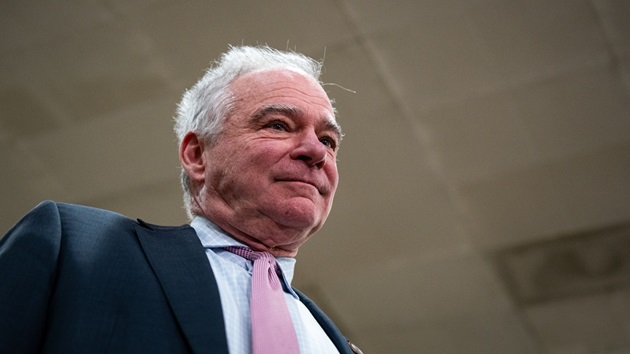
Democratic Sen. Tim Kaine, a member of the Senate Armed Services Committee, pushed for the resolution to receive a vote immediately after President Donald Trump announced U.S. forces carried out a large-scale attack in Venezuela, capturing dictator Nicolas Maduro and his wife, who are facing federal charges including narcoterrorism conspiracy and conspiracy to import cocaine. Both Maduro and his wife entered not guilty pleas earlier this week.
“Where will this go next? Will the President deploy our troops to protect Iranian protesters? To enforce the fragile ceasefire in Gaza? To battle terrorists in Nigeria? To seize Greenland or the Panama Canal? To suppress Americans peacefully assembling to protest his policies? Trump has threatened to do all this and more and sees no need to seek legal authorization from people’s elected legislature before putting servicemembers at risk,” Kaine said in a statement on Jan. 3.
Kaine added it was “long past time for Congress to reassert its critical constitutional role in matters of war, peace, diplomacy and trade.”
The White House “strongly” opposes the war powers resolution, according to a new memo from the Office of Management and Budget obtained by ABC News on Thursday.
“Maduro’s crimes and other hostile actions have resulted in a predatory incursion into the United States, the destabilization of the Western Hemisphere, massive death and human suffering, and a substantial and ongoing danger posed to our Nation,” the memo reads.
The memo stated that if the resolution is presented to the president, “his advisors would recommend that he veto” it.
After the vote, Trump called out the GOP senators who voted for the resolution, saying in a social media post that they “should be ashamed” and “never be elected to office again.”
“This Vote greatly hampers American Self Defense and National Security, impeding the President’s Authority as Commander in Chief,” Trump posted.
The Constitution vests Congress with the authority to declare war while making the president the commander in chief of the military. Trump’s action in Venezuela follows a decadeslong pattern of presidents occasionally taking military action without congressional approval.
The Trump administration described the strike in Venezuela as a law enforcement operation facilitated by the military, and Trump has said the U.S. is not at war with Venezuela but the U.S. will “run” the country for an unspecified period of time.
Some of the Republicans who voted in favor of the resolution on Thursday said that while they were supportive of Trump’s initial action against Maduro, they do not support moving forward with additional action in the country without congressional approval.
“With Maduro rightfully captured, the circumstances have now changed. While I support the operation to seize Nicolas Maduro, which was extraordinary in its precision and complexity, I do not support committing additional U.S. forces or entering into any long-term military involvement in Venezuela or Greenland without specific congressional authorization,” Collins said in a statement explaining her support for the measure.
Ahead of the vote, Senate Majority Whip John Barrasso urged senators to reject the resolution.
“Let’s be clear about what that resolution does and what it does not do. It does not reassert Congress’s powers. It does not make America stronger. It makes America weaker and less safe,” Barrasso said in a statement on Wednesday.
“It would weaken the President’s legitimate, constitutional authority. This body, the United States Senate, is being asked whether the President of the United States has the authority to arrest indicted criminals. Of course he does. Democrats want to weaken the President’s ability to enforce the law. That is the wrong message to send to hardened drug traffickers and to dictators,” Barrasso added.
Copyright © 2026, ABC Audio. All rights reserved.